Xyris pauciflora
Willd.
XyridaceaeRoots

iNaturalist · cc-by-sa
(c) Len Worthington, some rights reserved (CC BY-SA)
(c) Len Worthington, some rights reserved (CC BY-SA)

iNaturalist · cc-by-nc
(c) H.T.Cheng, some rights reserved (CC BY-NC), uploaded by H.T.Cheng
(c) H.T.Cheng, some rights reserved (CC BY-NC), uploaded by H.T.Cheng
iNaturalist · cc-by-nc
(c) geoffbyrne, some rights reserved (CC BY-NC)
(c) geoffbyrne, some rights reserved (CC BY-NC)
What to Eat
Edible parts: Bulbs
The bulbs are eaten.
Where to Find It
A tropical plant. It grows on the edges of pools and creeks. In grows in swamps and damp sandy soils between 300-900 m above sea level in southern China. In Yunnan.
Asia, Australia, Bhutan, Cambodia, Himalayas, India, Indochina, Indonesia, Laos, Malaysia, Myanmar, Nepal, New Guinea, Philippines, SE Asia, Sri Lanka, Thailand, Vietnam,
Countries: United Arab Emirates, Afghanistan, Armenia, Australia, Azerbaijan, Bangladesh, Bahrain, Brunei, Bhutan, China, Georgia, Indonesia, Israel, India, Iraq, Iran, Jordan, Japan, Kyrgyzstan, Cambodia, North Korea, South Korea, Kuwait, Kazakhstan, Laos, Lebanon, Sri Lanka, Myanmar, Mongolia, Maldives, Malaysia, Nepal, Oman, Philippines, Pakistan, Qatar, Saudi Arabia, Singapore, Syria, Thailand, Tajikistan, Timor-Leste, Turkmenistan, Turkey, Taiwan, Uzbekistan, Vietnam, Yemen
How to Identify
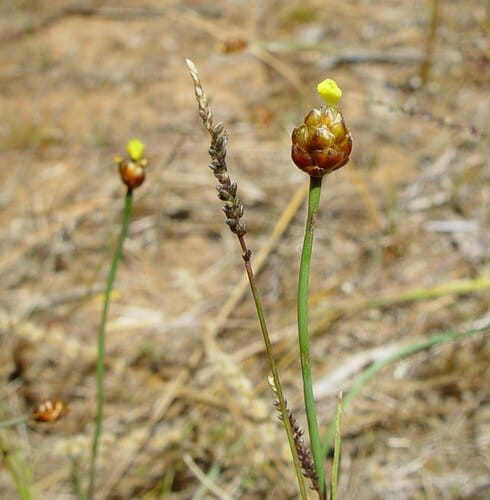
A tufted annual herb. It grows 20-40 cm high. The leaf sheath is 2-6 cm long. The leaves are narrow and 8-22 cm long by 1-3 mm wide. The flower stalk is 5-35 cm long by 1-2 mm wide. The flower spikes are oval and 6-13 mm long by 6-11 mm wide. The flowers are yellow.
Notes
There are about 350 Xyris species. There are 200 in tropical America.
Names & Synonyms
Baluyamjuri, Huringdimbu
References (4)
- Ambasta, S.P. (Ed.), 2000, The Useful Plants of India. CSIR India. p 695
- Heywood, V.H., Brummitt, R.K., Culham, A., and Seberg, O., 2007, Flowering Plant Families of the World. Royal Botanical Gardens, Kew. p 407 (Family)
- Paczkowska, G. & Chapman, A.R., 2000, The Western Australian Flora. A Descriptive Catalogue. Western Australian Herbarium. p 131
- Smith, N., Mori, S.A., et al, 2004, Flowering Plants of the Neotropics. Princeton. p 492 (Family)