Drimys winteri
J.R. & J.G. Forster
Winter's bark

(c) Benjamín Andrés Maldonado-Paredes, some rights reserved (CC BY-NC), uploaded by Benjamín Andrés Maldonado-Paredes

(c) Benjamín Andrés Maldonado-Paredes, some rights reserved (CC BY-NC), uploaded by Benjamín Andrés Maldonado-Paredes
(c) Montserrat Fica Henriquez, some rights reserved (CC BY-NC), uploaded by Montserrat Fica Henriquez
What to Eat
Edible parts: Bark, Seeds - Spice
The aromatic, pungent bark is powdered and used as a pepper substitute in Brazil, Chile, and Argentina. It is rich in vitamin C.
Known Hazards
Where to Find It
It is a temperate plant. It is native to Mexico and South America. It grows in the mountains. It needs cool soil and well-drained but moist conditions. In Argentina it grows from sea level to 2,500 m above sea level. It suits hardiness zones 8-9. Mt Lofty Botanical Gardens. Hobart Botanical Gardens. Arboretum Tasmania.
Argentina, Australia, Belize, Brazil, Britain, Central America, Chile, El Salvador, Europe, Faroe Islands, Guatemala, Honduras, Mexico*, Nicaragua, North America, Panama, South America, Tasmania,
How to Identify
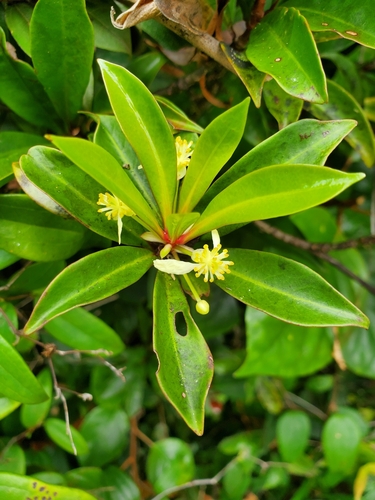
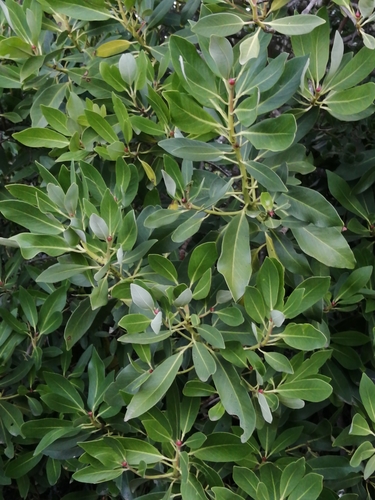
An evergreen tree. It grows 15 m tall. It is a narrow cone shape. The bark is grey-brown and has an aroma. The leaves are oblong and 20 cm long by 6 cm wide. They do not have teeth. They are glossy dark green above and bluish-green underneath. They are leathery and have an aroma when crushed. The flowers are 4 cm across and white. They have many slender petals. The flowers are borne in large clusters. The fruit is a small green berry. It becomes purple-black as it ripens. They grow in clusters at the end of long stalks.
How to Grow
Requires a light lime-free soil in semi-shade. Tolerates chalk in the soil. Requires a deep moist soil. Dislikes dry conditions. Prefers a warm sandy loam with some shelter. Fairly wind resistant. Another report says that the plant resents severe wind-chill. Succeeds against a wall at Kew and it thrives in an open position in S.W. England. Tolerates temperatures down to about -10°c. This species is less hardy than D. lanceolata but it usually recovers from damage. Another report says that it is hardier than D. lanceolata. A very ornamental plant. The sub-species D. winteri andina. Reiche. is a slow growing dwarf form seldom exceeding 1 metre in height. It usually commences flowering when about 30cm tall. A polymorphic species. The flowers have a delicate fragrance of jasmine, whilst the bark has a powerful aromatic smell. This plant was a symbol of peace to the indigenous Indian tribes of S. America in much the same way as an olive branch was used in Greece. Plants in this genus are notably resistant to honey fungus.
Propagation: Sow seed as soon as it is ripe in autumn in a greenhouse. Prick out seedlings into individual pots when large enough to handle, and grow on for at least the first winter in a cold frame. Plant out in late spring or early summer after the last expected frosts. Layering in March/April takes approximately 12 months. Take cuttings of half-ripe wood, 10–15 cm with a heel, in July/August in a frame — approximately 60% take. Alternatively, take cuttings of mature wood from the current year's growth with a heel of older wood in November in a cold frame.
Medicinal Uses
The bark is a pungent, bitter tonic herb that relieves indigestion. It is antiscorbutic, aromatic, febrifuge, stimulant, and stomachic, and acts as a parasiticide. An infusion of the bark treats indigestion, colic, dandruff, and scurvy. The bark is harvested in autumn and winter and dried for later use.
Other Uses
The powerfully aromatic bark contains resinous matter and 0.64% aromatic essential oil. The wood is heavy — it sinks in water — and not durable; it is used for house interiors and boxes. It burns poorly and with a strong smell.
Wikipedia
Source ↗Drimys winteri, also known as Winter's bark, foye and canelo, is a slender species of tree in the family Winteraceae, growing up to 20 m (66 ft) tall. It is native to the Magellanic and Valdivian temperate forests of Chile and Argentina, where it is a dominant tree in the coastal evergreen forests. It is found below 1,200 m (3,900 ft) between latitude 32° south and Cape Horn at latitude 56°. In its southernmost natural range it can tolerate temperatures down to −20 °C (−4 °F). The plant is renowned for its phenotypic plasticity being able to grow in different sites from "extreme arid zones to wetlands along Chile". The tree does also grow in places with various types and degrees of competition from other plants.
Notes
There are 4 Drimys species. Several have now been put in Tasmannia genus.
Names & Synonyms
Canelo, Chachaca, Palo de mambo
References (18)
- Bodkin, F., 1991, Encyclopedia Botanica. Cornstalk publishing, p 359
- Brown, D., 2002, The Royal Horticultural Society encyclopedia of Herbs and their uses. DK Books. p 197
- Char. gen. pl. 83, t. 42. 1776
- Coombes, A.J., 2000, Trees. Dorling Kindersley Handbooks. p 310
- Cordero, S. E., Abello, L. A., & Galvez, F. L., 2017, Plantas silvestres comestibles y medicinales de Chile y otras partes del mundo. CORMA p 53
- Cundall, P., (ed.), 2004, Gardening Australia: flora: the gardener's bible. ABC Books. p 512
- Facciola, S., 1998, Cornucopia 2: a Source Book of Edible Plants. Kampong Publications, p 247
- Grandtner, M. M., 2008, World Dictionary of Trees. Wood and Forest Science Department. Laval University, Quebec, Qc Canada. (Internet database http://www.WDT.QC.ca)
- Grandtner, M. M. & Chevrette, J., 2013, Dictionary of Trees, Volume 2: South America: Nomenclature, Taxonomy and Ecology. Academic Press p 208
- Heywood, V.H., Brummitt, R.K., Culham, A., and Seberg, O. 2007, Flowering Plant Families of the World. Royal Botanical Gardens, Kew. p 337
- Hibbert, M., 2002, The Aussie Plant Finder 2002, Florilegium. p 89
- Kew Plants of the World Online
- Leon-Lobos, P., et al, 2022, Patterns of Traditional and Modern Uses of Wild Edible Native Plants of Chile: Challenges and Future Perspectives. Plants (Basel) v 11 (6) Table S1
- Martin, J. S. & Villagra M. M., 2013, Productos forestales no madereros de la Region del Maule. p 22
- Ryan, S., 2008, Dicksonia. Rare Plants Manual. Hyland House. p 23
- Seidemann J., 2005, World Spice Plants. Economic Usage, Botany, Taxonomy. Springer. p 140
- Smith, N., Mori, S.A., et al, 2004, Flowering Plants of the Neotropics. Princeton. p 399 (Drawing), Plate 52 (Photo)
- Uphof,