Fernandoa adenophylla
(Wall. ex Don) Steenis
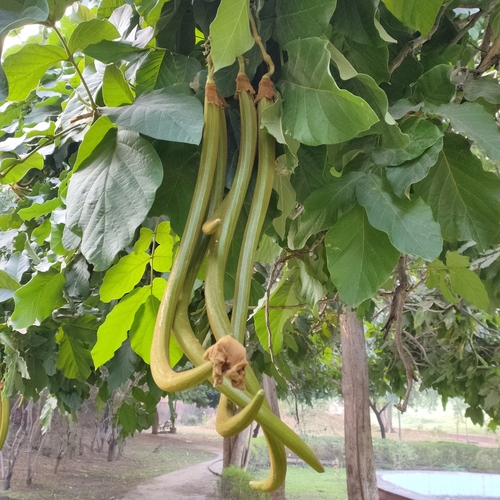
(c) SONU KUMAR, some rights reserved (CC BY-NC)

(c) vasiliipavlov, some rights reserved (CC BY-NC)
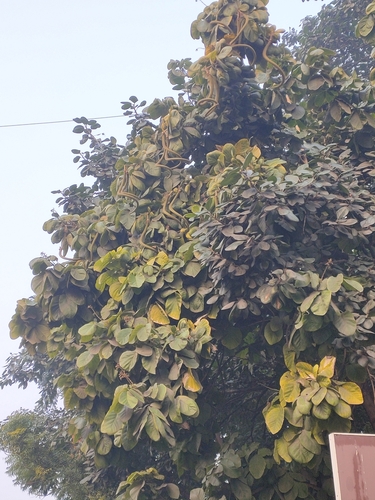
(c) SONU KUMAR, some rights reserved (CC BY-NC)
What to Eat
Edible parts: Flowers, Fruit
The flowers are eaten fresh or in stir fries, and the fruit are grilled and eaten.
Where to Find It
A tropical plant. It is native to Indochina and Malesia. It grows in open forest and secondary forest. It grows in limestone areas. It grows in coastal areas up to 100 m above sea level.
Andamans, Asia, India, Indochina, Indonesia, Laos, Malaysia, Myanmar, SE Asia, Thailand,
How to Identify
A deciduous tree. It grows 15 m high. The trunk has smooth shallow cracks. The bark is pale brown. The leaves are 45 cm long. The leaves have 2-4 pairs of leaflets and a leaflet at the end. These are rusty hairy underneath. The flowers are broadly funnel shaped. They are cream or yellow brown. They are in short erect clusters at the ends of the branches. The fruit pods are ribbed and twisted in spirals. They are up to 90 cm long.
How to Grow
Plants can be grown from seed.
Wikipedia
Source ↗Fernandoa adenophylla, synonym Haplophragma adenophyllum, is a species of flowering plant in the family Bignoniaceae that is native to the Andaman Islands, India (Assam and other states), Bangladesh, Myanmar, Cambodia, Laos, Peninsular Malaysia, Thailand and Vietnam. It is commonly known as katsagon, marodphali, petthan, and Karen wood.
Production
In NE Thailand flowers and fruit occur October to December.
Notes
There are 15 Fernandoa species.
Names & Synonyms
Kaw-hang-kang, Katsagon, Khae nang khang, Marodphali, Petthan, Pohon kayu busur, Quepaw
References (11)
- Barwick, M., 2004, Tropical and Subtropical Trees. A Worldwide Encyclopedic Guide. Thames and Hudson p 181
- Blumea 23:135. 1976
- Delang, C. O., 2007, Ecological Succession of Usable Plants in an Eleven-Year Fallow Cycle in North Lao P.D.R., Ethnobotany Research and Applications. Vol. 5:331-350 (As Fernandoa sp.)
- Johnson, N., 2002, Environmental Change in northern Thailand: Impact on Wild Edible Plant Availability. Ecology of Food and Nutrition, 41: 5, 373-399
- Kachenchart, B., et al, 2008, Phenology of Edible Plants at Sakaerat Forest. In Proceedings of the FORTROP II: Tropical Forestry Change in a Changing World. Bangkok, Thailand.
- Krishen P., 2006, Trees of Delhi, A Field Guide. DK Books. p 262
- Nakahara, K. et al, 2002, Antimutagenicity of Some Edible Thai Plants, and a Biocative Carbazole Alkaloid, Mahanine, Isolated from Micromelum minutum. Journal of Agricultural and Food Chemistry. 50: 4796-4892
- Sosef, M. S. M., Hong, L. T., & Prawirohatmodjo, S., (Eds.), 1998, Timber tree: Lesser-known timbers. Plant Resources of South-East Asia, 5(3), p 231
- Suksri, S., et al, 2005, Ethnobotany in Bung Khong Long Non-Hunting Area, Northeast Thailand. Kasetsart J., (Nat. Sci) 39: 519-533
- Sukarya, D. G., (Ed.) 2013, 3,500 Plant Species of the Botanic Gardens of Indonesia. LIPI p 279
- Thitiprasert, W., et al, 2007, Country report on the State of Plant Genetic Resources for Food and Agriculture in Thailand (1997-2004). FAO p 95


