Hamelia patens
Jacq.
Butterfly bush, Fire bush
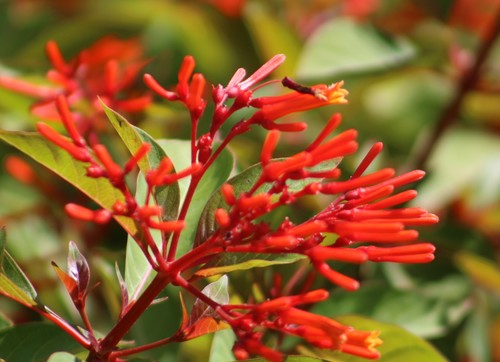
(c) Cindy Chrisler, some rights reserved (CC BY-NC), uploaded by Cindy Chrisler

(c) berger_a_14, some rights reserved (CC BY-NC)

(c) nogle, some rights reserved (CC BY-NC), uploaded by nogle
What to Eat
Edible parts: Fruit, Flower nectar
Hummingbirds are attracted by its flowers and other birds feed on the fruit, both of which will also forage on small insects found in the vicinity, helping to keep down pests. These flowers are also fed on by butterflies, such as the statira sulphur (Aphrissa statira), which are attracted to red flowering plants. The fruits have a refreshing, acidic taste and are also edible by humans; in Mexico, they are made into a fermented drink.
Known Hazards
Where to Find It
A tropical plant. They prefer a rich, moist but well-drained soil. It can tolerate some salt spray. In Argentina it grows from sea level to 1,500 m above sea level. It suits hardiness zones 10-12. In XTBG Yunnan.
Africa, Argentina, Asia, Australia, Bahamas, Belize, Bolivia, Brazil*, Caribbean, Central America*, China, Colombia, Costa Rica, Cuba, Dominica, Dominican Republic, East Africa, Ecuador, El Salvador, French Guiana, Guatemala, Guyana, Haiti, Hawaii, Honduras, India, Indochina, Indonesia, Jamaica, Mexico*, Mozambique, Myanmar, Nicaragua, North America, Pacific, Pakistan, Panama, Paraguay, Peru, Philippines, Puerto Rico, SE Asia, South America*, Sri Lanka, Tanzania, Thailand, Trinidad-Tobago, USA, Venezuela, West Indies, Winward Is., Zambia, Zimbabwe,
How to Identify
An erect shrub or small tree. It grows 7 m tall. It spreads 2-5 m wide. The leaves are simple and dull green. They are 5-10 cm long and broadly oval. They are softly hairy. The flowers are orange-scarlet. They are 2 cm across. They are downy and tube shaped. The fruit are berries and are 8 mm across. They are fleshy and red to purple.
How to Grow
Plants can be grown from seed or by half ripened cuttings under glass. They can also be grown using air layering.
Propagation: Seed - Cuttings.
Medicinal Uses
The plants are used in folk medicine for a range of ailments.
Other Uses
The stems and leaves have been used in tanning leather. The light brown wood is hard. It is generally of too small a dimension to have much function.
Wikipedia
Source ↗Hamelia patens is a large evergreen perennial shrub or small tree in the family Rubiaceae, that is native to the American subtropics and tropics. Its range extends from Florida in the southern United States to as far south as Argentina. Common names include firebush, hummingbird bush, scarlet bush, and redhead. In Belize, this plant's Mayan name is Ix Canaan and is also known as "Guardian of the Forest".
Production
It is fast growing.
Other Information
It is cultivated.
Notes
There are about 16 (40) Hamelia species. They grow in tropical and subtropical America. It is used in medicine.
Names & Synonyms
Amelia, Ashiluna muyu, Chacoclo, Coloradillo, Coralillo, Cuseje'cho, Firebush, Hierba de la mula, Jimia-jimias, Llaga panka, Manvel, Mariposa panka, Ongay, Perdu api, Ponasf, Prathat-lek, Prathat-thawng, Scarlet bush, Tisiku panka, Tuta pishku panka, Uvero, Wipenimo, Yana muyu, Zorrillo real
References (30)
- Arora, R. K., 2014, Diversity in Underutilized Plant Species - An Asia-Pacific Perspective. Bioversity International. p 74
- Barwick, M., 2004, Tropical and Subtropical Trees. A Worldwide Encyclopedic Guide. Thames and Hudson p 214
- Brack, P., et al, 2020, Frutas nativas do Rio Grande do Sul, Brasil: riqueza e potencial alimentício. Native fruits of Rio Grande do Sul, Brazil: richness and potential as food. Rodriguésia 71: e03102018
- Condit, R., et al, 2011, Trees of Panama and Costa Rica. Princeton Field Guides. p 396
- Engel, D.H., & Phummai, S., 2000, A Field Guide to Tropical Plants of Asia. Timber Press. p 127
- Enum. syst. pl. 16. 1760 (Select. stirp. amer. hist. 72, t. 50. 1763)
- Etherington, K., & Imwold, D., (Eds), 2001, Botanica's Trees & Shrubs. The illustrated A-Z of over 8500 trees and shrubs. Random House, Australia. p 370
- Flora of Pakistan. www.eFloras.org
- Grandtner, M. M., 2008, World Dictionary of Trees. Wood and Forest Science Department. Laval University, Quebec, Qc Canada. (Internet database http://www.wdt.qc.ca)
- Grandtner, M. M. & Chevrette, J., 2013, Dictionary of Trees, Volume 2: South America: Nomenclature, Taxonomy and Ecology. Academic Press p 288
- Hibbert, M., 2002, The Aussie Plant Finder 2002, Florilegium. p 119
- Hellmuth, N. M., 2013, Maya Ethnobotany. Complete Inventory of plants. Associacion FLAAR Mesoamerica. Thirteenth edition. p
- http://www.ntbg.org/plants/plant details.php
- Kermath, B. M., et al, 2014, Food Plants in the Americas: A survey of the domesticated, cultivated and wild plants used for Human food in North, Central and South America and the Caribbean. On line draft. p 404
- Kew Plants of the World On line
- Little, E. L., et al, 1974, Trees of Puerto Rico and the Virgin Islands. USDA Handbook 449. Forestry Service. p 946
- Llamas, K.A., 2003, Tropical Flowering Plants. Timber Press. p 327
- Miguel, E., et al, 1989, A checklist of the cultivated plants of Cuba. Kulturpflanze 37. 1989, 211-357
- Piedra-Malagón, E. M., et al, 2022, Edible native plants of the Gulf of Mexico Province. Biodiversity Data Journal 10: e80565 p 29
- Plants of Haiti Smithsonian Institute http://botany.si.edu/antilles/West Indies
- Roa, J. A. G. & Boada, D. S. G., 2018, Fundación para el Fortalecimiento de la Fruticultura y Plantas Alimenticias no Convencionales en Colombia.
- Segura, S., et al, 2018, The edible fruit species in Mexico. Genet Resour Crop Evol (2018) 65:1767–1793
- Standley, P. C. & Record, S. J., 1936, The Forests and Flora of British Honduras. (Belize). p 381
- Staples, G.W. and Herbst, D.R., 2005, A tropical Garden Flora. Bishop Museum Press, Honolulu, Hawaii. p 490
- Steggerda, M., Some Ethnological Data Concerning One Hundred Yucatan Plants. Smithsonian Institution Anthropological Papers, No. 29
- Sukarya, D. G., (Ed.) 2013, 3,500 Plant Species of the Botanic Gardens of Indonesia. LIPI p 639
- Torre, de la, L., et al, 2008, Enciclopedia de las Plantas Útiles del Ecuador. Herbario QCA. Pontificia Universidad Católica del Ecuador. p 547
- World Checklist of Useful Plant Species 2020. Royal Botanic Gardens, Kew
- www.colecionandofrutas.org
- Zuchowski W., 2007, Tropical Plants of Costa Rica. A Zona Tropical Publication, Comstock Publishing. p 101


