Simarouba amara
Aubl.
Paradise tree
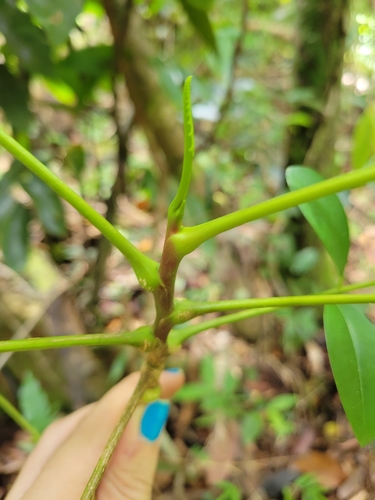
(c) Juan E. Santiago, some rights reserved (CC BY-NC), uploaded by Juan E. Santiago
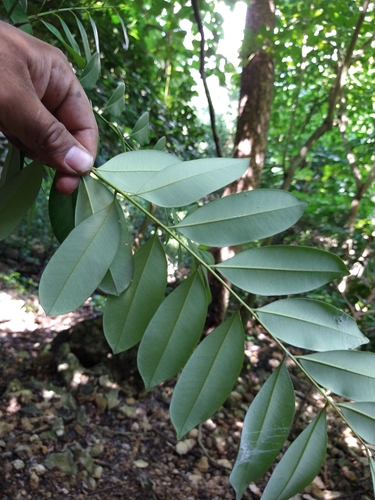
(c) Luis Humberto Vicente-Rivera, some rights reserved (CC BY-NC), uploaded by Luis Humberto Vicente-Rivera
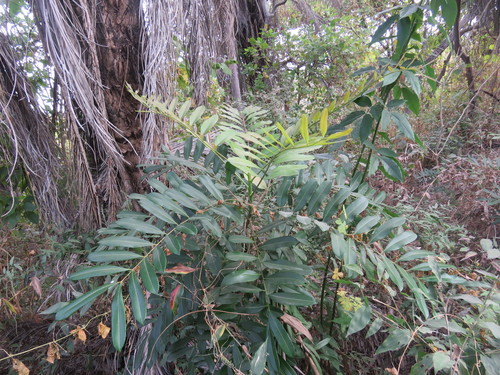
(c) Alexis López Hernández, some rights reserved (CC BY), uploaded by Alexis López Hernández
What to Eat
Edible parts: Fruit, Seeds - oil, Bark - drink
The seeds contain 60–75% edible oil, extractable by conventional methods. Each well-grown tree yields 15–30 kg of nutlets, equivalent to 2.5–5 kg of oil and a similar quantity of oilcake, amounting to 1,000–2,000 kg of oil per hectare per year with an equal yield of oilcake. The oil is widely used in bakery products in Central America and can be used in the manufacture of vanaspati, vegetable oil and margarine in India. It is free from bad cholesterol. The fruit pulp is rich in sugars (around 11%) and can be used to prepare beverages.
Known Hazards
Where to Find It
A tropical plant. It grows in dry soil. It grows below 1,000 m above sea level. It grows in rainforests and savannah. It can grow in arid places. It needs to be in a sunny position.
Africa, Amazon, Antilles, Asia, Bahamas, Belize, Bolivia, Brazil, Caribbean, Central America, Colombia, Costa Rica, Cuba, Dominican Republic, Ecuador, El Salvador, French Guiana, Grenada, Guadeloupe, Guatemala, Guyana, Haiti, Honduras, India, Jamaica, Kenya, Lesser Antilles, Martinique, Mexico, Nicaragua, North America, Panama, Peru, Puerto Rico, South America*, Sri Lanka, St Kitts and Nevis, St Lucia, St Vincent, Suriname, Trinidad, USA, Venezuela, West Indies,
How to Identify
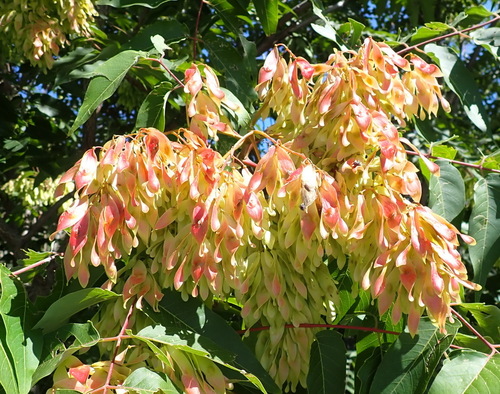
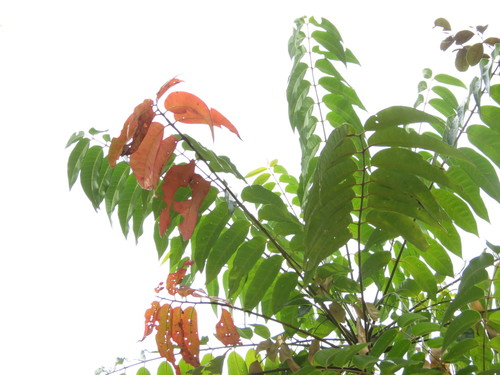
An evergreen tree. It grows 42 m tall. The crown is broad. There are flushes of new growth. The trunk is 50-60 cm across. The leaves are compound and 60 cm long. There are 9-16 leaflets and these are 3-11 cm long by 12-45 mm wide. The leaflets towards the top are smaller. Male and female flowers are on separate trees. The flowers are small and pale yellow. The fruit are 17 mm long and have large seeds. The seeds are 10-14 mm long.
How to Grow
Experimental Crop Industrial Crop: Oil Management: StandardA plant of the moist, lowland tropics, where it is found at elevations up to 800 metres. It grows best in areas where the mean annual temperature ranges between 22 - 29°c, but can tolerate a range of 18 - 34°c. It prefers a mean annual rainfall in the range 2,000 - 3,000mm, but tolerates 1,200 - 4,000mm, growing in areas with a distinct dry season and where there is no dry season. Shade tolerant. Prefers sandy soils in the wild. In the wild, it is found on rocky, shallow calcareous soils of mountain slopes and ridges, as well as on the deeper soils of the ravines and alluvial plains. The plant develops a shallow root system, often suitable to mountain soils. Prefers a pH in the range 6 - 8, tolerating 5.5 - 8.5. A fast-growing tree.
Propagation: Seed is best sown as soon as it is ripe in a partially shaded nursery seedbed or in individual containers. Germination is moderate, typically occurring within 20–40 days. When seedbed-sown seedlings reach 4–6 cm tall, pot them into individual containers; they should be ready to plant out 4–5 months later.
Medicinal Uses
The leaves and bark have a long history of medicinal use in the tropics, particularly for malaria, fevers and dysentery, as an astringent to stop bleeding, and as a tonic. They are also used as a digestive, emmenagogue, and to treat internal and external parasites. The main active compounds are a group of triterpenes called quassinoids. Several of these — including ailanthinone, glaucarubinone and holacanthone — are documented as antiprotozoal, anti-amoebic, antimalarial and toxic to cancer and leukaemia cells. Studies show the plant is over 90% effective against amoebic dysentery. The bark and its key quassinoids have been shown to effectively treat malaria, including drug-resistant strains, and have demonstrated antiviral activity against herpes, influenza, polio and vaccinia viruses. The bark is used as a bitter tonic, known as 'Jamaica Bark' or 'Orinoco Simaruba Oil'. A decoction is taken internally for anaemia, diarrhoea, dysentery, malaria, fevers, haemorrhages, intestinal parasites and colitis. The leaves are used for rheumatism and applied as a lotion for body pain, bruises and skin itch. The fruit is a strong, pleasantly bitter stimulant used as an effective treatment for dysentery.
Other Uses
The tree is a fast-growing species tolerant of full sun. Its well-developed root system and dense evergreen canopy help check soil erosion, support soil microbial life and improve groundwater availability. It is shade tolerant and occurs as an understorey tree, particularly beneath large fruit trees where birds perch and deposit seeds. It is found alongside species such as mango (Mangifera indica), royal palm (Roystonea borinquena), avocado (Persea americana) and plantain (Musa x paradisiaca) in subtropical moist forest and humid perennial gardens. The oilcake is rich in nitrogen (8%), phosphorus (1.1%) and potash (1.2%), making it a good organic manure. Pulp and leaf litter can be used to produce approximately 8 tonnes per hectare per year of vermicompost. Seed oil can be used industrially in the manufacture of biofuels, soaps, detergents, lubricants, varnishes, cosmetics and pharmaceuticals. Seed shells are suitable for making particleboard, activated charcoal or fuel. The heartwood is whitish or cream when freshly cut, becoming uniform cream when dry, sometimes with oily streaks. The texture is medium to coarse and uniform, with a usually straight grain and fairly high lustre. There is no odour but a bitter quinine-like taste. The wood is very light and soft, not particularly strong, somewhat brittle, not durable outdoors and very susceptible to drywood termite attack and blue stain. It seasons rapidly with little distortion or checking and is stable once dry. It machines to a smooth surface, finishes easily (filling recommended for a good surface), but nailing and screwing are poor while gluing is satisfactory. Uses include sounding boards for string instruments, interior construction, turnery, boxes and crates, matches, furniture components, veneer and plywood, pattern making, millwork, particleboard and fibreboard.
Wikipedia
Source ↗Simarouba amara is a species of tree in the family Simaroubaceae, found in the rainforests and savannahs of South and Central America and the Caribbean. It was first described by Aubl. in French Guiana in 1775 and is one of six species of Simarouba. The tree is evergreen, but produces a new set of leaves once a year. It requires relatively high levels of light to grow and grows rapidly in these conditions, but lives for a relatively short time. In Panama, it flowers during the dry season in February and March, whereas in Costa Rica, where there is no dry season it flowers later, between March and July. As the species is dioecious, the trees are either male or female and only produce male or female flowers. The small yellow flowers are thought to be pollinated by insects, the resulting fruits are dispersed by animals including monkeys, birds and fruit-eating bats and the seeds are also dispersed by leaf cutter ants. Simarouba amara has been studied extensively by scientists in an attempt to understand the tree and also to gain a better understanding of the ecology of the rainforest in general. Many of these studies were conducted on Barro Colorado Island in Panama or at La Selva Biological Station in Costa Rica. Of particular interest is how it competes with other species and with individuals of the same species at different stages in its life cycle. The seedlings are normally limited by the amount of light and nutrients found where they are growing and the saplings are considered relatively light demanding compared to other species. Young individuals are more likely to survive when they grow further away from their parents and when there are few other individuals growing near to them, which may be due to them being able to escape diseases. Plant physiologists have investigated how the leaves of the tree differ depending on their location in the forest canopy finding they are thicker in the canopy and thinner in the understory. They have also measured how the water potential of their leaves changes and when their stomata open and close during the day; the findings suggest that rather than closing their stomata to control water loss, it is controlled by the leaf area instead. Population geneticists have examined the way in which its genes vary, at both the local scale and across its range using microsatellites. It is genetically diverse, indicating gene flow occurs between populations and seeds can be dispersed up to 1 km. The leaves of S. amara are eaten by several species of caterpillar, particularly those in the genus Atteva. Several species of termite and ants live on or around the tree and lianas and epiphytes grow on the tree. The bark of S. amara has been used by people in its range to treat dysentery and diarrhea, as well as other diseases, and was also exported to Europe in the eighteenth century to treat these illnesses. A number of compounds have since been isolated from the bark and have been shown to have antimicrobial effects. Local people use the wood of the tree for various purposes and it is also grown in plantations and harvested for its timber, some of which is exported.
Production
It is fairly fast growing. A tree can yield 15-30 kg of nuts. These yield 2.5-5 kg of oil. It is only a short lived tree.
Other Information
It is a cultivated plant.
Notes
There are 6 Simarouba species.
Names & Synonyms
Acaju blanc, Aceituno, Gavilan, Gusano, Jucumico, Pasaque, Rabo de lagarto, Ruga, Simarupe
References (25)
- Ann. Mus. Natl. Hist. Nat. 17:242. 1811
- Castaneda, H., & Stepp, J. R., 2007, Ecosystems as Sources of Useful Plants for the Guaymi People of Costa Rica. Ethnobotany Journal. 5:249-257
- D'Ambrosio, U., & Puri, R. K., 2016, Foodways in transition: food plants, diet and local perceptions of change in a Costa Rican Ngäbe community. Journal of Ethnobiology and Ethnomedicine (2016) 12:3 p 27 (As Simarouba glauca)
- Facciola, S., 1998, Cornucopia 2: a Source Book of Edible Plants. Kampong Publications, p 230
- FAO, 2012, Forest Genetic Resources Situation in Mexico. Final Report of Project TCP/ 3301 p 289 (As Simarouba glauca)
- Fern, K., 2012, Tropical Species Database http://theferns.info/tropical/
- Forest Genetic Resources Situation in Mexico, FAO 2012 Annex 15 p 289 (As Simarouba glauca)
- Grandtner, M. M., 2008, World Dictionary of Trees. Wood and Forest Science Department. Laval University, Quebec, Qc Canada. (Internet database http://www.wdt.qc.ca)
- Grandtner, M. M. & Chevrette, J., 2013, Dictionary of Trees, Volume 2: South America: Nomenclature, Taxonomy and Ecology. Academic Press p 605
- Kermath, B. M., et al, 2014, Food Plants in the Americas: A survey of the domesticated, cultivated and wild plants used for Human food in North, Central and South America and the Caribbean. On line draft. p 806
- Langlois, H. C., 2004, Ethnobotanical analysis of different successional stages as sources of wild edible plants for the Guaymi people in Costa Rica. M. Sc. thesis University of Florida. (As Simarouba glauca)
- Lorenzi, H., 2002, Brazilian Trees. A Guide to the Identification and Cultivation of Brazilian Native Trees. Vol. 01 Nova Odessa, SP, Instituto Plantarum p 342 (? Simarouba amara)
- Miguel, E., et al, 1989, A checklist of the cultivated plants of Cuba. Kulturpflanze 37. 1989, 211-357 (As Simarouba glauca)
- Piedra-Malagón, E. M., et al, 2022, Edible native plants of the Gulf of Mexico Province. Biodiversity Data Journal 10: e80565 p 30 (As Simarouba glauca)
- Reis, S. V. and Lipp, F. L., 1982, New Plant Sources for Drugs and Foods from the New York Botanical Garden herbarium. Harvard. p 146 (As Simarouba glauca)
- Roa, J. A. G. & Boada, D. S. G., 2018, Fundación para el Fortalecimiento de la Fruticultura y Plantas Alimenticias no Convencionales en Colombia.
- Royal Botanic Gardens, Kew (1999). Survey of Economic Plants for Arid and Semi-Arid Lands (SEPASAL) database. Published on the Internet; http://www.rbgkew.org.uk/ceb/sepasal/internet [Accessed 11th June 2011]
- Segura, S., et al, 2018, The edible fruit species in Mexico. Genet Resour Crop Evol (2018) 65:1767–1793 (As Simarouba glauca)
- Smith, N., Mori, S.A., et al, 2004, Flowering Plants of the Neotropics. Princeton. p 353
- Timyan, J., 1996, Bwa Yo: Important Trees of Haiti. SE Consortium for International Development. Washington. p 41(As Simarouba glauca) Turreira-Garcia, N., et al, 2015, Wild edible plant knowledge, distribution and transmission: a case study of the Achi Mayans of Guatemala. Journal of Ethnobiology and Ethnomedicine. 11:52
- Morton,
- Standley, P. C. & Record, S. J., 1936, The Forests and Flora of British Honduras. (Belize). p 198 (As Simarouba glauca)
- Wiersema, J. H. & Leon, B., 2013, World Economic Plants. A Standard Reference CRC Press. 2nd Ed. p 638 (As Simarouba glauca)
- World Checklist of Useful Plant Species 2020. Royal Botanic Gardens, Kew
- www.worldagroforestrycentre.org/treedb/ (As Simarouba glauca)