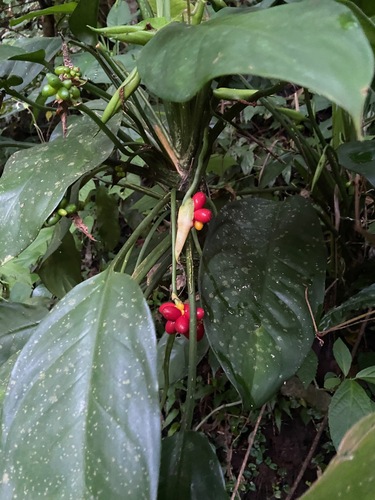
Amorphophallus lyratus
(Roxb.) Kunth.
Telinga potato
What to Eat
Edible parts: Roots, Corm
The roots and corms are edible but require boiling in several changes of water before eating due to oxalate content.
Known Hazards
Where to Find It
A tropical plant. It grows near Chennai.
Asia, India,
Countries: United Arab Emirates, Afghanistan, Armenia, Azerbaijan, Bangladesh, Bahrain, Brunei, Bhutan, China, Georgia, Indonesia, Israel, India, Iraq, Iran, Jordan, Japan, Kyrgyzstan, Cambodia, North Korea, South Korea, Kuwait, Kazakhstan, Laos, Lebanon, Sri Lanka, Myanmar, Mongolia, Maldives, Malaysia, Nepal, Oman, Philippines, Pakistan, Qatar, Saudi Arabia, Singapore, Syria, Thailand, Tajikistan, Timor-Leste, Turkmenistan, Turkey, Taiwan, Uzbekistan, Vietnam, Yemen
How to Identify
A taro family herb native to tropical regions near Chennai, with a round tuber that produces a single leaf.
Notes
There are about 170-200 Amorphophallus species.
Names & Synonyms
Arum lyratum Roxb.Conophallus lyratus (Roxb.) Schott.
References (2)
- Hedrick, U.P., 1919, (Ed.), Sturtevant's edible plants of the world. p 51
- SHORTT (As Arum lyratum)