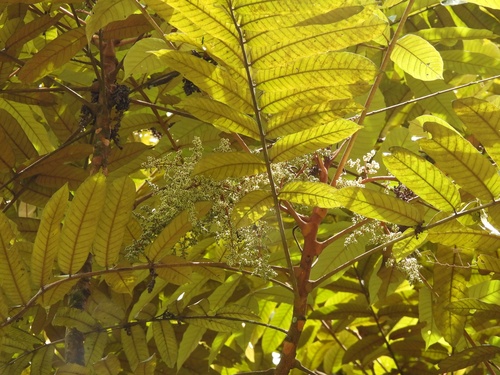
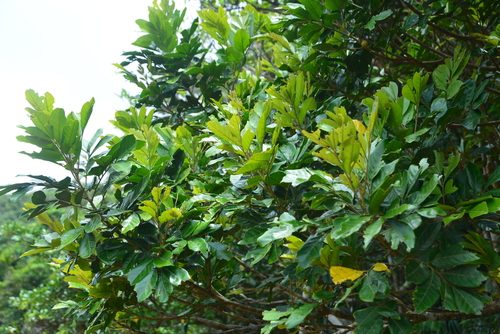
Cedrela odorata
Linn.
Barbadoes cedar, Cigar-box wood

(c) Luis Enrique Villegas, some rights reserved (CC BY-NC), uploaded by Luis Enrique Villegas
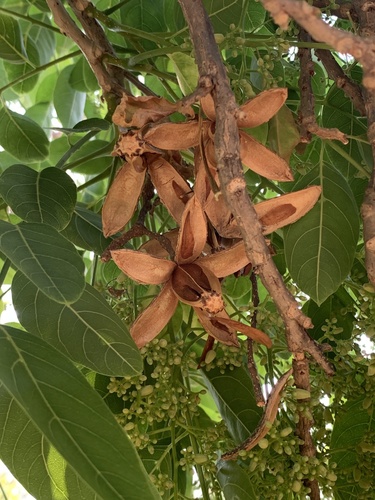
(c) Alänä Atl, some rights reserved (CC BY-NC), uploaded by Alänä Atl
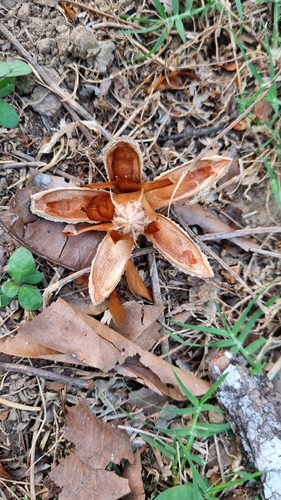
(c) Kelin Guerra, some rights reserved (CC BY), uploaded by Kelin Guerra
What to Eat
Edible parts: Leaves
The young leaves are eaten.
Known Hazards
Where to Find It
A tropical plant. It suits hardiness zones 10-12. In Fiji it is grown near sea level. In Costa Rica it grows from sea level to about 1,200 m altitude. It grows on dry or wet slopes. It is best in well-composted, moist, well-drained soils. It is damaged by drought or frost.
Africa, Amazon, Argentina, Asia, Australia, Bahamas, Barbados, Belize, Bolivia, Brazil, Central America*, Costa Rica, China, Costa Rica, Cuba*, Dominica, Dominican Republic, East Africa, El Salvador, Fiji, Grenada, Guadeloupe, Guatemala, Guiana, Guianas, Guyana, Haiti, Honduras, Indonesia, Jamaica, Lesser Antilles, Martinique, Mexico, Mozambique, North America, Pacific, Panama, Paraguay, Peru, Puerto Rico, Sao Tome and Principe, SE Asia, South America, St. Kitts and Nevis, Suriname, Trinidad & Tobago, West Indies*,
How to Identify
A tree. It grows 18 m high and spreads 4.5 m wide. The trunk can be 1.5 m across. It has large buttresses. It has an open canopy. The bark is grey or brown and furrowed. The lower limbs curve down. The leaves have leaflets along the stalk. The leaves are 60 cm long. There are 5-12 pairs of leaflets. The flowers are separately male and female but on the same plant. The flowers are small and tube shaped and cream or green. They are in hanging clusters at the ends of branches. The clusters are 15-50 cm long.
How to Grow
A plant of low to middle elevations of the moister tropics, where it is found from sea level to 1,900 metres. It succeeds in areas where the mean annual temperature is in the range 22 - 26°c and the mean annual rainfall is 1,000 - 3,700 mm. Drought for part of the year does not adversely affect the health of the tree. Requires a sunny position. It is not demanding of soil nutrients, tolerating soils high in calcium. Plants are not tolerant of waterlogging or flooding. They prefer a very fertile, free draining, weakly acidic soil but tolerate heavy soil. Cedar wood is a fast-growing and long-lived pioneer species. The plants commence flowering when about 10 - 15 years old. Flowering is annual, but good seed crops only occur every 1 - 2 years. The flowers are visited by bees as a source of nectar for honey production. As the root system is superficial, there is some risk of wind damage and therefore thinning should be executed carefully. As the trees have many low branches and a spreading crown, they are used for shade and as a windbreak in courtyard gardens and in cocoa and coffee plantations. The tree does not respond to coppicing. Cedar wood is highly susceptible to Hypsipyla attack; therefore it is recommended that trees be planted in mixed plantations, for example with Leucaena leucocephala, Cordia spp., or Anthocephalus chinenesis or under the light shade of trees such as Eucalyptus delgupta. Because of the valuable wood, the native trees of this species have been over-exploited and they are now found only in scattered, remote areas in Puerto Rico, chiefly in the moist limestone and lower cordillera forest regions.
Propagation: Sow seed as soon as it is ripe in a sunny nursery seedbed; germination rates of 80% or more can be expected, with sprouting within a few days. Transplanting naturally regenerated seedlings and establishing branch or stem cuttings are the most common propagation methods; grafting, budding, and air-layering have also been successful. Fresh seed germinates readily, but viability drops rapidly under ambient storage conditions. Seed may be broadcast or sown in lines in level nursery beds and lightly covered with soil, sand, sawdust, or charcoal. Where adequate moisture is available, shade is not necessary and actually increases the risk of damping-off. Germination takes 2–4 weeks and is fastest at 30–35°C, though seed also germinates at 15°C. Seedlings grow very quickly, reaching 40–50 cm after 3 months and 130–150 cm after 12 months. In the Philippines, transplanted wildings showed 94% survival and developed shorter taproots with more lateral roots than seedlings grown under the mother tree; height increment in the first 6 months after transplanting was 50 cm. In Papua New Guinea, transplanted wildings showed 100% survival under approximately 60% relative light intensity. Stumps 20 cm tall with a diameter of 1–2 cm, planted 10 cm deep, showed nearly 100% survival in Indonesia. Direct seeding is feasible given how rapidly young plants develop; because transplanting can cause severe planting shock, direct seeding is recommended when seed is not in short supply. Early annual growth under favourable conditions can reach 2.3 m in height and 4.8 cm in diameter when not attacked by Hypsipyla shoot borers. Shoot dormancy may be signalled by the shedding of the terminal shoot tip, with lateral buds continuing axial growth. Seed storage behaviour is orthodox; viability is maintained in hermetic storage at cool temperatures with 6–9.5% moisture content. Seeds stored in dry, cool (2–4°C), airtight containers can remain viable for about 2 years. Well-dried seeds at 6–9.5% moisture content stored in sealed glass bottles at 4–6°C show 82% germination after 2 months and 78% after 14 months.
Medicinal Uses
The bark is aromatic, astringent, and tonic. A cold water infusion of the stem bark is taken to treat fevers, and the root and trunk bark is used to reduce fever and pain. The bark is also applied to sores. A decoction of the bark and leaves is used as a wash for headaches, and a decoction of the leaves alone is used as a wash to treat fevers. The leaves and flowers are antispasmodic, and an infusion is taken for earache. A decoction prepared from trunk shavings is used to induce abortion, and shavings of the wood are used in sweat baths to treat skin eruptions. The seeds are believed to have vermifugal properties, and an oil obtained from the seed is used to cicatrize wounds. The fruit is anthelmintic. The plant contains leucocyanidin, gedunin, methylangolensate, 7-desacetoxy-7-ketogedunin, maxicanolide, camphor oil, triterpenes, meliacine, p-coumaric acid, and the essential oil cedrelanol.
Other Uses
The bark has been used for making twine. The heartwood is pale creamy immediately after sawing, turning pinkish-brown on exposure, and is clearly demarcated from the 3–5 cm wide band of sapwood. The grain is usually interlocked, sometimes straight or woolly; texture is moderately fine to moderately coarse; flat-sawn boards show an attractive grain pattern; freshly cut wood has a distinct onion-like odour that disappears after 2–3 days. The wood is light in weight and comparatively soft; the heartwood is moderately durable and moderately resistant to termites, though the sapwood is susceptible to staining and powder-post beetles and is not durable. It works easily — sawing, boring, turning, and sanding present no problems, and it produces a good finish and glues well. However, growth stresses can cause severe end splitting of logs and warping and splitting during sawmilling. Rotary peeling without pre-treatment produces good results and attractively patterned veneer; sliced veneer is also successful. The wood is difficult to treat with preservatives even under pressure. It is a premier timber for furniture, decorative veneer, musical instruments, wooden novelties, and doors. Its best-known application is cigar boxes, but it is also used for light construction, mouldings, cabinets, panelling, exterior joinery, weather boards, louvred doors, boat building (especially racing boats), canoes, turnery, matchboxes, household implements, face veneer, and plywood. Lower grades are used for crates, fencing, and animal pens. The wood's insect-repellent scent makes it particularly suitable for clothing chests and wardrobes. It is a good firewood. As a natural pioneer species that also produces excellent long-lived timber, it is a strong candidate for reforestation schemes.
Wikipedia
Source ↗Cedrela odorata, commonly known as Spanish cedar, Cuban cedar, or cedro in Spanish, is a commercially important species of tree in the chinaberry family, Meliaceae native to the Neotropics.
Other Information
A minor food. The tree is a source of honey.
Notes
There are 8 Cedrela species. The leaves are used in medicine.
Names & Synonyms
Akuyari, Cede, Ceder, Cedro amargo, Cedro, Pohon sedrela harum, Sedre, Spanish cedar, West Indian cedar
References (14)
- Bodkin, F., 1991, Encyclopedia Botanica. Cornstalk publishing, p 230
- Condit, R., et al, 2011, Trees of Panama and Costa Rica. Princeton Field Guides. p 312
- Cundall, P., (ed.), 2004, Gardening Australia: flora: the gardener's bible. ABC Books. p 349
- Ekman Herbarium records Haiti
- Grandtner, M. M., 2008, World Dictionary of Trees. Wood and Forest Science Department. Laval University, Quebec, Qc Canada. (Internet database http://www.WDT.QC.ca)
- Hedrick, U.P., 1919, (Ed.), Sturtevant's edible plants of the world. p 177
- Jamaica: A country report to the FAO International Technical Conference on Plant Genetic Resources for Food and Culture. 2008
- Plants of Haiti Smithsonian Institute http://botany.si.edu/antilles/West Indies
- Recher, P, 2001, Fruit Spirit Botanical Gardens Plant Index. www.nrg.com.au/~recher/ seedlist.html p 5
- Smith, A.C., 1985, Flora Vitiensis Nova, Lawaii, Kuai, Hawaii, Volume 3 p 571
- Syst. nat. ed. 10. 2:940. 1759
- van Roosmalen, M.G.M., 1985, Fruits of the Guianan Flora. Utrecht Univ. & Wageningen Univ. p 284
- World Checklist of Useful Plant Species 2020. Royal Botanic Gardens, Kew
- Zuchowski W., 2007, Tropical Plants of Costa Rica. A Zona Tropical Publication, Comstock Publishing. p 58