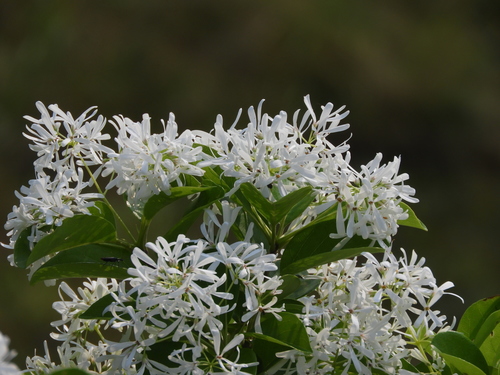
Jasminum lanceolaria
Roxb.
Jasmine, Sieu-hing-hwa
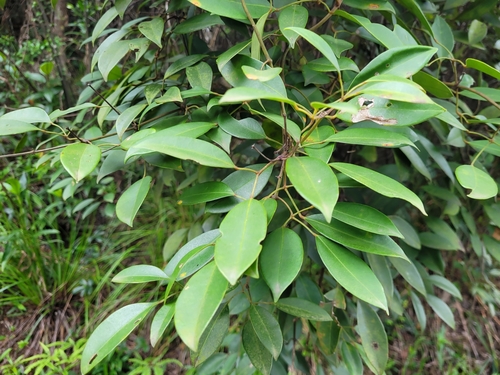
(c) Crawford Law @HKCWW, some rights reserved (CC BY-NC)
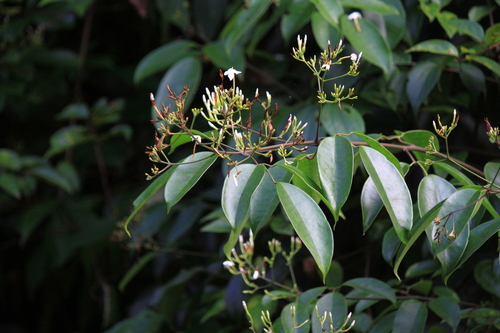
(c) MP Zhou, some rights reserved (CC BY-NC)

(c) MP Zhou, some rights reserved (CC BY-NC)
What to Eat
Edible parts: Flowers - flavouring
The flowers are used for scenting tea. Normally used in conjunction with the flowers of Jasminum sambac, 10 kilos of the flowers are used with 30 kilos of J. Sambac flowers to scent 100 kilos of tea.
Where to Find It
It is a temperate plant. It grows in dense valley forests below 2,200 m above sea level. In Sichuan and Yunnan.
Asia, Bhutan, China, Himalayas, India, Indochina, Laos, Myanmar, SE Asia, Taiwan, Thailand, Vietnam,
How to Identify
A shrub. It often lies over. The leaves are opposite and have 3 leaflets. The leaflets are oval and 4-16 cm long by 1-5 cm wide. The flowers are in compound groups. The fruit is a black berry.
How to Grow
Members of this genus generally succeed in full sun or partial shade, preferring a fertile, humus-rich, moist but well-drained soil.
Propagation: Seed - it does not require pre-treatment and is best sown in a partially shaded position as soon as it is ripe. Cuttings 12 - 20cm long should be taken from terminal shoots; treatment with a root stimulator increases the strike rate. Semi-ripe cuttings, 8cm long, places in a sandy medium, usually root within 4 weeks. Cuttings taken from shoot tips have given better results than semi-ripe cuttings. They are usually treated with a fungicide, placed in prepared planting holes and watered. Layering in the field is done with one-year-old shoots; a slanting cut is made approximately half-way through the shoot some 50cm from the end; the cut is buried about 10 - 15cm deep with the top remaining above ground. After about 4 - 6 months the rooted layers can be separated from the parent plant and transplanted.
Names & Synonyms
References (3)
- Facciola, S., 1998, Cornucopia 2: a Source Book of Edible Plants. Kampong Publications, p 163 (As Jasminum paniculatum)
- Hedrick, U.P., 1919, (Ed.), Sturtevant's edible plants of the world. p 361 (As Jasminum paniculatum)
- Seidemann J., 2005, World Spice Plants. Economic Usage, Botany, Taxonomy. Springer. p 188 (As Jasminum paniculatum)