Passiflora lutea
Linn.
PassifloraceaeFruit
iNaturalist · cc-by-sa
(c) Turner Brockman, some rights reserved (CC BY-SA), uploaded by Turner Brockman
(c) Turner Brockman, some rights reserved (CC BY-SA), uploaded by Turner Brockman

iNaturalist · cc-by-sa
(c) Judy Gallagher, some rights reserved (CC BY-SA)
(c) Judy Gallagher, some rights reserved (CC BY-SA)
iNaturalist · cc-by
(c) Michael J. Papay, some rights reserved (CC BY)
(c) Michael J. Papay, some rights reserved (CC BY)
What to Eat
Edible parts: Fruit
The fruit is edible.
Where to Find It
A tropical plant.
Central America, North America, USA, West Indies,
Countries: Antigua & Barbuda, Barbados, Bahamas, Belize, Canada, Costa Rica, Cuba, Dominica, Dominican Republic, Grenada, Guatemala, Honduras, Haiti, Jamaica, St Kitts & Nevis, St Lucia, Mexico, Nicaragua, Panama, Puerto Rico, El Salvador, Trinidad & Tobago, United States, St Vincent
How to Identify
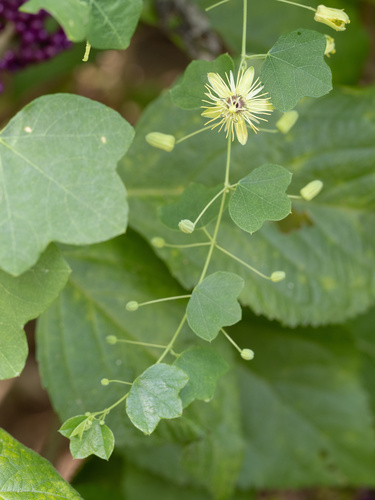
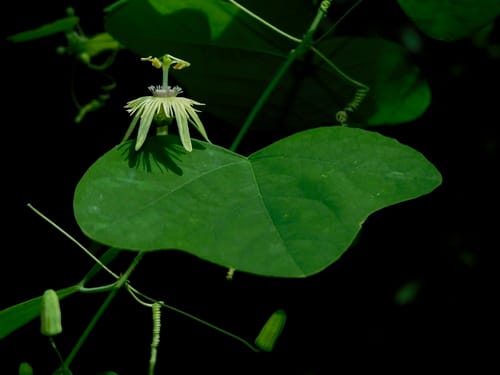
It is like Passiflora incarnata but smaller. The leaves are wider than they are long. The flowers are 2-2.5 cm across. They are greenish-yellow.
Wikipedia
Source ↗Passiflora lutea, commonly known as yellow passionflower, is a flowering perennial vine in the family Passifloraceae, native to the central and eastern United States. The vine has three-lobed leaves and small, yellowish-green, fringed flowers that appear in the summer, followed by green fruit that turn almost black at maturity. It grows in moist to wet habitats.
References (3)
- Hedrick, U.P., 1919, (Ed.), Sturtevant's edible plants of the world. p 467
- Loughmiller, C & L., 1985, Texas Wildflowers. A Field Guide. University of Texas, Austin. p 189
- Sp. pl. 2:958. 1753


