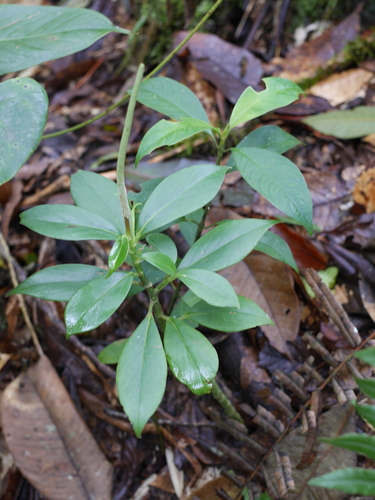
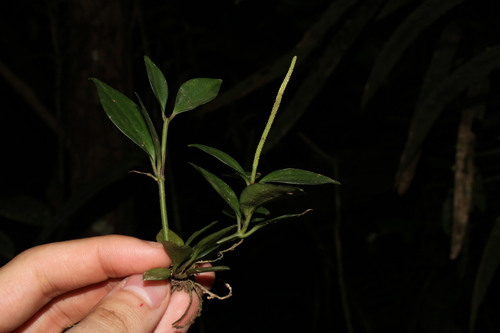
Piper amalago
Linn.
Amalago pepper

(c) B. Phalan, some rights reserved (CC BY), uploaded by B. Phalan
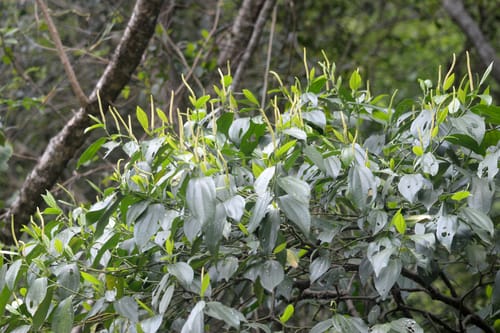
(c) pedronoe, some rights reserved (CC BY-NC)
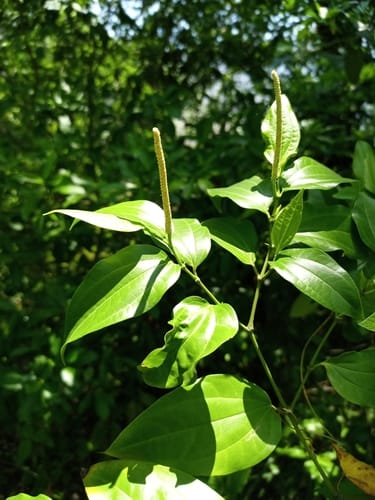
(c) Salvador Luna Vargas, some rights reserved (CC BY-NC)
What to Eat
Edible parts: Seeds, Fruit - Spice, Flowers - flavouring
The pungent, black fruit is used as a hot spice in food. It is extremely like black pepper (Piper nigrum) in quality. About the size of a mustard seed. The seed should be collected before it is quite ripe. The leaves are dried and used for making tea.
Where to Find It
A tropical plant. In Argentina it grows from sea level to 1,500 m above sea level.
Amazon, Andes, Argentina, Belize, Bolivia, Brazil, Central America, Colombia, Costa Rica, Cuba, Dominican Republic, Ecuador, El Salvador, French Guiana, Guadeloupe, Guatemala, Guianas, Guyana, Haiti, Honduras, Jamaica, Mexico, Nicaragua, North America, Panama, Paraguay, Peru, Puerto Rico, South America*, Suriname, Trinidad-Tobago, Venezuela, West Indies,
How to Identify
A vine or shrub. It can grow 1-4 m tall. The leaves are 5-13 cm long by 3-8 cm wide. The fruit are oval and 1.5-2 mm long.
Medicinal Uses
The leaves and young shoots are discutient. The green leaves are brewed to provide a remedy for coughs. The root is diaphoretic, resolutive, sudorific. It is used to treat snake bites. An infusion of the flowers is aperitive and vermifuge.
Other Uses
The stems are utilized in building small shelters or shacks in much the same way as bamboo is used.
Names & Synonyms
Aniset, Anis mawon, Bwa anis, Bwa nwayo, Cordillero, Cordoncillo, Cu-uc-tzu, Guayuyo, Higuillo de limon, Higuillo olorosa, Macaxochitl, Matico macho, Sirio, Siwo bannann, Yaxal, Yazl
References (9)
- Grandtner, M. M., 2008, World Dictionary of Trees. Wood and Forest Science Department. Laval University, Quebec, Qc Canada. (Internet database http://www.wdt.qc.ca)
- Grandtner, M. M. & Chevrette, J., 2013, Dictionary of Trees, Volume 2: South America: Nomenclature, Taxonomy and Ecology. Academic Press p 500
- Hedrick, U.P., 1919, (Ed.), Sturtevant's edible plants of the world. p 499
- Kermath, B. M., et al, 2014, Food Plants in the Americas: A survey of the domesticated, cultivated and wild plants used for Human food in North, Central and South America and the Caribbean. On line draft. p 664
- Kew Plants of the World Online
- Piedra-Malagón, E. M., et al, 2022, Edible native plants of the Gulf of Mexico Province. Biodiversity Data Journal 10: e80565 p 27
- Plants of Haiti Smithsonian Institute http://botany.si.edu/antilles/West Indies
- Roa, J. A. G. & Boada, D. S. G., 2018, Fundación para el Fortalecimiento de la Fruticultura y Plantas Alimenticias no Convencionales en Colombia.
- World Checklist of Useful Plant Species 2020. Royal Botanic Gardens, Kew