Passiflora arida
(Mast. & Rose) Killip
Sonoran passion flower
PassifloraceaeFruit

iNaturalist · cc-by-nc
(c) Christian Schwarz, some rights reserved (CC BY-NC), uploaded by Christian Schwarz
(c) Christian Schwarz, some rights reserved (CC BY-NC), uploaded by Christian Schwarz
iNaturalist · cc-by-nc
(c) Louise, some rights reserved (CC BY-NC), uploaded by Louise
(c) Louise, some rights reserved (CC BY-NC), uploaded by Louise

iNaturalist · cc-by-nc
(c) Christian Schwarz, some rights reserved (CC BY-NC), uploaded by Christian Schwarz
(c) Christian Schwarz, some rights reserved (CC BY-NC), uploaded by Christian Schwarz
What to Eat
Edible parts: Fruit
The fruit are edible.
Where to Find It
A subtropical plant.
Mexico, North America, USA,
Countries: Antigua & Barbuda, Barbados, Bahamas, Belize, Canada, Costa Rica, Cuba, Dominica, Dominican Republic, Grenada, Guatemala, Honduras, Haiti, Jamaica, St Kitts & Nevis, St Lucia, Mexico, Nicaragua, Panama, Puerto Rico, El Salvador, Trinidad & Tobago, United States, St Vincent
How to Identify
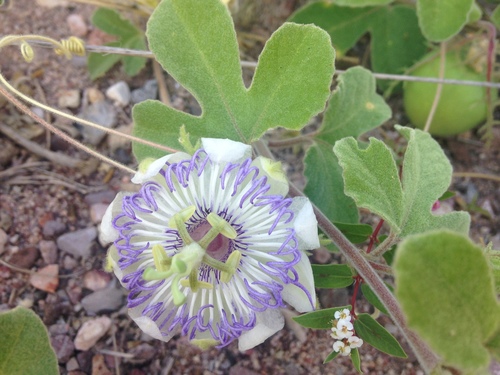
A climber. The stems are hairy. The leaves are hairy. The leaves are 3-6 cm long by 2-7 cm wide and have 5-7 lobes. The middle lobe is the largest. There can be teeth along the edge. The flowers are white with a purple ring at the base. The fruit are oval and green to pale yellow. They are 2-3 mm long by 15-25 mm wide.
Names & Synonyms
Sandillita
References (2)
- Pio-Leon, J. F., et al, 2017, Prioritizing Wild Edible Plants of potential new crops based on Deciduous Forest traditional knowledge by a Rancher community. Botanical Sciences 95(1): 47-59
- Ulmer, T., & MacDougal, J.M., 2004, Passiflora Passionflowers of the World. Timber Press. p 69


