Crocus cartwrightianus
Herb.
Wild saffron crocus
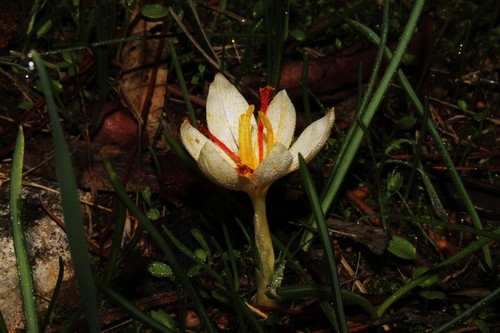
(c) Σάββας Ζαφειρίου (Savvas Zafeiriou), some rights reserved (CC BY-NC), uploaded by Σάββας Ζαφειρίου (Savvas Zafeiriou)

(c) Nicolas Lagière, some rights reserved (CC BY-NC)

(c) Nicolas Lagière, some rights reserved (CC BY-NC)
What to Eat
Edible parts: Styles, Stigma, Flowers, Spice
The flower styles and stigmas are collected for saffron; flowers can also be used as a spice.
Where to Find It
It grows on rocky hillsides and in grassy places.
Australia, Europe, Greece, Mediterranean,
How to Identify
A low plant which forms corms. It keeps growing from year to year. There are 5-11 leaves and these are grey-green. They are 0.5-1.5 mm wide. The flowers are pale or deep lilac-purple. They are strongly veined on the outside. They can be a darker colour towards the base. The stamen have yellow anthers and a white or purple stalk. The style is divided into 3 very long and deep red branches. They are flared at the tip. Each is 15-27 mm long.
Medicinal Uses
The flower styles are traditionally collected for saffron.
Wikipedia
Source ↗Crocus cartwrightianus is a species of flowering plant in the family Iridaceae. It is native to mainland Greece, Euboea, Crete, Skyros and some islands of the Cyclades. It is a cormous perennial growing to 5 cm (2 in). The flowers, in shades of lilac or white with purple veins and prominent red stigmas, appear with the leaves in autumn and winter.
Names & Synonyms
Cartwright saffron
References (3)
- Blamey, M and Grey-Wilson, C., 2005, Wild flowers of the Mediterranean. A & C Black London. p 498
- Edward's Bot. Reg. 29: misc. 82. 1843
- Seidemann J., 2005, World Spice Plants. Economic Usage, Botany, Taxonomy. Springer. p 121


