Blechnum orientale
L.
Bungwall, Mountain fern cat, Centipede fern

(c) 橘子拔(橘子熊), some rights reserved (CC BY-NC), uploaded by 橘子拔(橘子熊)
no rights reserved, uploaded by 葉子

(c) leung-, some rights reserved (CC BY-NC)
What to Eat
Edible parts: Rhizome, Root, Fronds, Leaves, Vegetable
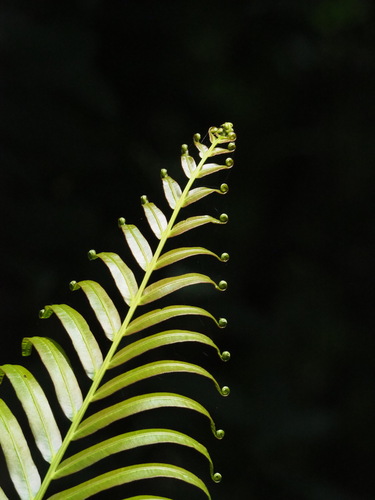
The rhizome is eaten after cooking and pounding, and boiled. Fresh fronds and fiddle heads are used as vegetables, in stir-fries, and added to soups.
Where to Find It
A tropical plant. It occurs in rainforest and swampy areas. It suits humid locations. It grows best with regular water but can tolerate some sun and dryness. It grows in forest clearings and along roadsides. It is frost tender. It can grow on rocky edges of waterfalls. In China it grows between 200-1,000 m above sea level. In Yunnan.
Africa, American Samoa, Asia, Australia, Bangladesh, China, Fiji, Guam, India, Indochina, Indonesia, Japan, Laos, Madagascar, Malaysia, Mariana Islands, Micronesia, New Zealand, Northeastern India, Pacific, Palau, Papua New Guinea, PNG, Philippines, Pohnpei, Rotuma, Samoa, SE Asia, Solomon Islands, Tonga, Vietnam, Wallis and Futuna, Yap,
How to Identify
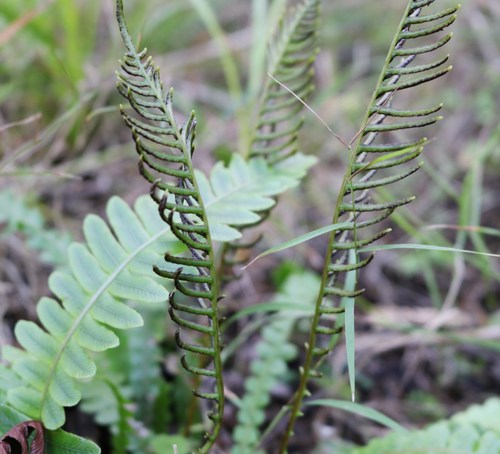
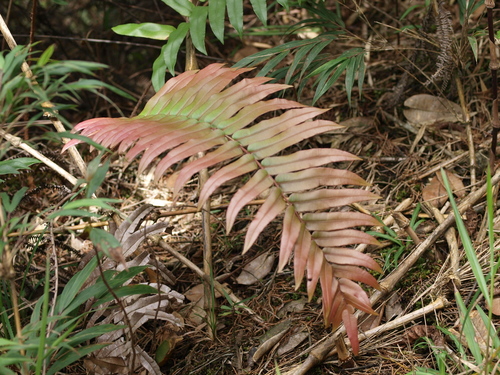
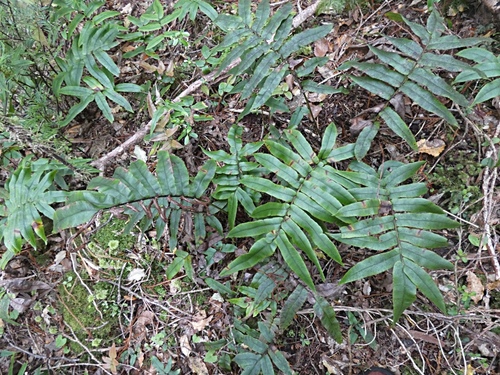
A medium to tall fern. It grows 0.3-1.2 m tall. It forms round clumps. The stem is short and has brown scales with very small teeth. The fronds can be 1 m high. The fronds are spreading or erect, forming a rosette. They often droop at the tips. The side leaflets are thin and long, with a long pointed tip. They do not have teeth along the edge. They are about 20-25 cm long and 0.8-1.8 cm wide. They are attached directly to the stalk. The youngest leaflets are pink. The leaf segments are rounded and smallest at the base. The fronds are dark green and shiny. The spore bodies are produced under the fertile fronds which have an appearance similar to the other fronds. These spores occur in a long continuous line along both sides of the midrib.
Nutrition Score: 26/100
| Part | Moisture | kJ | kcal | Protein | Vit A | Vit C | Iron | Zinc |
|---|---|---|---|---|---|---|---|---|
| Leaves | 88.5 | 167 | 40 | 1.2 | — | 0.3 | 2.4 | 2.3 |
| Rhizome | — | — | — | — | — | — | — | — |
How to Grow
Plants are grown from spores.
Medicinal Uses
The plant is anthelmintic, antiviral, contraceptive and tonic. It is used in the treatmenr of urinary complaints, impotence; boils in infants and older children and diarrhoea. In Papua New Guinea it is believed that total sterility in women can be achieved by eating the new leaves of this plant each day for three successive days, then waiting a fortnight and repeating the treatment. A paste of the young fronds is applied topically to treat abscesses and fungal skin infections, esp ringworm, and also to stop bleeding. The plant contains an essential oil, phenolic compounds and triterpenoids.
Other Information
It is not known if it is used for food in Papua New Guinea.
Notes
There are between 150 and 200 Blechnum species. It is used in medicine.
Names & Synonyms
Dhekiashak, Dheki shak, Ge long, Haththazori, Julia roroa, Khammouan, Mahrekenleng, Majuwa, Paku jahe, Paku kelindang, Paku lipan, Paku lobang, Parangipang, Rang dua dong, Vawm-ban, Vomban
References (43)
- Ambasta S.P. (Ed.), 2000, The Useful Plants of India. CSIR India. p 74
- Andrews, S.B., 1990, Ferns of Queensland. A handbook to the ferns and fern allies. Queensland DPI p 91
- BARC, 2016, State of Biodiversity for Food and Agriculture in Bangladesh. Bangladesh Agricultural Research Council.
- Borrell, O.W., 1989, An Annotated Checklist of the Flora of Kairiru Island, New Guinea. Marcellin College, Victoria Australia. p 1
- Brock, J., 1993, Native Plants of Northern Australia, Reed. p 97
- Burkill, I.H., 1966, A Dictionary of the Economic Products of the Malay Peninsula. Ministry of Agriculture and Cooperatives, Kuala Lumpur, Malaysia. Vol 1 (A-H) p 336
- Chaffey, C.H., 1999, Australian Ferns. Growing them successfully. Kangaroo Press. p 11, 110
- Chai, P. P. K. (Ed), et al, 2000, A checklist of Flora, Fauna, Food and Medicinal Plants. Lanjak Entimau Wildlife Sanctuary, Sarawak. Forestry Malaysia & ITTO. p 159
- Chai, T., et al, 2015, Evaluation of Glucosidase Inhibitory and Cytotoxic Potential of Five Selected Edible and Medicinal Ferns. Tropical Journal of Pharmaceutical Research March 2015; 14 (3): 449-454.
- Cherikoff V. & Isaacs, J., The Bush Food Handbook. How to gather, grow, process and cook Australian Wild Foods. Ti Tree Press, Australia p 198
- Chin, W.Y., 1998, Ferns in the Tropics. Kangaroo. p 14, 103
- Cribb, A.B. & J.W., 1976, Wild Food in Australia, Fontana. p 159
- Elliot, W.R., & Jones, D.L., 1982, Encyclopedia of Australian Plants suitable for cultivation. Vol 2. Lothian. p 329 (picture)
- Flora of Solomon Islands
- French, B.R., 2010, Food Plants of Solomon Islands. A Compendium. Food Plants International Inc. p 120
- Goudey, C.J., 1988, A Handbook of Ferns for Australia and New Zealand. Lothian. p
- Hoe, V. B. & Siong, K. H., 1999, The nutritional value of indigenous fruit and vegetables in Sarawak. Asia Pacific J. Clin. Nutr. 8(1):24-31
- Hossain, U. & Rahman, A., 2018, Study and quantitative analysis of wild vegetable floral diversity available in Barisal district, Bangladesh. Asian J. Med. Biol. Res. 2018, 4 (4), 362-371
- Hu, Shiu-ying, 2005, Food Plants of China. The Chinese University Press. p 271
- Jones D, L, 1986, Ornamental Rainforest Plants in Australia, Reed Books, p 306
- Kar, A., et al, 2013, Wild Edible Plant Resources used by the Mizos of Mizoram, India. Kathmandu University Journal of Science, Engineering and Technology. Vol. 9, No. 1, July, 2013, 106-126
- Lazarides, M. & Hince, B., 1993, Handbook of Economic Plants of Australia, CSIRO. p 33
- Levitt, D., 1981, Plants and people. Aboriginal uses of plants on Groote Eylandt, Australian Institute of Aboriginal Studies, Canberra.
- Lim, T. K., 2015, Edible Medicinal and Non Medicinal Plants. Volume 9, Modified Stems, Roots, Bulbs. Springer p 15
- Liu, Y., et al, 2012, Food uses of ferns in China: a review. Acta Societatis Botanicorum Poloniae 84(4): 263-270
- Maghirang, R. G., et al, 2018. Ethnobotanical Studies of Some Plants Commonly Used as Vegetables in Selected Provinces of the Philippines. Journal of Nature Studies. 17(2), 30-43.
- Melzer, R. & Plumb, J., 2011, Plants of Capricornia. Belgamba, Rockhampton. p 406
- Menisa, A. A., et al, 2012, Survey and characterization of Indigenous Food Plants in Ilocos Norte, Philippines. SEARCA Discussion Paper series No. 2011-2
- Paczkowska, G. & Chapman, A.R., 2000, The Western Australian Flora. A Descriptive Catalogue. Western Australian Herbarium. p 23
- Parham, B. E. V., 1972, Plants of Samoa. New Zealand Department of Scientific and Industrial Research. Information Series. No. 85 p 59
- Pearson, S. & A., 1992, Rainforest Plants of Eastern Australia. Kangaroo Press p 43
- Pham-Hoang Ho, 1999, An Illustrated Flora of Vietnam. Nha Xuat Ban Tre. p 209
- Piggott, A. G. 1988, Ferns of Malaysia in Colour. Tropical press, Malaysia. p 400
- Sarker, S. K., & Enayet Hossain, A. B. M., 2009, Pteridophytes of Greater Mymensingh District of Bangladesh used as Vegetables and Medicines. Bangladesh J. Plant Taxon. 16(1) 47-56. p 50
- Sarma, H., et al, 2010, Updated Estimates of Wild Edible and Threatened Plants of Assam: A Meta-analysis. International Journal of Botany 6(4): 414-423
- Sp. pl. 2:1077. 1753
- Sujarwo, W., et al, 2014, Ethnobotanical Study of Edible Ferns Used in Bali Indonesia. Asia Pacific Journal of Sustainable Agriculture Food and Energy. 2(2): 1-4.
- Sukarya, D. G., (Ed.) 2013, 3,500 Plant Species of the Botanic Gardens of Indonesia. LIPI p 856
- Townsend, K., 1994, Across the Top. Gardening with Australian Plants in the tropics. Society for Growing Australian Plants, Townsville Branch Inc. p 101
- Wheeler, J.R.(ed.), 1992, Flora of the Kimberley Region. CALM, Western Australian Herbarium, p 48
- World Checklist of Useful Plant Species 2020. Royal Botanic Gardens, Kew
- Xu, You-Kai, et al, 2004, Wild Vegetable Resources and Market Survey in Xishuangbanna, Southwest China. Economic Botany. 58(4): 647-667.
- Yuncker, T.G., 1959, Plants of Tonga, Bernice P. Bishop Museum, Hawaii, Bulletin 220. p 34