Elaeocarpus sphaericus
(Gaertn.) K. Schum.
Bead tree
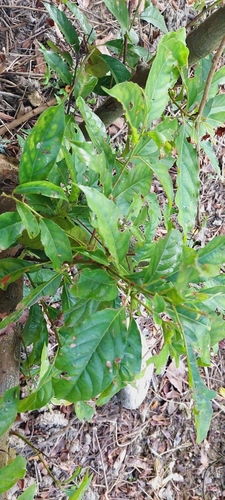
(c) 大冠鷲, some rights reserved (CC BY-NC)
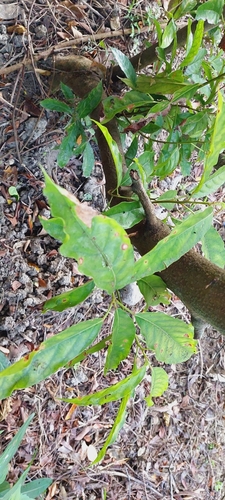
(c) 大冠鷲, some rights reserved (CC BY-NC)

(c) davidchiu7, some rights reserved (CC BY-NC)
What to Eat
Edible parts: Fruit
Hundreds of years ago this plant was an important article of international commerce, specifically, the burl-like stones containing the seeds. Rumphius describes that it was common practice across the islands of the Indonesian archipelago to trade in the stones, known as ganiter or ganitris in Malay, Javanese and Balinese—words known across the East Indies. Not all stones were valuable, the best were of a smaller size and were coloured deep brown. The stones often were collected from the defecations of cattle, for it was during the passage through the various stomachs of the cow that the stones gained the preferred colour, although less scrupulous dealers were wont to drown the stones in seawater to achieve a similar effect. Stones which had lain on the ground became a less appealing grey colour and thus had no value. A trader could collect some 3,000 Dutch pounds of the unsorted stones at a port in Java, Madura or Bali for only some 60 silver real, the merchant must then sort his cargo, retaining only the small and medium stones, and throwing out the rest. The middle-sized stones were not worth much, but for the small stones Hindus and Arab traders would pay good money, some 10 real for a handful of the stones, using them to make religious objects for their priests. A hole could be bored through them, and the stones could then be stringed up into chains, which were worn around the body in the same manner as European people do with corals in rosaries. Especially the Hindu priests were customers, but Muslim imams would also use the chains as prayer beads to recite Tasbih. The richest of the priests would string a golden nugget after every two ganiters, thus the Chinese called the stones kimkungtsi—'gold hard seeds'. Such was the worth of a good stone, that counterfeits were carved from hard wood, thus the Codjas were usually very savvy in telling apart the good stones from the false. In some parts of Java, the local population used a special method of cultivation to ensure themselves of a harvest of the good stones. When the trees were just beginning the process of fructification, and the young fruit were just beginning to develop, long strips of the bark were pried off the main branches and some off the trunk—this forced the fruit to be stunted, which caused the stones to be smaller and more grooved.
Where to Find It
A tropical plant.
How to Identify
An evergreen tree. It grows 15-25 m tall and spreads 4 m wide. The trunk is erect and stout. The bark is brown or grey and thin. The leaves are narrowly oval. They are 8-17 cm long by 3-6 cm wide. The flowers are white and occur in clusters that hang down. These are 4-10 cm long. The fruit are rounded berries. They are 2-3 cm across. They are blue green with a bright green pulp. There is a pitted stone with 2-5 seeds.
Production
Probably Elaeocarpus serratus L.;
Names & Synonyms
Bhagwan tasse, Rudraksha, Sunganerem
References (7)
- Bodkin, F., 1991, Encyclopedia Botanica. Cornstalk publishing, p 377
- Coronel, R.E., 1982, Fruit Collections in the Philippines. IBPGR Newsletter p 9
- Foreman, D. B., 1971, A checklist of the Vascular Plants of Bougainville with Descriptions of some Common Forest Trees. Botany Bulletin No. 5. Department of Botany. p 112
- Gardner, S., et al, 2000, A Field Guide to Forest Trees of Northern Thailand, Kobfai Publishing Project. p 95
- Mozhui, R., et al, 2011, Wild edible fruits used by the tribals of Dimapur district of Nagaland, India. Pleione 5(1): 56 - 64.
- Murtem, G. & Chaudhrey, P., 2016, An ethnobotanical note on wild edible plants of Upper Eastern Himalaya, India. Brazilian Journal of Biological Sciences, 2016, v. 3, no. 5, p. 63-81.
- Uprety, Y., et al, 2016, Traditional use and management of NTFPs in Kangchenjunga Landscape: implications for conservation and livelihoods. Journal of Ethnobiology and Ethnomedicine (2016) 12:19


