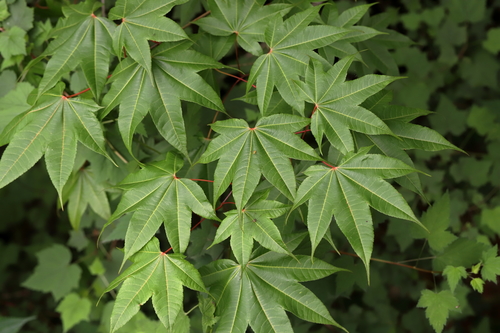
Acer pensylvanicum
L.
Striped maple, Moosewood
(c) beetlehei, some rights reserved (CC BY-NC)

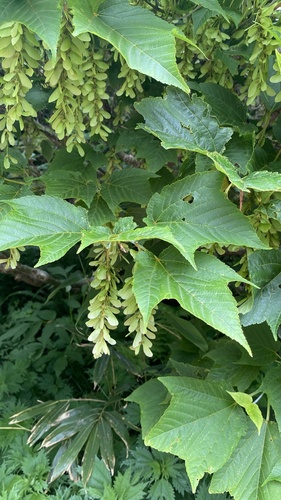
(c) Ashley M Bradford, some rights reserved (CC BY-NC), uploaded by Ashley M Bradford

(c) りなべる, some rights reserved (CC BY), uploaded by りなべる
What to Eat
Edible parts: Sap
None known
Where to Find It
A temperate plant. It does best in light well-drained soil. It needs a protected sunny position. It is resistant to frost but sensitive to drought.
Australia, Canada, North America*, USA,
How to Identify
A shrub or small tree. It grows 5 m tall. There are prickles along the stem. The leaves are twice divided and there are 8-18 pairs of pinnae. There are up to 50 pairs of pinnules on each pinnae. The flowers are yellow. They are in large clusters at the ends of branches. The pods are flattened.
How to Grow
Grows well in heavy clay soils. Plants are hardy to about -25°c when they are fully dormant. A good tree for street planting. Most maples are bad companion plants, inhibiting the growth of nearby plants.
Propagation: Seed is best sown as soon as it is ripe in a cold frame, where it usually germinates the following spring. Stored seed should be pre-soaked for 24 hours and then stratified for 2–4 months at 1–8°C, though germination can be slow. Seed can be harvested green — fully developed but before it has dried and produced germination inhibitors — and sown immediately for late-winter germination. Seed harvested too early will produce very weak plants or none at all. Prick seedlings into individual pots once large enough to handle and grow on until 20cm or more tall before planting out permanently. Layering is successful with most species in this genus and takes about 12 months. Cuttings of young shoots taken in June or July should have 2–3 pairs of leaves plus one pair of buds at the base; remove a thin slice of bark at the base and use a rooting hormone. Rooted cuttings must show new growth during the summer before being potted up, or they are unlikely to survive the winter. Grafting is not generally recommended for this species, though cultivars can be grafted onto rootstocks of the species.
Medicinal Uses
A tea brewed from the inner bark is used in the treatment of colds, coughs, bronchitis, kidney infections, gonorrhoea, and the spitting of blood. The same tea is also applied externally as a wash for swollen limbs and for paralysis. A tea made from the leaves and twigs can either allay or induce vomiting depending on the dosage.
Other Uses
Leaves packed around apples, root crops, and similar produce help preserve them. The wood is light, soft, close-grained, and satiny, weighing 33lb per cubic foot. It has no commercial use but is sometimes burned as fuel.
Wikipedia
Source ↗Acer pensylvanicum, known as the striped maple, whistlewood, moosewood, moose maple or goosefoot maple, is a North American species of maple. It is a small, slow-growing understory tree, and one of the most shade-tolerant species of maple. The striped maple is a sequential hermaphrodite, meaning that it can change its sex throughout its lifetime. It is the only species of snakebark maple native to North America.
Other Information
The sap makes a quality syrup.
Notes
There are about 120-150 Acer species.
Names & Synonyms
Goosefoot maple, Whistlewood
References (6)
- Bodkin, F., 1991, Encyclopedia Botanica. Cornstalk publishing, p 40
- Facciola, S., 1998, Cornucopia 2: a Source Book of Edible Plants. Kampong Publications. p 1
- Grandtner, M. M., 2008, World Dictionary of Trees. Wood and Forest Science Department. Laval University, Quebec, Qc Canada. (Internet database http://www.WDT.QC.ca)
- Kermath, B. M., et al, 2014, Food Plants in the Americas: A survey of the domesticated, cultivated and wild plants used for Human food in North, Central and South America and the Caribbean. On line draft. p 13
- MacKinnon, A., et al, 2009, Edible & Medicinal Plants of Canada. Lone Pine. p 66
- Sp. pl. 2:1055. 1753