Juniperus horizontalis
Moench
Creeping juniper, Blue carpet
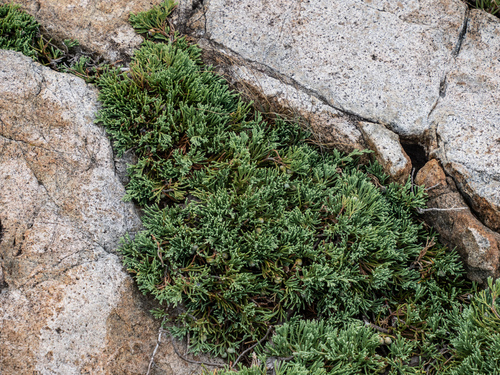
(c) kenttrulsson, some rights reserved (CC BY-NC), uploaded by kenttrulsson
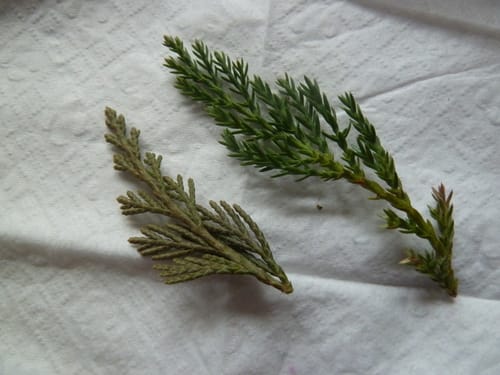
(c) Burkhard, some rights reserved (CC BY-NC-SA)
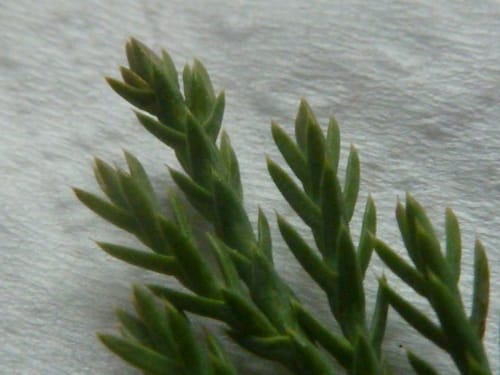
(c) Burkhard, some rights reserved (CC BY-NC-SA)
What to Eat
Edible parts: Fruit - coffee, Leaves - tea
The fruits of Juniperus horizontalis are roasted and used to prepare a coffee-like beverage. A tea is made from the young branch tips.
Where to Find It
It is a temperate plant. It grows in exposed places and on rocks or sand.
Australia, Canada, Hawaii, Nepal, North America, Slovenia, USA,
How to Identify
A low lying shrub. The shoots are long and trailing. The leaves are like scales. They are opposite each other and each pair is at right angles to the next. They are triangle shaped and overlap. They are 1-2 mm long. The pollen cone is brown. It is 2 mm long. The fruit are oval and 6 mm long. There are 1-4 seeds.
How to Grow
Succeeds in a sunny position in most soils so long as they are well drained, preferring a neutral or slightly alkaline soil and succeeding on chalk. Succeeds in dry soils. An aggregate species. There are many named varieties selected for their ornamental value. 'Bar Harbour' is very salt-resistant. Dioecious, male and female plants must be grown if seed is required. In garden design, as well as the above-ground architecture of a plant, root structure considerations help in choosing plants that work together for their optimal soil requirements including nutrients and water.
Propagation: The seed has a hard seedcoat and can be very slow to germinate, typically requiring a cold period followed by a warm period and then another cold spell, each of 2–3 months duration. Soaking the seed for 3–6 seconds in boiling water may speed up germination. Seed is best sown as soon as it is ripe in a cold frame; some may germinate the following spring, though most will take another year. Alternatively, seed can be harvested green — when the embryo has fully formed but before the seedcoat has hardened. Seedlings can be potted into individual pots when large enough to handle, grown on until sufficiently sized, then planted out in early summer. Stored dry, seed can remain viable for several years. Cuttings of mature wood, 5–10 cm with a heel, can be taken in September or October and rooted in a cold frame, then planted out the following autumn. Layering in September or October takes approximately 12 months.
Medicinal Uses
An infusion of the branches or fleshy cones has been used to treat coughs, colds, and fevers; the cones or branches can also be used as a steam bath. An infusion of the seeds has been used in the treatment of kidney problems.
Other Uses
This plant makes a good ground cover for sunny positions, eventually forming a dense mat, though it requires weeding during the first year or so. The bark has been crushed and used as a soft hygienic pad in cradles and has also been used to make mats. Young twigs and leaves have been burnt as incense. Landscape uses include erosion control, ground cover, massing, rock gardens, cascading planting, and seashore situations.
Wikipedia
Source ↗Juniperus horizontalis, the creeping juniper or creeping cedar, is a low-growing shrubby juniper native to northern North America, throughout most of Canada from Yukon east to Newfoundland, and in some of the northern United States.
Names & Synonyms
Dhupi, Polegli brin
References (7)
- Facciola, S., 1998, Cornucopia 2: a Source Book of Edible Plants. Kampong Publications, p 89
- http://www.botanic-gardens-ljubljana.com/en/plants
- Kermath, B. M., et al, 2014, Food Plants in the Americas: A survey of the domesticated, cultivated and wild plants used for Human food in North, Central and South America and the Caribbean. On line draft. p 461
- MacKinnon, A., et al, 2009, Edible & Medicinal Plants of Canada. Lone Pine. p 76
- Methodus 699. 1794
- Moerman, D. F., 2010, Native American Ethnobotany. Timber Press. p 284
- Staples, G.W. and Herbst, D.R., 2005, A tropical Garden Flora. Bishop Museum Press, Honolulu, Hawaii. p 66


