Pelargonium graveolens
L'Her. ex Aiton
Rose geranium, Peppermint-scented geranium

(c) galpinmd, some rights reserved (CC BY-NC), uploaded by galpinmd

(c) danielaperezorellana, some rights reserved (CC BY-NC-ND)

(c) Thierry Meyre, some rights reserved (CC BY-NC), uploaded by Thierry Meyre
What to Eat
Edible parts: Leaves, Flowers, Leaves - tea
The flowers can be eaten raw and make a colourful addition to salads. The rose-scented leaves are used as a flavouring in desserts, jellies, and vinegars, and can also be brewed into a tea.
Where to Find It
It is a subtropical plant. It grows on mountains and in light shade. It can grow in moist locations. It grows among rocks. In Zimbabwe it grows between 1,500-2,300 m above sea level.
Africa, Australia, Balkans, Bosnia, Canary Is., Central America, Costa Rica, Cuba, Dominican Republic, East Africa, Ecuador, Haiti, Mexico, Mozambique, Puerto Rico, Romania, South Africa, Southern Africa*, South America, Tasmania, West Indies, Zimbabwe,
How to Identify
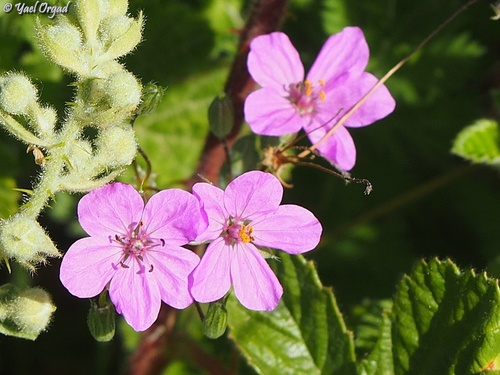
A shrubby bush. It grows 1 m high. The leaves have a scent. The leaves are broadly oval with lobes spread out like fingers on a hand. The lower lobes are often lobed again. The flowers are small and pink with dark purple veins. They are opposite the leaves and in groups of 2-7.
How to Grow
Requires a light well-drained neutral to alkaline soil in a sunny position. Plants are not very hardy in Britain, they generally require greenhouse protection but might succeed outdoors when grown in a very sheltered warm spot in the mildest parts of the country. They can also be grown in containers that are placed outdoors in the summer and then brought into the greenhouse or conservatory for the winter. The plants need to be kept fairly dry in the winter. Very tolerant of pruning, they can be cut right down to the base in the autumn when bringing them back indoors, or in the spring to encourage lots of fresh growth. Cultivated for its essential oil in S. France and Spain, there are many named varieties.
Propagation: Sow seed as soon as it is ripe in a greenhouse, or in early spring if using stored seed. A minimum germination temperature of 13°C is recommended; seeds usually sprout within 2 weeks, though germination can sometimes take several months. Prick seedlings out into individual pots when large enough to handle and overwinter them under glass for at least their first year. If planting outdoors, do so in early summer and consider extra winter protection. Cuttings can be taken at almost any point during the growing season, though early summer is ideal to allow the new plant to establish before winter.
Medicinal Uses
An aromatic, rose-scented herb, the whole plant has relaxant, anti-depressant, and antiseptic properties, reduces inflammation, and controls bleeding. All parts are astringent. It is used internally for pre-menstrual and menopausal problems, nausea, tonsillitis, and poor circulation. Externally, it is applied to acne, haemorrhoids, eczema, bruises, ringworm, and lice. The leaves can be used fresh at any time of year. The essential oil is used in aromatherapy and applied locally in the treatment of cervical cancer.
Other Uses
A well-known plant since the 17th century for its use in food, beverages, tea, pot-pourri, and perfume, it is also widely grown in Bulgaria for the production of rose geranium essential oil. The oil, which has an orange-rose fragrance, is the main source of commercial geranium oil, used extensively in aromatherapy, skin care, and food flavouring. The leaves are used in pot-pourri.
Wikipedia
Source ↗Pelargonium graveolens is a Pelargonium species native to the Cape Provinces and the Northern Provinces of South Africa, Zimbabwe and Mozambique. Common names include rose geranium, sweet scented geranium, old-fashioned rose geranium, and rose-scent geranium.
Production
Plants are fast growing.
Other Information
It is cultivated.
Names & Synonyms
Esencia de rosa, Lemon geranium, Malva
References (15)
- W. Aiton, Hort. kew. 2:423. 1789 - [plants cultivated under this name differ from wild plants & may be of hybrid origin]\; for authorship see comments in J. S. African Bot. 45:377-380. 1979
- Facciola, S., 1998, Cornucopia 2: a Source Book of Edible Plants. Kampong Publications, p 118
- Joffe, P., 2007, Creative Gardening with Indigenous Plants. A South African Guide. Briza. p 169
- Kapelle, M., et al, 2000, Useful plants within a Campesino Community in a Costa Rican Montane Cloud Forest. Mountain Research and Development, 20(2): 162-171
- Kermath, B. M., et al, 2014, Food Plants in the Americas: A survey of the domesticated, cultivated and wild plants used for Human food in North, Central and South America and the Caribbean. On line draft. p 625
- Kew Plants of the World Online
- Pieroni, A., et al, 2012, "We are Italians!": The Hybrid Ethnobotany of a Venetian Diaspora in Eastern Romania. Human Ecology 40:435-451
- Plants of Haiti Smithsonian Institute http://botany.si.edu/antilles/West Indies
- Redzic, S., 2010, Use of Wild and Semi-Wild Edible Plants in Nutrition and Survival of People in 1430 Days of Siege of Sarajevo during the War in Bosnia and Herzegovina (1992–1995). Coll. Antropol 34 (2010) 2:551-570
- Ruiters-Welcome, A. K., 2019, Food plants of southern Africa. Ph.D. thesis. Univ. of Johannesburg p 64
- Staples, G.W. and Herbst, D.R., 2005, A tropical Garden Flora. Bishop Museum Press, Honolulu, Hawaii. p 340
- van Wyk, B-E., 2011, The potential of South African plants in the development of new food and beverage products. South African Journal of Botany 77 (2011) 857–868
- Welcome, A. K. & Van Wyk, B.-E., 2019, An inventory and analysis of the food plants of southern Africa. South African Journal of Botany 122 (2019) 136–179
- Wiersema, J. H. & Leon, B., 2013, World Economic Plants. A Standard Reference CRC Press. 2nd Ed. p 503
- World Checklist of Useful Plant Species 2020. Royal Botanic Gardens, Kew