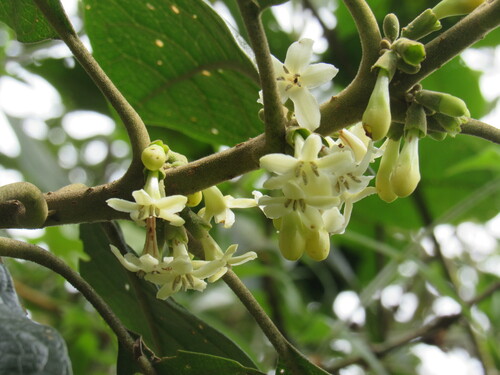
Leonotis ocymifolia
(Burm. f.) Iwarsson
Minaret flower

(c) Richard Gill, some rights reserved (CC BY-NC), uploaded by Richard Gill

(c) Tony Rebelo, some rights reserved (CC BY-SA)

(c) Tony Rebelo, some rights reserved (CC BY-SA)
What to Eat
Edible parts: Flowers, Flower - nectar, Spice
The flowers are cooked as a vegetable, and the nectar is sucked fresh from the flowers, particularly by children.
Where to Find It
It is a tropical plant. It can grow in hot arid places with a dry season of 6-11 months. It grows between 50-3,700 m above sea level in warmer places and lower in cooled places. It grows in areas with a rainfall between 500-2,000 mm per year. It can grow in arid places.
Africa, Angola, Botswana, Burundi, Central Africa, Congo, East Africa, Eswatini, Ethiopia, Kenya, Lesotho, Malawi, Mozambique, Namibia, Rwanda, South Africa, Southern Africa, Sudan, Swaziland, Tanzania, Uganda, Zambia, Zimbabwe,
How to Identify
An erect shrub. It grows 5 m high. It has a thick woody base. The leaf blade is 1-17 cm long by 1-9 cm wide. It is broadly oval. The leaves are green on the upper surface and silvery underneath. The flowers are usually orange. The upper lobe is 12-30 mm long. The seeds are 2-4 mm long by 1-2 mm wide. They are dark brown and glossy. There are at least 2 varieties.
Medicinal Uses
The leaves and flowering stems are emmenagogue and purgative. They are used internally in the treatment of diabetes, hypertension and anaemia. Applied externally as a wash, the leaves are used to treat eczema and other skin irritations. South African forms of the plant contain alkaloids, saponins and tannins but not cardiac or anthraquinone glycosides. The alkaloids are not of the indole or tropane type. The leaves of forms from Ethiopia revealed the presence of labdane type diterpene lactones such as leonitin.
Wikipedia
Source ↗Leonotis ocymifolia, occasionally referred to as the minaret flower, is a flowering plant of the mint family, Lamiaceae. The plant is used in Ethiopian folk medicine (link misleading) and found in Eastern Africa spanning from Sudan to South Africa. The plant is reasonably drought-resistant and wind tolerant. Unlike the similar Leonotus leonuris, in the ocymifolia, the tubular flowers are bolder and larger.
Other Information
The nectar of the flower is especially eaten by children.
Names & Synonyms
Ezewe, Fofiofo, Ifipa, Irenge, Koppie dagga, Mununzu, Ras kimir, Rooidagga, Sonja, Tchimuachope, Wilde dagga
References (11)
- De Vynk, J. C., et al, 2016, Indigenous edible plant use by contemporary Khoe-San descendants of South Africa's Cape South Coast. South African Journal of Botany. 102 (2016) 60-69
- Facciola, S., 1998, Cornucopia 2: a Source Book of Edible Plants. Kampong Publications, p 127
- Iwarsson, M. & Harvey, Y., 2003, Monograph of the genus Leonotis (Pers.) R. Br. (Lamiaceae) Kew Bulletin, Vol. 58, No. 3 (2003), pp. 597-645
- Magwede, K., van Wyk, B.-E., & van Wyk, A. E., 2019, An inventory of Vhavenḓa useful plants. South African Journal of Botany 122 (2019) 57–89
- Molla, A., Ethiopian Plant Names. http://www.ethiopic.com/aplants.htm
- Orto bot. Padova 142. 1842
- PROTA
- Royal Botanic Gardens, Kew (1999). Survey of Economic Plants for Arid and Semi-Arid Lands (SEPASAL) database. Published on the Internet; http://www.rbgkew.org.uk/ceb/sepasal/internet [Accessed 19th April 2011]
- Ruiters-Welcome, A. K., 2019, Food plants of southern Africa. Ph.D. thesis. Univ. of Johannesburg p 70
- Welcome, A. K. & Van Wyk, B.-E., 2019, An inventory and analysis of the food plants of southern Africa. South African Journal of Botany 122 (2019) 136–179 (Also as Leonotis dubia)
- World Checklist of Useful Plant Species 2020. Royal Botanic Gardens, Kew