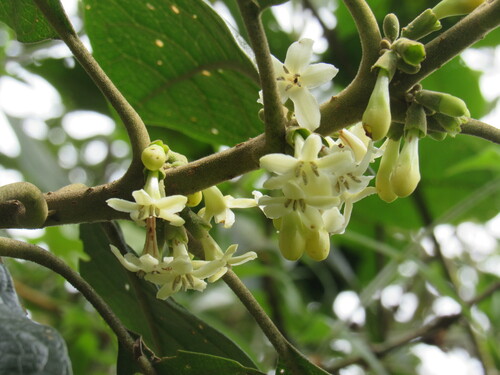
Pogostemon heyneanus
Benth.
Java patchouli, Smooth patchouli

Wikimedia Commons - Yercaud-elango

Wikimedia Commons - Photo by David J. Stang
What to Eat
Edible parts: Leaves drink flavour
The dried leaves are used to flavor a country spirit drink.
Where to Find It
A tropical plant.
Asia, Indonesia, Myanmar, SE Asia,
How to Identify
A tropical shrub in the mint family (Lamiaceae) native to Java and surrounding regions.
How to Grow
Plants can flower all year round. The leaves have a faint, pleasant scent.
Propagation: Seed - Cuttings of half-ripe wood 5 - 10cm long.
Medicinal Uses
The leaves are antiasthmatic, carminative, diuretic and stomachic. They are used in the treatment of stomach and skin diseases, to treat coughs and asthma. They are generally given with the seeds of tulsi (Ocimum tenuiflorum) in cases of scanty urine and biliousness. They could possibly be used in the treatment of cancer. The powdered dry leaves are used as a cephalic snuff in native medicine. A decoction made from the roots is sometimes used in the treatment of dropsy.
Other Uses
An essential oil is distilled from the leaves. It is much inferior to patchouli oil (from Pogostemon cablin) but small quantities are occasionally produced in India for local use or as an adulterant for patchouli oil. One of the most important sources of patchouli oil, which is extracted from the dried tops. It is very rich in volatile terpenoids. The leaves are placed amongst clothes to impart a pleasant smell and also to repel insects. The crushed leaves have been used to wash clothes.
Names & Synonyms
Thanat-pyit-si
References (3)
- Facciola, S., 1998, Cornucopia 2: a Source Book of Edible Plants. Kampong Publications, p 133
- N. Wallich, Pl. asiat. rar. 1:31. 1830
- World Checklist of Useful Plant Species 2020. Royal Botanic Gardens, Kew