Teucrium polium
L.
Germander
(c) Виктор, some rights reserved (CC BY-NC), uploaded by Виктор

(c) Marios Thoma, some rights reserved (CC BY)

(c) Marios Thoma, some rights reserved (CC BY)
What to Eat
Edible parts: Leaves - tea, Leaves - spice, Flowers - spice
The plant can be mixed with boiled water and sugar to make a refreshing beverage, and is also used as a spice.
Where to Find It
It is a Mediterranean climate plant. It grows in the Sahara.
Africa, Armenia, Asia, Bahrain, Balkans, Caucasus, Europe, Iran, Macedonia, Mediterranean, Middle East, Morocco, North Africa, Palestine, Saudi Arabia, Sinai, Spain, Turkey, Türkiye,
How to Identify
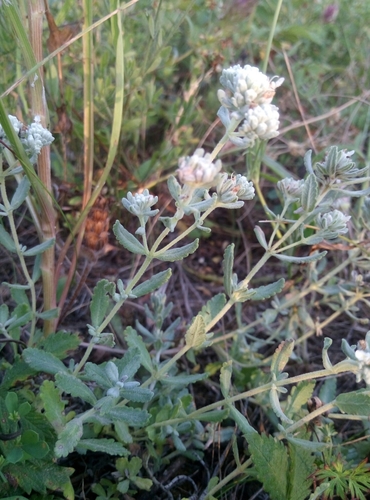
A woolly looking herb. It grows 20-40 cm high. The stems branch at the base. The leaves are whitish-green and hairy. They have a wavy edge. The flowers are white with a tinge of yellow in the middle of the bottom lip.
How to Grow
Succeeds in any moderately good well-drained soil in full sun. Plants require a very well-drained soil. Requires an alkaline soil. A very variable species with a number of distinct sub-species. The bruised foliage releases a pleasant aromatic scent. Plants are sub-shrubs, retaining a woody base but the stems often dying back in the winter. Plants in this genus are notably resistant to honey fungus.
Propagation: Sow seed in spring in a cold frame, barely covering it. Prick out seedlings into individual pots when large enough to handle, and plant out in summer if sufficiently developed; otherwise overwinter in the cold frame and plant out the following spring. Divide in early spring — larger divisions can go directly into permanent positions, while smaller ones are best potted up and grown on in light shade in a greenhouse or cold frame until growing well, then planted out in summer or the following spring. Half-ripe cuttings can be taken in July or August and rooted in a frame.
Medicinal Uses
A liquid extract of the plant has been used in the treatment of fungal diseases and abscesses.
Other Uses
None known
Wikipedia
Source ↗Teucrium polium, known popularly as felty germander, is a sub-shrub and herb native to the western Mediterranean region (Albania, North Macedonia, Spain, France, Algeria, Morocco, Tunisia). Its flowers are small and range from pink to white, and its leaves are used in cooking and for medicine.
Notes
The leaves are used in medicine. The dried leaves are boiled and used as tea.
Names & Synonyms
Bojnak, Cade, Giyahabo, Ja-ad, Ja'adah, Jedeh subian, Mariamakhot, Merven, Meyremxort, Poleo de monte, Tealik, Timo, Timonet, Urper, Ya-ad
References (18)
- Ali-Shtayeh, M. S., et al, 2008, Traditional knowledge of wild edible plants used in Palestine (Northern West Bank): A comparative study. J Ethnobiol Ethnomed. 4: 13
- Al-Sodany, Y. M., et al, 2013, Medicinal Plants in Saudi Arabia: I. Sarrwat Mountains at Taif, KSA. Academic Journal of Plant Sciences 6 (4): 134-145
- Bailey, C. and Danin, A., 1981, Bedouin Plant Utilization in Sinai and the Negev. Economic Botany 35(2): 145-162
- Bonet, M. A. & Valles, J., 2002, Use of non-crop food vascular plants in Montseny biosphere reserve (Catalonia, Iberian Peninsula). International Journal of Food Sciences and Nutrition (2002) 53, 225–248
- Demir, I. & Ayaz, N., 2022, Wild edible plants contributing to the traditional foods of Mardin (Turkey) Province. Indian Journal of Traditional Knowledge Vol 21(3), July 2022, pp 569-582
- Everest, A. & Ozturk, E., 2005, Focusing on the ethnobotanical uses of plants in Mersin and Adana provinces (Turkey). Journal of Ethnobiology and Ethnomedicine 1:6
- Facciola, S., 1998, Cornucopia 2: a Source Book of Edible Plants. Kampong Publications, p 137
- Hinnawi, N. S. A., 2010, An ethnobotanical study of wild edible plants in the Northern West Bank "Palestine". An-Najah National University. p 93
- Kaya, O. M., et al, 2020, An ethnobotanical research in Sanhurfa central district and attached Villages (Turkey). Indian Journal of Traditional Knowledge. Vol. 19(1) pp 7-23
- Nanagulyan, S., et al, 2020, Wild plants and fungi sold in the markets of Yerevan (Armenia). Journal of Ethnobiology and Ethnomedicine 16:26
- Nassif, F., & Tanji, A., 2013, Gathered food plants in Morocco: The long forgotten species in Ethnobotanical Research. Life Science Leaflets 3:17-54
- Phillips, D.C., 1988, Wild Flowers of Bahrain. A Field Guide to Herbs, Shrubs, and Trees. Privately published. p 138
- Polat, R., et al, 2015, Survey of wild food plants for human consumption in Elazig (Turkey). Indian Journal of Traditional Knowledge. Vol. 1(1): 69-75
- Polat, R., et al, 2017, Survey of wild food plants for human consumption in Bingol, (Turkey). Indian Journal of Traditional Knowledge. Vol. 16(3) July 2017, pp. 378-384
- Senkardes, I & Tuzlaci, E., 2016, Wild Edible Plants of Southern Part of Nevsehir inTurkey. Marmara Pharmaceutical Journal 20:34-43
- Sp. pl. 2:566. 1753
- Tardio, J., et al, Ethnobotanical review of wild edible plants in Spain. Botanical J. Linnean Soc. 152 (2006), 27-71
- World Checklist of Useful Plant Species 2020. Royal Botanic Gardens, Kew