Thymus caespititius
Brot.
Azores thyme, Cretan thyme
no rights reserved, uploaded by José Luis Camaño
(c) susanabastos, some rights reserved (CC BY-NC)
(c) zebedeugalinha, some rights reserved (CC BY)
What to Eat
Edible parts: Leaves - flavouring
The leaves are used as a condiment in cooked foods. They have a tangerine-like scent and can be used in place of, or alongside, lemon-scented thyme (Thymus citriodorus). For drying, harvest plants in early and late summer just before the flowers open and dry the leaves quickly.
Where to Find It
It is a temperate or Mediterranean climate plant. In Melbourne Botanical gardens. It suits USDA hardiness zones 9-11.
Australia, Europe, Greece, Mediterranean, Portugal, Spain,
How to Identify
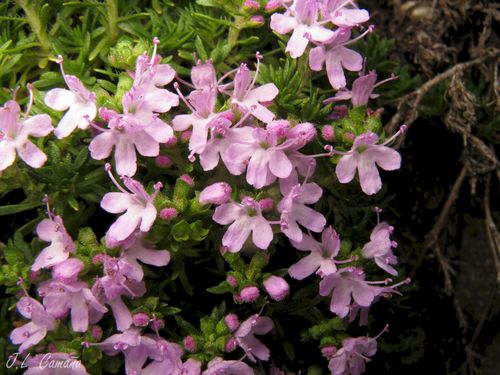
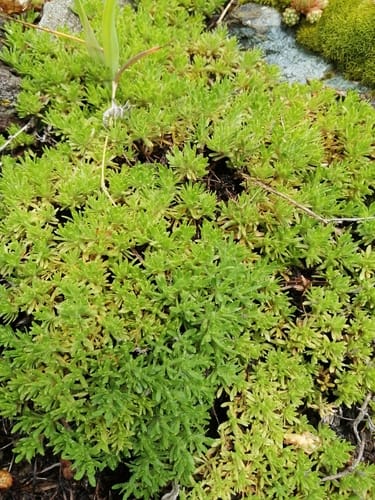
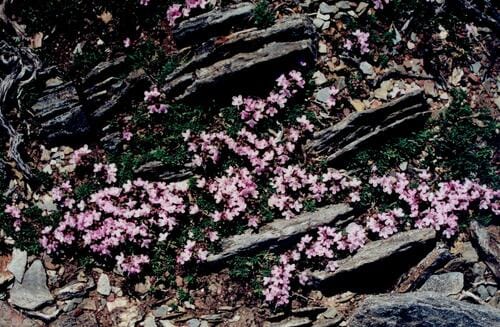
A herb. It grows 10-30 cm tall. The leaves are narrow and spoon shaped. They are 6 mm long. They have a fringe of tiny hairs. The flowers are red or white and in small flattened heads.
How to Grow
Prefers a light, well-drained calcareous soil and a sunny position. Plants tolerate occasional walking on and can be grown in cracks in paths, they also succeed on walls. Thymes dislike wet conditions, especially in the winter. A layer of gravel on the soil around them will help protect the foliage from wet soils. Plants are hardy to at least -15°c. There is at least one named variety. 'Celery' is a low compact grower that forms small mounds of growth. The leaves have a celery-like flavour. The flowers are rich in nectar and are very attractive to honey bees. This is a very difficult genus taxonomically, the species hybridize freely with each other and often intergrade into each other.
Propagation: Sow seed in spring in a cold frame, or in autumn in a greenhouse. Surface sow or barely cover the seed, as germination can be erratic. Prick seedlings into individual pots when large enough to handle and grow on under glass for at least their first winter, then plant out in late spring or early summer after the last expected frosts. Divide plants in spring or autumn; larger divisions can go directly into permanent positions, while smaller ones are best potted up and grown on in light shade until well established, then planted out in summer or the following spring. Take cuttings of young shoots 5–8cm with a heel in May/June in a frame, or half-ripe cuttings 5–8cm with a heel in July/August in a frame. Layering is also possible.
Medicinal Uses
The leaves, and particularly their essential oil, are strongly antiseptic, deodorant, and disinfectant. The plant can be used fresh year-round, or harvested as it comes into flower for distillation of the oil or drying for later use.
Other Uses
The essential oil obtained from the leaves is used in perfumery, as a mouthwash, and medicinally.
Wikipedia
Source ↗Thymus caespititius is a dwarf, aromatic mat-forming groundcover shrub. It is native to oceanic areas in the Iberian Peninsula (northwest Portugal and northwest Spain) and the Atlantic archipelagos of the Azores and Madeira. The plant has narrow, spatula-shaped, smooth leaves to 6 mm (0.24 in) long, fringed with tiny hairs. The rose, lilac or white flowers are borne in small, flattened mat-hugging heads from late spring to summer.
References (5)
- Encyclopedia of Life.
- Facciola, S., 1998, Cornucopia 2: a Source Book of Edible Plants. Kampong Publications, p 137
- Plants For a Future.
- Fl. lusit. 1:176. 1804
- World Checklist of Useful Plant Species 2020. Royal Botanic Gardens, Kew