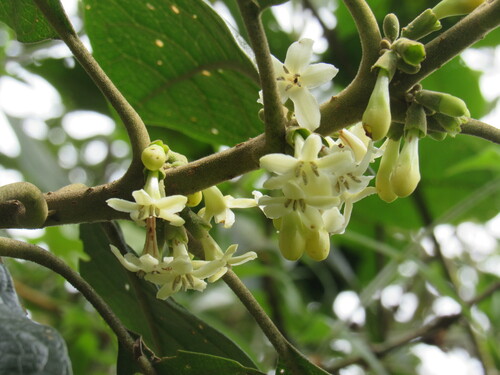
Thymus mastichina
L.
Mastic thyme, Spanish marjoram

(c) Ingeborg van Leeuwen, some rights reserved (CC BY-NC-ND)

(c) Axel Gosseries, some rights reserved (CC BY-NC), uploaded by Axel Gosseries
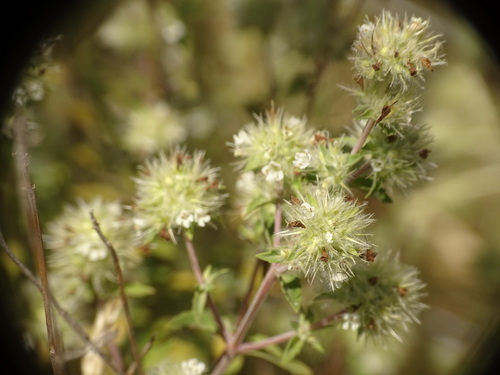
(c) Antonio Rico García, some rights reserved (CC BY-NC), uploaded by Antonio Rico García
What to Eat
Edible parts: Leaves - flavouring, Leaves - oil, Flowers
The leaves serve as a pungent, eucalyptus-scented seasoning. For drying, harvest plants in early and late summer just before the flowers open, then dry the leaves quickly. The plant also yields an essential oil known as 'oil of marjoram,' which is used extensively as a flavouring for soups and similar dishes.
Where to Find It
It is a Mediterranean climate plant.
Europe, Mediterranean, Portugal, Spain,
How to Identify
Evergreen shrub growing to 30cm tall and 60cm wide. Flowers July to August with hermaphroditic blooms pollinated by insects. Hardy to UK zone 7. Requires full sun and well-drained mildly acid to basic soil; tolerates drought. Cannot grow in shade.
How to Grow
Requires a light well-drained preferably calcareous soil in a sunny position. Succeeds in dry soils. Thymes dislike wet conditions, especially in the winter. A layer of gravel on the soil around them will help protect the foliage from wet soils. Plants are hardy to about -10°c, but are best given some protection in the winter - a pane of glass supported over the plant is usually sufficient. The flowers are rich in nectar and are very attractive to honey bees. The bruised leaves are powerfully aromatic. This is a very difficult genus taxonomically, the species hybridize freely with each other and often intergrade into each other.
Propagation: Sow seed in spring in a cold frame, or in autumn in a greenhouse. Surface sow or barely cover the seed, as germination can be erratic. Once seedlings are large enough to handle, prick them out into individual pots and grow on in the greenhouse for at least their first winter. Plant out into permanent positions in late spring or early summer, after the last expected frosts. Divide plants in spring or autumn — larger divisions can go straight into permanent positions, while smaller ones are best potted up and grown on in light shade in a greenhouse or cold frame until established, then planted out in summer or the following spring. Take cuttings of young shoots, 5–8cm with a heel, in May/June in a frame, or half-ripe wood cuttings, 5–8cm with a heel, in July/August in a frame. Layering is also possible.
Medicinal Uses
The leaves, and especially their essential oil, are strongly antiseptic, deodorant, and disinfectant. The plant can be used fresh at any time of year, or harvested as it comes into flower and either distilled for the oil or dried for later use.
Other Uses
The essential oil extracted from the leaves is used in perfumery, as a mouthwash, and medicinally.
Wikipedia
Source ↗Thymus mastichina is a species in the family Lamiaceae. It is endemic to the central Iberian Peninsula in Spain and Portugal. The perennial herb, with white flowers, can reach a height of 50 centimetres (1+1⁄2 ft). Uses: Oil from the flower is used in some pain relieving lotion. Such as Aleve X.
Other Information
It is cultivated.
References (10)
- Aceituno-Mata, L., et al, 2021, The Persistence of Flavor: Past and Present Use of Wild Food Plants in Sierra Norte de Madrid, Spain. Front. Sustain. Food Syst., 11 January 2021
- Blanco-Salas, J., et al, 2019, Wild Plants Potentially Used in Human Food in the Protected Area “Sierra Grande de Hornachos” of Extremadura (Spain). Sustainability 2019, 11, 456
- Facciola, S., 1998, Cornucopia 2: a Source Book of Edible Plants. Kampong Publications, p 137
- Gonzalez, J. A., et al, 2011, The consumption of wild and semi-domesticated edible plants in the Arribes del Duero (Salamanca-Zamora, Spain): an ananalysis of traditional knowledge. Genetic Resources and Crop Evolution 58:991-1006
- INFOODSUpdatedFGU-list.xls
- Pardo-de-Santayana, M., et al, 2007, Traditional knowledge of wild edible plants used in the northwest of the Iberian Peninsula (Spain and Portugal): a comparative study. Journal of Ethnobiology and Ethnomedicine 2007, 3:27
- Sp. pl. ed. 2, 2:827. 1763
- Tardio, J., et al, Ethnobotanical review of wild edible plants in Spain. Botanical J. Linnean Soc. 152 (2006), 27-71
- Wiersema, J. H. & Leon, B., 2013, World Economic Plants. A Standard Reference CRC Press. 2nd Ed. p 686
- World Checklist of Useful Plant Species 2020. Royal Botanic Gardens, Kew