Sesamum capense
Burm. f.
Wild foxglove

(c) Sylvain Piry, some rights reserved (CC BY-NC), uploaded by Sylvain Piry
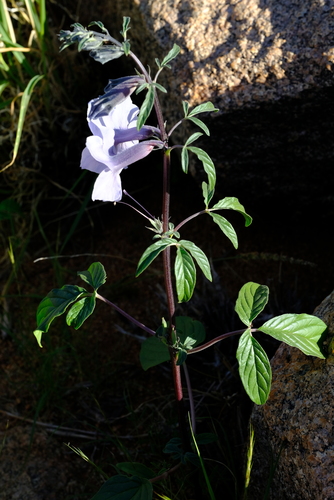
(c) Nick Helme, some rights reserved (CC BY-NC), uploaded by Nick Helme

(c) Eric Hunt, some rights reserved (CC BY-SA)
What to Eat
Edible parts: Seeds, Seeds - oil
The seeds are eaten with boiled maize and also yield an edible oil.
Where to Find It
It is a subtropical plant. It grows in well-drained sandy or stony soil. It is often over limestone material. It grows between 500-1,500 m above sea level. It is rare in Swaziland. It can grow in arid places.
Africa, Botswana, East Africa, Eswatini, Lesotho, Mozambique, Namibia, South Africa, Southern Africa, Swaziland,
How to Identify
A shrub. It is an annual plant with a taproot. It grows 2 m tall. The stems have 4 angles. The lowest leaves have 5-7 lobes. The higher leaves have 3 lobes. The flowers are large and have a tube 2-4 cm long. They occur singly in the axils of leaves. The flowers are purple. The seeds are small and light brown and have wings.
How to Grow
A plant of the drier areas of the subtropics, just entering the tropics in southern Africa. It is found at elevations from 500 - 1,500 metres.
Other Information
It is a cultivated food plant.
Names & Synonyms
Aprilbaadjie, Chinhonhoane, Lenonya, Molokelela
References (9)
- Facciola, S., 1998, Cornucopia 2: a Source Book of Edible Plants. Kampong Publications, p 168
- Fox, F. W. & Young, M. E. N., 1982, Food from the Veld. Delta Books. p 289
- Long, C., 2005, Swaziland's Flora - siSwati names and Uses http://www.sntc.org.sz/flora/
- Prodr. fl. cap. 17. 1768
- Royal Botanic Gardens, Kew (1999). Survey of Economic Plants for Arid and Semi-Arid Lands (SEPASAL) database. Published on the Internet; http://www.rbgkew.org.uk/ceb/sepasal/internet [Accessed 5th May 2011]
- Ruiters-Welcome, A. K., 2019, Food plants of southern Africa. Ph.D. thesis. Univ. of Johannesburg p 85
- Swaziland's Flora Database http://www.sntc.org.sz/flora
- Welcome, A. K. & Van Wyk, B.-E., 2019, An inventory and analysis of the food plants of southern Africa. South African Journal of Botany 122 (2019) 136–179
- World Checklist of Useful Plant Species 2020. Royal Botanic Gardens, Kew


