Boletus edulis
Bulliard ex Fries
Sponge Fungus, Cep, King bolete

(c) wp-polzin, some rights reserved (CC BY-NC)
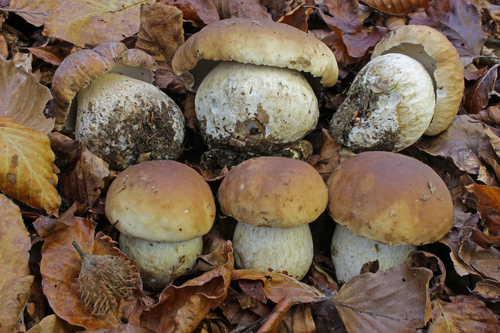
(c) Davide Puddu, some rights reserved (CC BY), uploaded by Davide Puddu

(c) hankabroz, some rights reserved (CC BY-NC)
What to Eat
Edible parts: Fungus, Mushroom, Spice, Vegetable
Boletus edulis, as the species epithet edulis (Latin: edible) indicates, is an edible mushroom. Italian chef and restaurateur Antonio Carluccio described it as representing "the wild mushroom par excellence", and hailed it as the most rewarding of all fungi in the kitchen for its taste and versatility. Considered a choice edible, particularly in France, Germany, Poland and Italy, it was widely written about by the Roman writers Pliny the Elder and Martial, although ranked below the esteemed Amanita caesarea. When he was served suilli instead of boleti, the disgruntled Martial wrote: sunt tibi boleti; fungos ego sumo suillos (Ep. iii. 60)("You eat the choice boletus, I have mushrooms that swine grub up.") The flavour of porcini has been described as nutty and slightly meaty, with a smooth, creamy texture, and a distinctive aroma reminiscent of sourdough. Young, small porcini are most appreciated, as the large ones often harbour maggots (insect larvae), and become slimy, soft and less tasty with age. The fruit bodies are collected by holding the stipe near the base and twisting gently. Cutting the stipe with a knife may risk the part left behind rotting and the mycelium being destroyed. Peeling and washing are not recommended. The fruit bodies are highly perishable, due largely to the high water content (around 90%), the high level of enzyme activity, and the presence of a flora of microorganisms. Caution should be exercised when collecting specimens from potentially polluted or contaminated sites, as several studies have shown that the fruit bodies can bioaccumulate toxic heavy metals like mercury, cadmium, caesium and polonium. Bioaccumulated metals or radioactive fission decay products are like chemical signatures: chemical and radiochemical analysis can be used to identify the origin of imported specimens, and for long-term radioecological monitoring of polluted areas. Porcini are sold fresh in markets in summer and autumn in Europe and Russia, and dried or canned at other times of the year, and distributed worldwide to countries where they are not otherwise found. They are eaten and enjoyed raw, sautéed with butter, ground into pasta, in soups, and in many other dishes. In France, they are used in recipes such as cèpes à la Bordelaise, cèpe frits and cèpe aux tomates. Porcini risotto is a traditional Italian autumn dish. Porcini are a feature of many cuisines, including Provençal, and Viennese. In Thailand they are used in soups and consumed blanched in salads. Porcini can also be frozen, either while raw or after cooking in butter. The colour, aroma, and taste of porcini deteriorate noticeably after being frozen for four months. Blanching (or soaking and blanching) as a processing step before freezing can extend the freezer life to 12 months. They are also one of the few species sold commercially as pickled mushrooms.
Where to Find It
It is found under shrubs and trees after heavy rain. It is eaten by the Dani in Papua Indonesia. In Nepal it grows in moist shady places in mixed forest. In Yunnan.
Africa, Alaska, Andorra, Asia, Australia, Austria, Balkans, Belarus, Belgium Britain, Bulgaria, Canada, Caucasus, Central America, China, Croatia, East Africa, Ethiopia, Europe, Finland, France, Georgia, Germany, Guatemala, Himalayas, India, Indochina, Indonesia, Italy, Kosovo, Latvia, Mediterranean, Mexico, Morocco, Mozambique, Nepal, Netherlands, New Zealand, North Africa, North America, Peru, Poland, Portugal, Romania, Russia, Scandinavia, SE Asia, Serbia, Slovenia, South Africa, Southern Africa, South America, Spain, Sweden, Switzerland, Thailand, Turkey, Türkiye, Ukraine, USA, Zimbabwe,
How to Identify
A mushroom. It is a common mushroom up to 15-20 cm high. The cap is umbrella shaped. It has tubes instead of gills. It has a large stalk base up to 5 cm across. It is dark brown.
Wikipedia
Source ↗Boletus edulis (English: cep, penny bun, porcino) is a basidiomycete fungus, and the type species of the genus Boletus. It is prized as an edible mushroom. The fungus produces spore-bearing fruit bodies above ground in summer and autumn. The fruit body has a large brown cap which can reach 30 cm (12 in) in diameter and 3 kg (6 lb 10 oz) in weight. Like other boletes, it has tubes extending downward from the underside of the cap, rather than gills; spores escape at maturity through the tube openings (pores). The pore surface of the fruit body is whitish when young, aging to a greenish-yellow. The stout stipe (or stem) is white or yellowish, up to 25 cm (10 in) tall and 7 cm (3 in) thick, and partially covered with a raised network pattern (reticulations). The fungus grows in deciduous and coniferous forests and tree plantations, forming symbiotic ectomycorrhizal associations with living trees by enveloping the tree's underground roots with sheaths of fungal tissue. Widely distributed in the Northern Hemisphere across Eurasia and North America, it does not occur naturally in the Southern Hemisphere but has been introduced to it. Several closely related European mushrooms formerly thought to be varieties or forms of B. edulis have been shown using molecular phylogenetic analysis to be distinct species, while others previously classified as separate species are conspecific with B. edulis. The western North American species commonly known as the California king bolete (B. edulis var. grandedulis) is a large, darker-coloured variant first formally identified in 2007. B. edulis is held in high regard in many cuisines and is commonly prepared and eaten in soups, pasta, or risotto. The mushroom is low in fat and digestible carbohydrates, while being high in protein, vitamins, minerals and dietary fibre. Although it is sold commercially, it is very difficult to cultivate. Available fresh in autumn throughout Europe and Russia, it is most often dried, packaged, and distributed worldwide. It keeps its flavour after drying and is then reconstituted and used in cooking. B. edulis is also one of the few fungi sold pickled.
Production
The mushroom can weigh 2.5 kg and be 30 cm across.
Other Information
It is popular. It is sold in local markets.
Names & Synonyms
Bavoselli, Bavuseddhi, Bavuso, Cep de Bordeaux, Cepe, Chipo de toro y chipo, Chumugulu, Datik'a sok'o, Datvis soko, Edible boletus, Eekhoorntjesbrood, Enguday, Hed tab tao, Karl johan, King bolete, Maiwei niuganjun, Mazayel, Mei wei niu gan jun, Pananacatl, Pansa, Penny bun, Pho shyamo, Porcini, Porcino bianco, Porcino, Sangiovannino, Shophaa, Steinpilz, Stensopp, Vrganj
References (64)
- Bianchini, F., Corbetta, F., and Pistoia, M., 1975, Fruits of the Earth. Cassell. p 124
- Boa, E. R., Wild edible fungi and their importance to people. FAO Non Wood Forest Products Booklet 17
- Brouk, B., 1975, Plants Consumed by Man. Academic Press, London. p 57
- Bussman, R. W., et al, 2016, A comparative ethnobotany of Khevsureti, Samtskhe-Javakheti, Tusheti, Svaneti, and Racha-Lechkhumi, Republic of Georgia (Sakartvelo), Caucasus. Journal of Ethnobiology and Ethnomedicine (2016) 12:4
- Bussman, R. W., et al, 2021, Unity in diversity—food plants and fungi of Sakartvelo (Republic of Georgia), Caucasus. Journal of Ethnobiology and Ethnomedicine (2021) 17:72 p 16
- Cerne, M., 1992, Wild Plants from Slovenia used as Vegetables. Acta Horticulturae 318
- Christanell, A., et al, 2010, The Cultural Significance of Wild Gathered Plant Species in Kartitsch (Eastern Tyrol, Austria) and the Influence of Socioeconomic Changes on Local Gathering Practices. Chapter 3 in Ethnobotany in the New Europe. Berghahn Books.
- Christensen, M., et al, 2008, Collection and Use of Wild Edible Fungi in Nepal. Economic Botany, 62(1), 2008, pp. 12–23
- Cocchi, L. et al, 2006, Heavy metals in edible mushrooms in Italy. Food Chemistry 98: 277-284
- Cortes, L.E.U., et al, 2018, Ethnomycology and mushroom selling in a market from Northwest Puebla, México. Scientia Fungorum vol. 47: 47-55
- Dembitsky, V. M., et al, 2010, Amino and Fatty Acids of Wild Edible Mushrooms of the genus Boletus, Rec. Nat. Prod. 4:4 (2010) 218-223
- Demise, S. & Asfaw, Z., 2020, Ethno Botanical Study of Wild Edible Plants in Adola District, Southern, Ethiopia. International Journal of Research and Analytical Reviews (IJRAR) 7(2).
- Denchev, C. M., et al, The wild edible mushrooms in Bulgaria. Bulgarian Academy of Science.
- Dolina, K. & Luczaj, L., 2014, Wild food plants used on the Dubrovnik coast (south-eastern Croatia) Acta Soc Bot Pol 83(3):175–181
- Dongol, et al, 1995, Edible Mushrooms in Nepal
- Estrada-Martinez, E., et al, 2009, Contribucion al conocimiento etnomicologico de los Hongos Comestibles Silvestres de Mercados Regionales y Comunidades de la Sierra Nevada (Mexico). Intercienca Jan 2009 Vol. 34 No. 1
- Facciola, S., 1998, Cornucopia 2: a Source Book of Edible Plants. Kampong Publications, p 250
- Fox, F. W. & Young, M. E. N., 1982, Food from the Veld. Delta Books. p 233
- Geng, Y., et al, 2016, Traditional knowledge and its transmission of wild edibles used by the Naxi in Baidi Village, northwest Yunnan province. Journal of Ethnobiology and Ethnomedicine. 12:10
- Guild, B., 1979, The Alaskan Mushroom Hunter's Guide. Alaska Northwest Publishing Company. p 172
- Guedes de Piniho, P., et al, 2008, Correlation between the Pattern Volatiles and the Overall Aroma of Wild Edible Mushrooms. Journal of Agricultural and Food Chemistry. 56: 1704-1712
- Gryzenhout, M., 2010, Mushrooms of South Africa. Pocket Guide. Struik. p 71
- Hall, I. R., et al, 2003, Edible and Poisonous Mushrooms of the World. Timber Press. p 222
- http://www.mykoweb.com/CAF/edible.html
- Hu, Shiu-ying, 2005, Food Plants of China. The Chinese University Press. p 267
- Jacquat, C., 1990, Plants from the Markets of Thailand. D.K. Book House p 30
- Jordan, P., 2000, The Mushroom Guide and Identifier, Hermes House, p 42
- Joshi, K. and Joshi, A. R., 2008, Ethnobotanical Studies on Some Lower Plants of the Central Development Region, Nepal. Ethnobotanical Leaflets 12:832-40
- Kalac, P. and Svoboda, L., 1999, A review of trace element concentrations in edible mushrooms. Food Chemistry 69: 273-281
- Kasper-Pakosz, R., et al, 2016, Wild and native plants and mushrooms sold in the open-air markets of south- eastern Poland. Journal of Ethnobiology and Ethnomedicine 12:45
- Kaufmann, B. et al, 1999, The Great Encyclopedia of Mushrooms. Konemann. p 28
- Kiple, K.F. & Ornelas, K.C., (eds), 2000, The Cambridge World History of Food. CUP p 322, 1735, 1818
- Lentini, F. and Venza, F., 2007, Wild food plants of popular use in Sicily. J Ethnobiol Ethnomedicine. 3: 15
- Liu, D., et al, 2018, An ethnobotanical survey of edible fungi in Chuxiong City, Yunnan, China. Journal of Ethnobiology and Ethnomedicine (2018) 14:42
- Luczaj, L., et al, 2015, Wild food plants and fungi used by Ukrainians in the western part of the Maramureş region in Romania. Acta Soc Bot Pol 84(3):339–346
- Mabey, R., 1973, Food for Free. A Guide to the edible wild plants of Britain, Collins. p 49
- Mortimer, P. E. et al, 2012, Prized edible Asian mushrooms: ecology, conservation and sustainability. Fungal Diversity 56(1) p 31-47
- Mulherin, J., 1994, Spices and natural flavourings. Tiger Books, London. p 61
- Nebel, S., Pieroni, A. & Heinrich, M., 2006, Ta cho`rta: Wild edible greens used in the Graecanic area in Calabria, Southern Italy. Appetite 47 (2006) 333–342
- Ostry, M. E., et al, 2010, Field Guide to Common Macrofungi in Eastern Forests and Their Ecosystem Functions. USDA Forest Service General Technical Report NRS-79 p 50
- Pace, G., 1998, Mushrooms of the world. Firefly books. p 177
- Pelkonen, R., et al, 2008, Element Concentrations in Wild Edible Mushrooms in Finland. The Finnish Environment 25
- Perez-Moreno, J. et al, 2008, Wild Mushroom Markets in Central Mexico and a Case Study at Ozumba. Economic Botany, 62(3), 2008, pp. 425–436
- Perez-Moreno, J., et al, 2009, Social and Biotechnological Studies of Wild Edible Mushrooms in Mexico. Acta Botanica Yunnanica Suppl. XV1: 55-61
- Petersen, L. M., et al, 2012, Development of a Compendium of Local, Wild-Harvested Species Used in the Informal Economy Trade, Cape Town, South Africa. Ecology and Society 17(2):26
- Radomir, M., et al, 2018, Conservation and trade of wild edible mushrooms of Serbia – history, state of the art and perspectives. Nature Conservation 25: 31–53
- Rila Monastery Nature Park Management Plan 2004 - 2013 (Bulgaria) p 380
- Santiago, F, H., et al, Traditional knowledge and use of wild mushrooms by Mixtecs or Ñuu savi, the people of the rain, from Southeastern Mexico. Journal of Ethnobiology and Ethnomedicine (2016) 12:35
- Svanberg, I., & Lindh, H., 2019, Mushroom hunting and consumption in twenty-first century post-industrial Sweden. Journal of Ethnobiology and Ethnomedicine (2019) 15:42
- Szanto, Zs et al, 2007, Current Radioactivity Content of Wild Edible Mushrooms. Journal of Radioanalytical and Nuclear Chemistry, Vol. 273, No. 1: 167–170
- Walulo, E. B., 2008, Review: Research Ethnobotany in Indonesia and the Future Perspectives. Biodiversitas Vol. 9 Nomor 1. Halaman 59-63 http://www.unsjournals.com/D/D0901/D090114.pdf
- Pieroni, A., 1999, Gathered wild food plants in the Upper Valley of the Serchio River (Garfagnana), Central Italy. Economic Botany 53(3) pp 327-341
- Quininez-Martinez, M., et al, 2014, Knowledge and use of edible mushrooms in two municipalities of the Sierra Tarahumara, Chihuahua, Mexico. Journal of Ethniobiology and Ethnomedicine 10:6
- Schneider, E., 2001, Vegetables from Amaranth to Zucchini: The essential reference. HarperCollins. p 495
- Schunko, C., et al, 2010, Organic farmers use of wild food plants and fungi in a hilly area in Styria (Austria). Journal of Ethnobiology and Ethnomedicine 6:17
- Solomon, C., 2001, Encyclopedia of Asian Food. New Holland. p 238
- Stoyneva-Gartner, M.P. & Uzunov, B.A., 2015, An Ethnobiological Glance on Globalization Impact on the Traditional Use of Algae and Fungi as Food in Bulgaria. J Nutr Food Sci 2015, 5:5
- Stryamets, N., et al, 2015, From economic survival to recreation: contemporary uses of wild food and medicine in rural Sweden, Ukraine and NW Russia. Journal of Ethnobiology and Ethnomedicine 11:53
- Svanberg, I., & Lindh, H., 2019, Mushroom hunting and consumption in twenty-first century post-industrial Sweden. Journal of Ethnobiology and Ethnomedicine (2019) 15:42
- Tebkew, M. et al, 2014, Underutilized wild edible plants in the Chilga District, northwestern Ethiopia: focus on wild woody plants. Agriculture & Food Security 3:12
- Tebkew, M., et al, 2018, Uses of wild edible plants in Quara district, northwest Ethiopia: implication for forest management. Agriculture and Food Security (2018) 7:12
- Tredgold, M.H., 1986, Food Plants of Zimbabwe. Mambo Press. p 20
- Vorstenbosch, T., et al, 2017, Famine food of vegetal origin consumed in the Netherlands during World War II. Journal of Ethnobiology and Ethnomedicine (2017) 13:63
- www.plantnames.unimelb.edu.au


