Protea cynaroides
Linnaeus
Boer honey-pot, King protea

no rights reserved, uploaded by Klaus Wehrlin
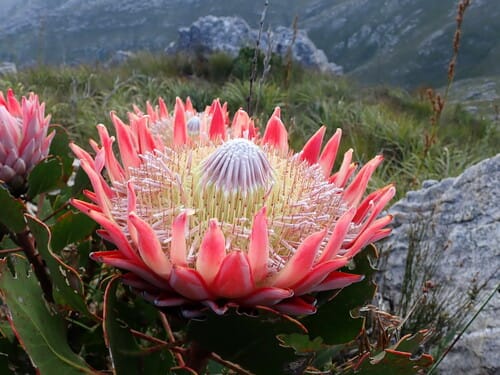
(c) Ren Hoekstra, some rights reserved (CC BY)
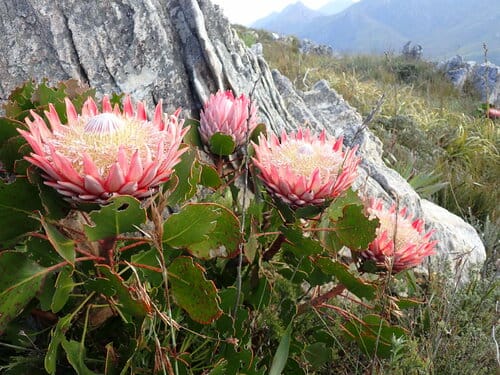
(c) Ren Hoekstra, some rights reserved (CC BY)
What to Eat
Edible parts: Nectar
The sweet nectar from the flowers can be consumed directly.
Where to Find It
It is a subtropical plant.
Africa, Hawaii, Pacific, Slovenia, South Africa, Southern Africa, USA,
How to Identify
A shrub. The leaves are oval or round with leaf stalks 4-18 cm long. The flower heads are 18-30 cm across. They are pink. The bracts are covered with fine hairs.
How to Grow
Requires a very well-drained light soil, preferably on the poor side, with plenty of humus and sand. Requires a pH of 6.5 or lower. Plants are very difficult to grow, they are sensitive to nitrates and phosphates in the soil, these can prove toxic even at moderate levels. Plants require reasonable potassium levels and may also suffer from magnesium deficiency. Requires a position with good air circulation, but sheltered from cold winds. Dislikes warm sultry or windless days. Requires full exposure to the sun. Plants are not very hardy in Britain, but they can be grown outdoors in selected areas. They tolerate slight short-lived frosts once they are established. Plants at Tresco on the Scilly Islands tolerated temperatures down to -9°c over a period of 10 days. Plants generally tolerate temperatures down to about -6°c, although prolonged frosts, or frosts combined with cold dry winds will cause damage. They are best grown in a cool greenhouse, but plants can be placed outdoors in the summer. A very ornamental plant. A good bee plant, providing an abundance of nectar. Plants are intolerant of root disturbance and should be grown in pots until they are planted into their final positions.
Propagation: Sow seed as soon as it is ripe in autumn, placing it in individual pots in a greenhouse. Pay attention to soil requirements. Once seedlings are large enough to handle, prick them out into individual pots and grow on in the greenhouse for at least their first winter. Plant out into permanent positions in late spring or early summer after the last expected frosts, and consider providing cold protection for at least their first winter outdoors. Cuttings of half-ripe wood can be taken in July/August in a frame.
Medicinal Uses
None known
Other Uses
None known
Wikipedia
Source ↗Protea cynaroides, also called the king protea (from Afrikaans: koningsprotea, Xhosa: isiQwane sobukumkani), is a flowering plant. It is a distinctive member of Protea, having the largest flower head in the genus. The species is also known as giant protea, honeypot, or king sugar bush. It is widely distributed in the fynbos region of South Africa, that is, in the southwestern and southern parts of Western Cape. The king protea is the national flower of South Africa. Protea cynaroides is adapted to survive wildfires by its thick underground stem, which contains many dormant buds; these will produce the new growth after the fire. The flower has a long vase life in flower arrangements, and makes for an excellent dried flower.
Names & Synonyms
Kraljevska proteja
References (4)
- Facciola, S., 1998, Cornucopia 2: a Source Book of Edible Plants. Kampong Publications, p 189
- http://www.botanic-gardens-ljubljana.com/en/plants
- Mant. pl. 2:190. 1771
- Staples, G.W. and Herbst, D.R., 2005, A tropical Garden Flora. Bishop Museum Press, Honolulu, Hawaii. p 471
More from Proteaceae


