Burchellia bubalina
(L. f.) Sims
South African pomegranate
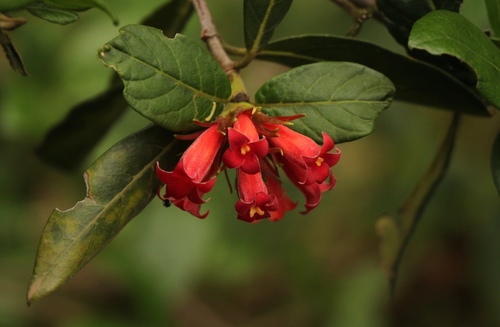
(c) Sandra Falanga, some rights reserved (CC BY-NC), uploaded by Sandra Falanga
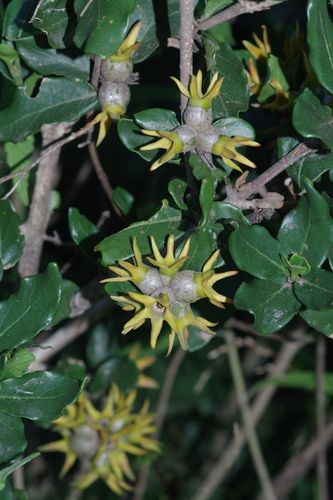
(c) Craig Peter, some rights reserved (CC BY-NC), uploaded by Craig Peter
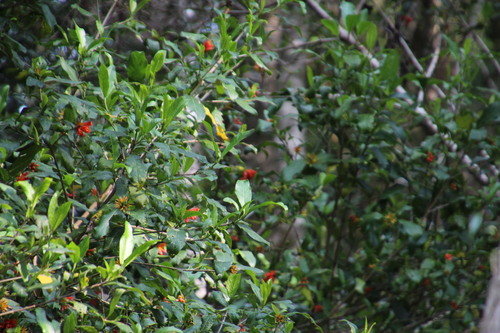
(c) Tony Rebelo, some rights reserved (CC BY-SA), uploaded by Tony Rebelo
What to Eat
Edible parts: Nectar, Flowers
The species is widely cultivated in frost-free gardens as an ornamental tree and has become a weed in some regions. The bark and root are used medicinally.
Where to Find It
It is a subtropical plant. It needs a well-drained soil and an open sunny position. It is damaged by drought and frost. In Swaziland it grows in the high veld only. Hobart Botanical Gardens.
Africa, Australia, East Africa, Eswatini, South Africa*, Southern Africa, Swaziland, Tasmania, Zimbabwe,
How to Identify
A shrub or small tree. It grows about 3 m high. It has a few hairs. The leaves are opposite and leathery. The leaf blade is oval and blunt. It narrows to the base. The base can sometimes be slightly heart shaped. The leaves are 15 cm long by 6 cm wide. The flowers are in a cluster at the ends of the branches. The flowers are tube shaped and orange-red. The fruit is fleshy with many seeds. The fruit are 1.5 cm across.
How to Grow
Plants can be grown by seeds.
Propagation: Seed - should be sown in a nursery seed bed straight after harvesting. They take about 4 - 6 weeks to germinate. Cuttings of half-ripe wood. They take about three to four weeks to root, and then can be transplanted to containers with potting soil for hardening off, before planting out in the garden.
Medicinal Uses
The roots are used as an emetic to cleanse the body. A combination of both bark and roots makes suitable splints for binding the fractured limbs of animals.
Other Uses
The wood is hard, dense and close-grained. The wood is usually of too small dimensions to be used commercially but is used locally to build hut and to make agricultural implements such as hoe handles and cattle yokes.
Notes
There is only one Burchellia species.
Names & Synonyms
Buffalo horn, Burchellia, Umfincafincane, Umfincane, Wild pomegranate
References (6)
- Bodkin, F., 1991, Encyclopedia Botanica. Cornstalk publishing, p 177
- Bot. Mag. 49: t. 2339. 1822
- Facciola, S., 1998, Cornucopia 2: a Source Book of Edible Plants. Kampong Publications, p 211
- Shava, S., 2000, The Use of Indigenous Plants as Food by a Rural Community in the Eastern Cape: an Educational Exploration. Masters Thesis Rhodes University. p 63
- Swaziland's Flora Database http://www.sntc.org.sz/flora
- von Breitenbach, F., 1985, Southern Cape Tree Guide. Department of Environment Affairs, Forestry Branch. Pamphlet 360 Pretoria p 30


