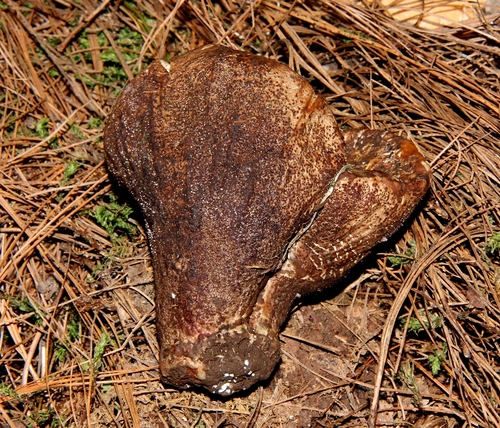
Hypomyces lactifluorum
(Schwein.) Tul. & C. Tul.
Lobster mushroom

iNaturalist · cc-by-nc
(c) tombigelow, some rights reserved (CC BY-NC), uploaded by tombigelow
(c) tombigelow, some rights reserved (CC BY-NC), uploaded by tombigelow
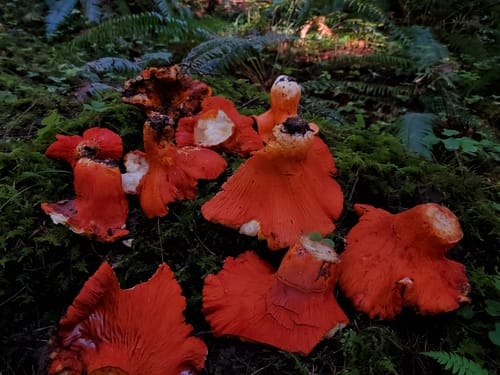
iNaturalist · cc-by-nc
(c) stellar_viscera, some rights reserved (CC BY-NC)
(c) stellar_viscera, some rights reserved (CC BY-NC)
What to Eat
Edible parts: Mushroom, Fungus
The fruiting bodies are eaten, including both the parasite and host mushroom. They can be sautéed or added to omelettes.
Known Hazards
Where to Find It
A temperate to tropical plant.
Canada, Central America, Guatemala, Mexico, North America, USA,
Countries: Antigua & Barbuda, Barbados, Bahamas, Belize, Canada, Costa Rica, Cuba, Dominica, Dominican Republic, Grenada, Guatemala, Honduras, Haiti, Jamaica, St Kitts & Nevis, St Lucia, Mexico, Nicaragua, Panama, Puerto Rico, El Salvador, Trinidad & Tobago, United States, St Vincent
How to Identify
A mushroom. A striking fluorescent-orange mould-like fungus. It grows on Russula and Lactarius. It develops a lumpy or pimpled layer over the surface.
Wikipedia
Source ↗Hypomyces lactifluorum, or the lobster mushroom, is a parasitic ascomycete fungus that grows on certain species of mushrooms, turning them a reddish orange color that resembles the outer shell of a cooked lobster. The fungus is edible.
Other Information
It is sold in local markets.
Names & Synonyms
Enchilado, Oreja, Xintazcal
References (13)
- Alonso-Aguilar, L. E., et al, 2014, The cultural significance of wild mushrooms in San Mateo Huexoyucan, Tlaxcala, Mexico. Journal of Ethnobiology and Ethnomedicine, 10:27
- Boa, E. R., 2004, Wild edible fungi and their importance to people. FAO Non Wood Forest Products Booklet 17
- Cortes, L.E.U., et al, 2018, Ethnomycology and mushroom selling in a market from Northwest Puebla, México. Scientia Fungorum vol. 47: 47-55
- Estrada-Martinez, E., et al, 2009, Contribucion al conocimiento etnomicologico de los Hongos Comestibles Silvestres de Mercados Regionales y Comunidades de la Sierra Nevada (Mexico). Intercienca Jan 2009 Vol. 34 No. 1
- Facciola, S., 1998, Cornucopia 2: a Source Book of Edible Plants. Kampong Publications, p 252
- Garibay-Orijel, R., et al, 2007, Understanding cultural significance, the edible mushrooms case. Journal of Ethnobiology and Ethnomedicine. 3:4
- Hall, I. R., et al, 2003, Edible and Poisonous Mushrooms of the World. Timber Press. p 178
- Perez-Moreno, J. et al, 2008, Wild Mushroom Markets in Central Mexico and a Case Study at Ozumba. Economic Botany, 62(3), 2008, pp. 425–436
- Perez-Moreno, J., et al, 2009, Social and Biotechnological Studies of Wild Edible Mushrooms in Mexico. Acta Botanica Yunnanica Suppl. XV1: 55-61
- Ponce, J. P. M., et al, 2019, Ethnomycological knowledge among Kaqchikel, indigenous Maya people of Guatemalan Highlands. Journal of Ethnobiology and Ethnomedicine (2019) 15:36
- Quinonez-Martinez, M., et al, 2014, Knowledge and use of edible mushrooms in two municipalities of the Sierra Tarahumara, Chihuahua, Mexico. Journal of Ethniobiology and Ethnomedicine 10:6
- Santiago, F, H., et al, 2016, Traditional knowledge and use of wild mushrooms by Mixtecs or Ñuu savi, the people of the rain, from Southeastern Mexico. Journal of Ethnobiology and Ethnomedicine 12:35 p 8
- Schneider, E., 2001, Vegetables from Amaranth to Zucchini: The essential reference. HarperCollins. p 361