Tuber indicum
C. & M.
Indian truffle
EutuberaceaeMushrooms

wikimedia · cc-by-sa
Wikimedia Commons - Ardo Beltz
Wikimedia Commons - Ardo Beltz

wikimedia · cc0
D. Lee (Duke University Herbarium Fungal Collection) (via Wikimedia Commons)
D. Lee (Duke University Herbarium Fungal Collection) (via Wikimedia Commons)

wikimedia · cc-by-sa
Sven Manguard (via Wikimedia Commons)
Sven Manguard (via Wikimedia Commons)
What to Eat
Edible parts: Truffle, Fungus
The truffle fungus is eaten.
Where to Find It
It is a tropical plant.
Asia, China, India, Japan,
Countries: United Arab Emirates, Afghanistan, Armenia, Azerbaijan, Bangladesh, Bahrain, Brunei, Bhutan, China, Georgia, Indonesia, Israel, India, Iraq, Iran, Jordan, Japan, Kyrgyzstan, Cambodia, North Korea, South Korea, Kuwait, Kazakhstan, Laos, Lebanon, Sri Lanka, Myanmar, Mongolia, Maldives, Malaysia, Nepal, Oman, Philippines, Pakistan, Qatar, Saudi Arabia, Singapore, Syria, Thailand, Tajikistan, Timor-Leste, Turkmenistan, Turkey, Taiwan, Uzbekistan, Vietnam, Yemen
How to Identify
A truffle fungus in the family Eutuberaceae, found in tropical regions.
Wikipedia
Source ↗Tuber indicum, commonly known as the Chinese black truffle or the Asian black truffle, is an edible fungus known for its hypogean fruiting bodies, characteristic of the Tuber genus. It is found natively in Himalayan India and parts of China, but has also been found invasively in the United States and Italy. It is sold commercially and often confused with Tuber melanosporum.
Names & Synonyms
Yindu kuaijun
References (5)
- Boa, E. R., 2004, Wild edible fungi and their importance to people. FAO Non Wood Forest Products Booklet 17
- Hall, I. R., et al, 2003, Edible and Poisonous Mushrooms of the World. Timber Press. p 263, 316
- Mortimer, P. E. et al, 2012, Prized edible Asian mushrooms: ecology, conservation and sustainability. Fungal Diversity 56(1) p 31-47
- Schneider, E., 2001, Vegetables from Amaranth to Zucchini: The essential reference. HarperCollins. p 675
- www.plantnames.unimelb.edu.au
More from Eutuberaceae
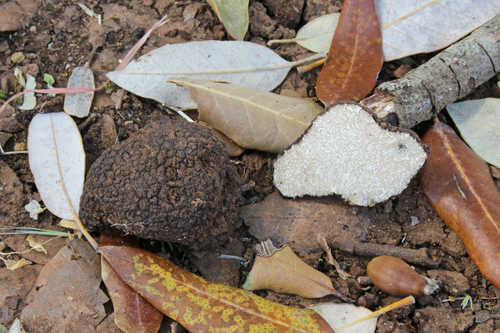
Tuber aestivum
Truffle, Summer truffle, Cook's truffle, Red-grained black truffle, Summer black truffle, Truffe de la Saint-Jean

Tuber aestivum var. uncinatum

Tuber borchii
March truffle, Tuscan white truffle

Tuber brumale var. moschatum
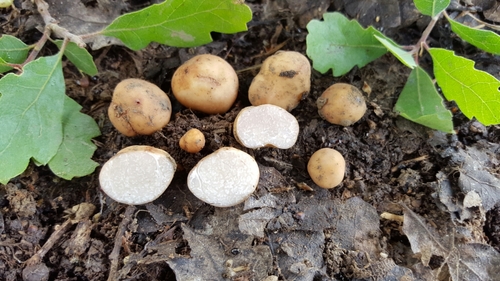
Tuber californicum
California truffle

Tuber excavatum
Hollowed truffle