Telopea truncata
(Labill.) R. Br.
Tasmanian waratah
(c) Reiner Richter, some rights reserved (CC BY-NC-SA), uploaded by Reiner Richter
(c) Reiner Richter, some rights reserved (CC BY-NC-SA), uploaded by Reiner Richter
(c) Reiner Richter, some rights reserved (CC BY-NC-SA), uploaded by Reiner Richter
What to Eat
Edible parts: Nectar
The flowers of T. truncata were once used extensively for decoration. Geoffrey Smith observed in 1909 that the collection of the flowers for this purpose had caused the decline of some populations on Mount Wellington. The timber of larger specimens has been used for inlays; it has an attractive grain and a pale red color.
Where to Find It
It is a temperate plant. It grows in lower mountain regions in Tasmania. It needs well-drained but well-watered soil. Arboretum Tasmania.
Australia*, Tasmania*,
How to Identify
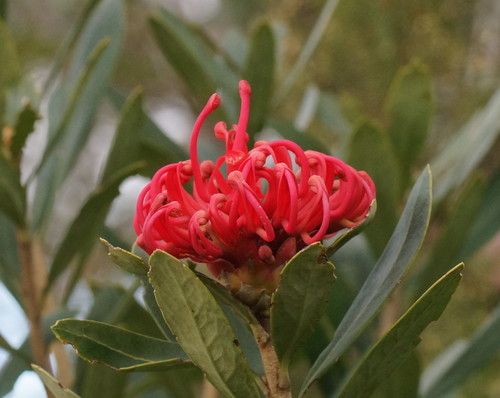
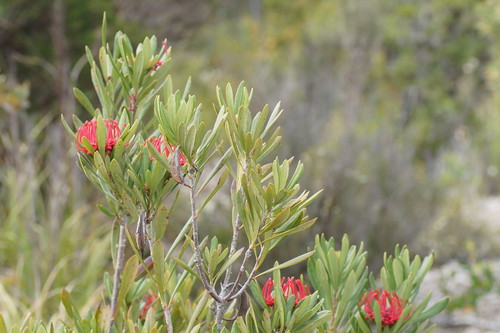
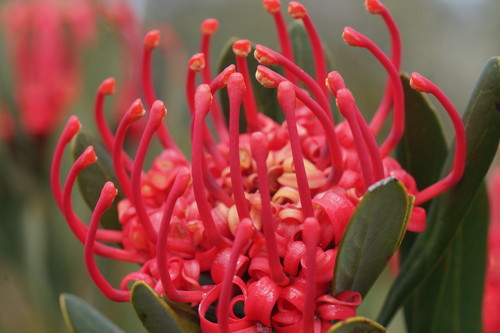
An upright shrub. It can grow 1-3 m tall. The leaves occur at right angles to the stem. The leaves are sword shaped and widest away from the stem. The leaves are 6-12 cm long. The leaves are dark green. The lower leaf surface is paler than the upper surface. The flowers are at the ends of the branches. The flowers are in a half round shape and large. They are usually red but can be yellow. The fruit is a dark brown pod-like follicle. The seeds are in rows and have wings.
Wikipedia
Source ↗Telopea truncata, commonly known as the Tasmanian waratah, is a plant in the family Proteaceae. It is endemic to Tasmania where it is found on moist acidic soils at altitudes of 600 to 1200 m (2000–4000 ft). Telopea truncata is a component of alpine eucalypt forest, rainforest and scrub communities. It grows as a multistemmed shrub to a height of 3 metres (10 ft), or occasionally as a small tree to 10 m (35 ft) high, with red flower heads, known as inflorescences, appearing over the Tasmanian summer (November to February) and bearing 10 to 35 individual flowers. Yellow-flowered forms are occasionally seen, but do not form a population distinct from the rest of the species. Collected by French botanist Jacques Labillardière in 1792–93, Telopea truncata was first scientifically described in 1805. Genetic analysis revealed that the Tasmanian waratah is the most distinctive of the five waratah species. It can be cultivated in temperate climates, requiring soils with good drainage and ample moisture in part-shaded or sunny positions. Several commercially available cultivars that are hybrids of T. truncata with the New South Wales waratah (T. speciosissima) and Gippsland waratah (T. oreades) have been developed.
References (5)
- Curtis, W.M., 1993, The Student's Flora of Tasmania. Part 3 St David's Park Publishing, Tasmania, p 612
- Lavelle, M., 2008, Wild Flowers of Australia and Oceania. Southwater. p 97
- Noetling, F., 1910, The Food of the Tasmanian Aborigines. Pap. & Proc. Roy Soc. Tasmania p 292
- Ryan, S., 2008, Dicksonia. Rare Plants Manual. Hyland House. p 56
- Trans. Linn. Soc. London 10:198. 1810
More from Proteaceae


