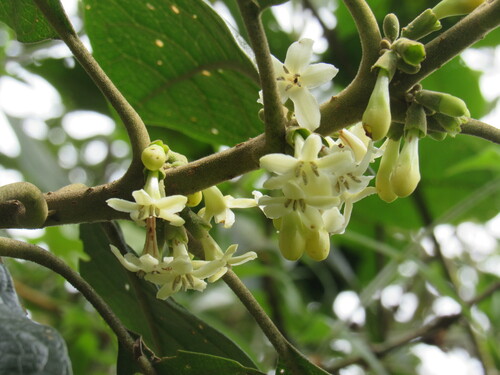
Vitex polygama
Cham.
Polygamous chastetree

(c) Nágyla Fachetti Coser, some rights reserved (CC BY-NC-SA)

(c) Marinaldo, some rights reserved (CC BY), uploaded by Marinaldo
What to Eat
Edible parts: Fruit
Fruit - raw. A fleshy pulp with a sweet flavour, but it is difficult to separate from the seed. The fruit is about 3cm long and 2cm wide.
Where to Find It
It is a tropical plant. It grows naturally in the savannas and semi-deciduous forests in Brazil.
Bolivia, Brazil, South America,
How to Identify
A tree. It can lose all its leaves during the year. Trees grow 6-12 m tall. The leaves are compound having leaflets like the fingers on a hand. There are 5 leaflets with short stalks. They have hairs on both surfaces. They are 10-18 cm long. The flowers are in the axils of leaves. They are pale blue. The fruit are round and hairy. They are black to violet.
How to Grow
Plants are grown from seeds.
Propagation: Seed - best sown as soon as it is ripe. Sow the seed in individual containers and place in light shade. Germination rates are normally low, with the seed sprouting within 30 - 50 days. Seedlings grow away quickly and are ready for planting out just 6 months after germinating.
Other Uses
The wood is moderately heavy, easy to split, moderately durable when not exposed to the moistness of the soil. It is used for internal finishing in buildings. We have no more information on the wood for this species. However, we have a general description for the wood of S. American species of this genus, which is as follows:- The heartwood is variable according to the species, ranging from yellowish-brown through deep brown, olive-green or olive-brown; it is usually not sharply demarcated from the whitish, yellow, or pale brown sapwood. The texture is rather fine to moderately coarse; the grain straight, sometimes irregular; lustre ranges from low to high; there is no distinctive odour or taste. A silica content of 0.76% is reported. Depending on the species, durability varies from moderately durable to very durable when exposed to a white-rot and brown-rot fungus. Actual field exposures show some species as durable and others as susceptible to attack by decay fungi and insects. Reports are also variable on seasoning, material from Panama had a moderate drying rate and no appreciable defects. The wood is easy to work with both hand and machine tools, though there is some tearing if grain is irregular; it takes a high polish. It is used for purposes such as furniture, millwork, veneer and plywood, general carpentry, mallet heads, chisel handles and flooring. A pioneer species within its native range, where it can be used in reforestation projects.
Other Information
The fruit are not very popular.
Notes
Also put in the family Verbenaceae.
Names & Synonyms
Azetona-do-campo, Jaruman, Mama-de-cachoiro, Mameira, Maria-preta, Taruma, Taruma-bori, Taruma-do-cerrado, Taruma-tuira, Velame-do-campo
References (3)
- Grandtner, M. M. & Chevrette, J., 2013, Dictionary of Trees, Volume 2: South America: Nomenclature, Taxonomy and Ecology. Academic Press p 695
- Lorenzi, H., Bacher, L., Lacerda, M. & Sartori, S., 2006, Brazilian Fruits & Cultivated Exotics. Sao Paulo, Instituto Plantarum de Estuados da Flora Ltda. p 153
- www.colecionandofrutas.org