Passiflora loefgrenii
Vitta
Maracuja-de-alho, Maracuja-de-cobra

(c) Andreina Schoeberlein, some rights reserved (CC BY-NC-ND)
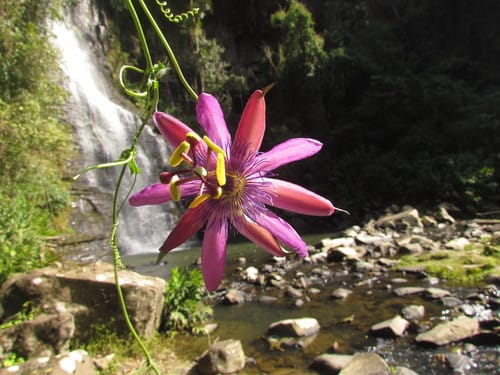
(c) Luís A. Funez, some rights reserved (CC BY-NC)
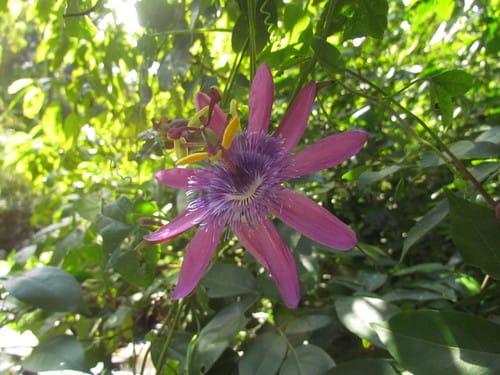
(c) Luís A. Funez, some rights reserved (CC BY-NC)
What to Eat
Edible parts: Fruit
Fruit - raw. The translucent pulp is sweet and juicy, but with a strong overtone of garlic in the flavour. The green fruits are about 8cm long and 5cm wide.
Where to Find It
It is a tropical plant. It grows naturally in the southern regions in Brazil.
Brazil*, South America,
How to Identify
A climbing herb. It has tendrils. The stem is cylinder shaped and has stripes along it. The leaves have 3 lobes and are thin. They are 5-9 cm long and the leaf stalk is 3-7 cm long. There are 6 paired glands on it. The flowers occur singly. They are 9-12 cm across. The flowers hang down on thin stalks 11-20 cm long. They fruit have juicy sweet pulp.
How to Grow
Plants are grown from seed.
Propagation: Seed - best sown as soon as it is ripe along with the pulp which will help break down the seed coat and speed up germination. Stored seed should be soaked for 24 hours in warm water and germination time can be reduced if the seed is then mixed with the juice of a fresh passion fruit (of any species). Even so, it can take 12 months for stored seed to germinate. Place the seed tray in a shady position, maintaining a temperature around 19 - 24°c. Prick the seedlings out into individual containers as soon as they are large enough to handle and plant out when large enough. Cuttings of young shoots, taken at the nodes. The cuttings root best in a neutral to slightly acid compost, but 100% sharp sand also produces good results. Cuttings of fully mature wood taken at a node. They can take 3 months. Layering. Very easy. Air layering.
Medicinal Uses
The leaves and roots of some, if not all, members of this genus contain a substance called 'passiflorina' which has similaritiesr to morphine and is an effective tranquilizer. We have no specific information for this species but many species are used in herbal infusions to calm the nerves and help bring about a restful sleep. The leaves of many species are also considered to be anthelmintic, antihysteric and diaphoretic. They are used in Brazil to combat intermittent fevers, cutaneous inflammations, and erysipelas.
Wikipedia
Source ↗Passiflora loefgrenii, the garlic passion fruit, is a passion flower first formally described in 1997 by Fabio Augusto Vitta. The plant is named after Albert Löfgren, the first known collector. Passiflora loefgrenii is a perennial, climbing vine. The stems are smooth, round and thin. In the leaf axils are kidney-shaped stipules of up to 3.5 cm long, which the tendrils flank. The sheet steal are up to 7 cm long. The alternately arranged leaves are tri-lobed with smooth edges and 5 to 9.5 x 5.5 to 14 cm. The solitary penduncles are 11–20 cm long. The flowers are purple, bluish violet and white in color and 9–12 cm wide. The sepals are purple, up to 5.5 x 1.5 cm and ending in a 1 cm long awn. The petals are purple and almost as big as the sepals. The corona consists of 6 or 7 rows, which are white at the base and above bluish purple. The outer two rows of 1.7–2 cm long, and the innermost rows are 1–1.2 cm long. The flowers are pollinated by hummingbirds, Phaethornis eurynome and Phaethornis squalidus, and carpenter bees (Xylocopa). The fruit are elliptical, greenish yellow and approximately 6 x 4 cm. Initially it was thought that the distribution of Passiflora loefgrenii limited to Ribeirão Preto in the state of São Paulo in Brazil, but later the plant was also discovered near Iporanga São Paulo and Corupá in the state of Santa Catarina. In Europe, the plant has been cultivated since 2000. The plant can be kept in a temperate greenhouses or in a living room. In summer the plant can be grown outside.
Other Information
The fruit are not popular.
References (1)
- Lorenzi, H., Bacher, L., Lacerda, M. & Sartori, S., 2006, Brazilian Fruits & Cultivated Exotics. Sao Paulo, Instituto Plantarum de Estuados da Flora Ltda. p 268


