Passiflora setacea
DC.
Sururuca, Maracuja-sururuca
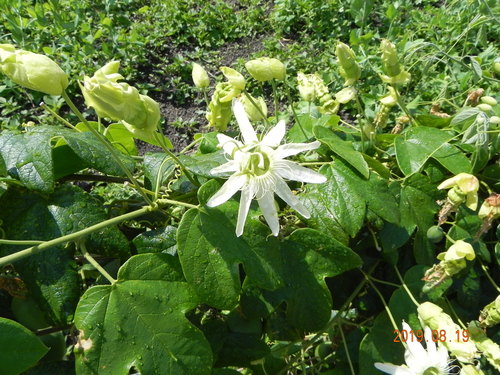
(c) Eric Fischer Rempe, some rights reserved (CC BY-NC), uploaded by Eric Fischer Rempe

no rights reserved

no rights reserved
What to Eat
Edible parts: Fruit
Passiflora incarnata (maypop) leaves and roots have a long history of use as a traditional medicine by Native Americans in North America and were adapted by European colonists. The fresh or dried leaves of maypop are used to make a tea that is used as a sedative. Passionflower as dried powder or an extract is used as a dietary supplement. There is insufficient clinical evidence for using passionflower to treat any medical condition. Passionflower is classified as generally recognized as safe for use as a food ingredient in the U.S.
Known Hazards
Where to Find It
It is a tropical plant. It grows naturally in forests on river banks in Brazil.
Brazil*, South America,
How to Identify
A climbing herb. It keeps growing from year to year. It has tendrils. The leaves have 3 leaflets and are 5-8 cm long. The leaf stalk is 3 cm long. These have 1 pair of glands. The flowers occur singly. They are about 10 cm across. They fruit are green and 5-6 cm wide by 6-7 cm long. The pulp is juicy and acid.
Nutrition Score: 30/100
| Part | Moisture | kJ | kcal | Protein | Vit A | Vit C | Iron | Zinc |
|---|---|---|---|---|---|---|---|---|
| Fruit | 80.2 | 311 | 75 | 2 | — | — | 0.5 | 0.2 |
How to Grow
Plants are grown from seed.
Propagation: Seed - best sown as soon as it is ripe along with the pulp which will help break down the seed coat and speed up germination. Stored seed should be soaked for 24 hours in warm water and germination time can be reduced if the seed is then mixed with the juice of a fresh passion fruit (of any species). Even so, it can take 12 months for stored seed to germinate. Place the seed tray in a shady position, maintaining a temperature around 19 - 24°c. Prick the seedlings out into individual containers as soon as they are large enough to handle and plant out when large enough. Cuttings of young shoots, taken at the nodes. The cuttings root best in a neutral to slightly acid compost, but 100% sharp sand also produces good results. Cuttings of fully mature wood taken at a node. They can take 3 months. Layering. Very easy. Air layering.
Medicinal Uses
The leaves and roots of some, if not all, members of this genus contain a substance called 'passiflorina' which has similaritiesr to morphine and is an effective tranquilizer. We have no specific information for this species but many species are used in herbal infusions to calm the nerves and help bring about a restful sleep. The leaves of many species are also considered to be anthelmintic, antihysteric and diaphoretic. They are used in Brazil to combat intermittent fevers, cutaneous inflammations, and erysipelas.
Other Information
The fruit are popular.
Names & Synonyms
References (3)
- Brazil: Biodiversity for Food and Nutrition. http://www.b4fn.org/countries/brazil/
- Hunter, D., et al, 2019, The potential of neglected and underutilized species for improving diets and nutrition. Planta (2019) 250:709-729
- Lorenzi, H., Bacher, L., Lacerda, M. & Sartori, S., 2006, Brazilian Fruits & Cultivated Exotics. Sao Paulo, Instituto Plantarum de Estuados da Flora Ltda. p 274


