Cordiera sessilis
(Vell.) Kuntze
Sessile cordiera

(c) Onildo João Marini Filho, some rights reserved (CC BY-NC), uploaded by Onildo João Marini Filho

(c) Onildo João Marini Filho, some rights reserved (CC BY-NC), uploaded by Onildo João Marini Filho
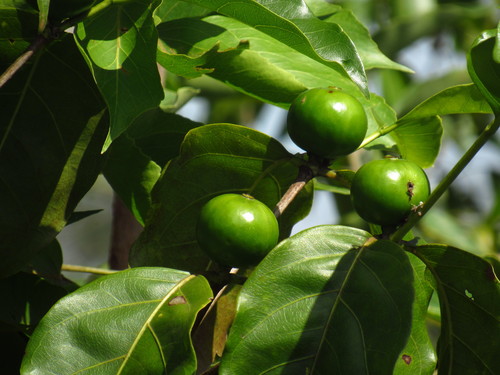
(c) Ricardo Dislich, some rights reserved (CC BY-NC), uploaded by Ricardo Dislich
What to Eat
Edible parts: Fruit
Fruit - raw. The thin-skinned fruit has a fleshy pulp containing many small seeds, and a sweet flavour. The black, globose fruits are around 3cm in diameter.
Where to Find It
A tropical plant. It grows throughout most of Brazil. It grows near streams and in soil that is clayey and fertile in Brazil.
Bolivia, Brazil*, Paraguay, South America,
How to Identify
A bush or large shrub. It loses many of its leaves during the year. It grows 2-4 m tall. The crown is dense and round. The trunk is short and has branches from the base. It is 15-20 cm across. The bark is wrinkled. The leaves are simple and opposite. The leaves are papery and smooth on both surfaces and shiny on the top surface. The leaves are 14-22 cm long and 4-7 cm wide. The leaf stalks are 6-12 mm long and have a groove along them. There are 6-7 pairs of side veins. Plants are separately male and female. The flowers are white and the female flowers occur singly while the male flowers are in groups of 8-15 in the axils of leaves. The fruit are round berries 3-5 cm across. The pulp is fleshy and sweet. The skin is thin. There are many small seeds.
How to Grow
The plants are grown from seed.
Propagation: Seed - best sown as soon as it is ripe in a sunny position in a nursery seedbed. A germination rate in excess of 50% can be expected, with the seed sprouting within 28 - 42 days.
Other Uses
The wood is fine-textured, straight-grained, heavy, soft, with poor mechanical properties and of low natural durability. It is too small to be of much use other than for fuel and making charcoal.
Names & Synonyms
Asuka revira, Bola, Marmelada-de-cachorro, Marmelada-preta, Nigua, Puruna
References (8)
- Bortolotto, I. M., et al, 2018, Lista preliminar das plantas alimenticias nativas de Mato Grosso do Sul, Brasil. Iheringia, Serie Botanica, Porto Alegre, 73 (supl.):101-116
- Grandtner, M. M. & Chevrette, J., 2013, Dictionary of Trees, Volume 2: South America: Nomenclature, Taxonomy and Ecology. Academic Press p 164
- Kermath, B. M., et al, 2014, Food Plants in the Americas: A survey of the domesticated, cultivated and wild plants used for Human food in North, Central and South America and the Caribbean. On line draft. p 264
- Lorenzi, H., 2002, Brazilian Trees. A Guide to the Identification and Cultivation of Brazilian Native Trees. Vol. 02 Nova Odessa, SP, Instituto Plantarum p 300 (As Alibertia sessilis)
- Lorenzi, H., Bacher, L., Lacerda, M. & Sartori, S., 2006, Brazilian Fruits & Cultivated Exotics. Sao Paulo, Instituto Plantarum de Estuados da Flora Ltda. p 286
- Peres, M. K., 2011, Diasporos do Cerrado Atrativos para Fauna: Chave Interativa Caracterizacao Visual e Relacoes Ecologicas. Masters thesis. Universidade de Brasilia.
- Reis, S. V. and Lipp, F. L., 1982, New Plant Sources for Drugs and Foods from the New York Botanical Garden herbarium. Harvard. p 283 (As Alibertia sessilis)
- www.colecionandofrutas.org


