Spathularia flavida
Pers.
Yellow earth tongue

(c) Andrew, some rights reserved (CC BY-NC), uploaded by Andrew
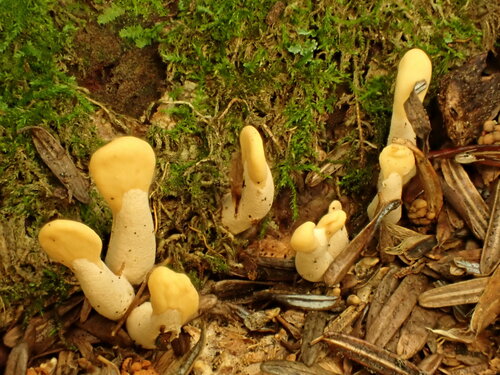
(c) L Joan Heyding, some rights reserved (CC BY-NC), uploaded by L Joan Heyding

(c) Svetlana Nesterova, some rights reserved (CC BY-NC), uploaded by Svetlana Nesterova
What to Eat
Edible parts: Mushroom, Fungus
The mushroom fungus is eaten.
Where to Find It
It is a temperate plant.
Alaska, North America, USA,
How to Identify
A temperate mushroom in the family Geoglossaceae, also known as the yellow earth tongue.
Wikipedia
Source ↗Spathularia flavida, commonly known as the yellow earth tongue, the yellow fan, or the fairy fan, is an ascomycete fungus. It produces a small, fan- or spoon-shaped fruit body with a flat, wavy or lobed cream to yellow colored "head" raised on a white to cream stalk. It is usually 2–5 cm (3⁄4–2 in) tall. The spores produced by the fungus are needle-like, and up to 95 μm long. Several varieties have been described that differ largely in their microscopic characteristics. The fungus fruits on the ground in mosses, forest duff or humus, and fruit bodies may occur singly, in large groups, or in fairy rings. It is found in coniferous forests of Asia, Europe and North America. It has been described by authorities variously as inedible, of unknown edibility, or edible but tough.
Names & Synonyms
References (1)
- Guild, B., 1979, The Alaskan Mushroom Hunter's Guide. Alaska Northwest Publishing Company. p 240