Bellucia mespiloides
(Miq.) J. F. Macbr.
Medlar like loreya

(c) Guillaume Léotard, some rights reserved (CC BY-NC), uploaded by Guillaume Léotard
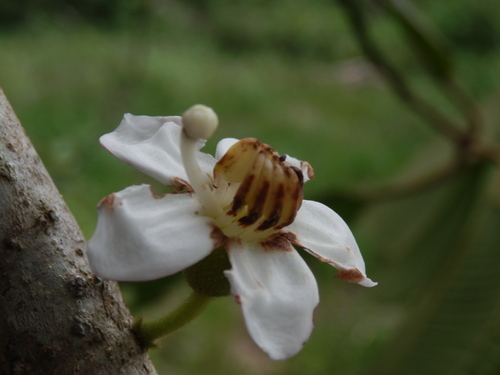
(c) Maël Lemaitre, some rights reserved (CC BY-NC), uploaded by Maël Lemaitre
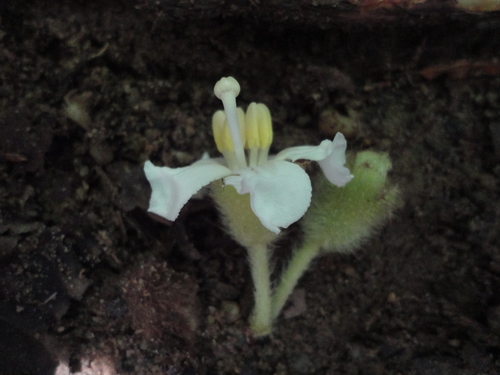
(c) humbertomendozacifuentes, some rights reserved (CC BY-NC), uploaded by humbertomendozacifuentes
What to Eat
Edible parts: Fruit
The fruit pulp is eaten raw, especially by children.
Where to Find It
It is a tropical plant. It grows in rainforests and secondary forests. In Venezuela it grows between 1,100-1,700 m above sea level.
Brazil, Central America, Colombia, Costa Rica, Ecuador, French Guiana, Guianas, Guyana, Nicaragua, Panama, Peru, South America, Suriname, Venezuela,
How to Identify
A shrub or tree. It grows 10 m tall. The flowers are in clusters on old wood in the axils of fallen leaves. They are also on the trunk. The fruit is an urn shaped berry. It is up to 2 cm long by 1.8 cm wide. It is pale green to yellow. It is densely hairy. The edges of the fruit have 5 weak lobes. The pulp is edible. There are many small seeds.
Other Information
The fruit are eaten especially by children.
Names & Synonyms
Buck varnish, Camburito, Capirote blanco, Itara, Mesproe, Mesoepoe, Mispel, Pakiyapotai, Small jiggernet
References (8)
- Boom, B. M. & Moestl. S., 1990, Ethnobotanical Notes of Jose M. Cruzent from the Franco-Venezuelan Expedition to the Headquarters of the Orinico River. 1951-1952. Economic Botany, Vol 44 No. 2 pp. 416-419 (As Loreya mespiloides)
- Fouqué, A., 1972, Espèces fruitières d'Amérique tropicale. Institut français de recherches fruitierès outre-mer (As Loreya mespiloides)
- Grandtner, M. M. & Chevrette, J., 2013, Dictionary of Trees, Volume 2: South America: Nomenclature, Taxonomy and Ecology. Academic Press p 360 (As Loreya mespiloides)
- Maas, P.J. M., Non-Timber Forest Products of the North-West District of Guyana Part 2. The 85 most important NTFP species. p 144 (As Loreya mespiloides)
- NYBG herbarium "edible" (As Bellucia mespiloides)
- Reis, S. V. and Lipp, F. L., 1982, New Plant Sources for Drugs and Foods from the New York Botanical Garden herbarium. Harvard. p 213 (As Loreya mespiloides)
- Roa, J. A. G. & Boada, D. S. G., 2018, Fundación para el Fortalecimiento de la Fruticultura y Plantas Alimenticias no Convencionales en Colombia.
- van Roosmalen, M.G.M., 1985, Fruits of the Guianan Flora. Utrecht Univ. & Wageningen Univ. p 276 (As Loreya mespiloides)


