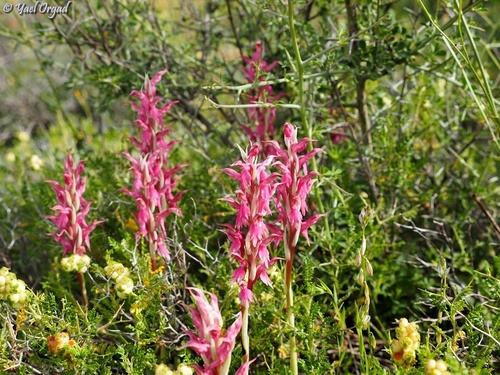
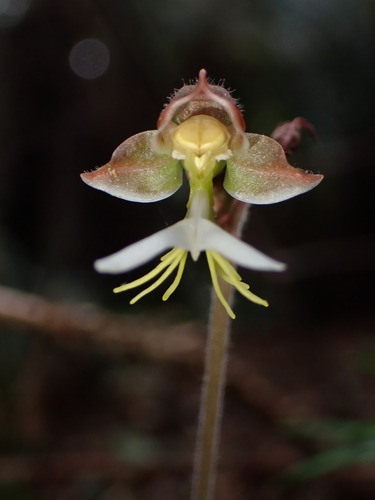
Cryptostylis erecta
R. Br.
Bonnet orchid, Hooded orchid

(c) David Lochlin, some rights reserved (CC BY)

(c) Murray NZ, some rights reserved (CC BY), uploaded by Murray NZ
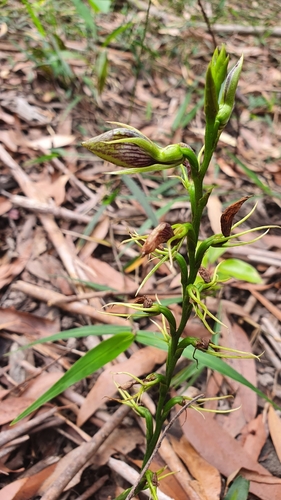
(c) olly88, some rights reserved (CC BY-NC), uploaded by olly88
What to Eat
Edible parts: Stems, Rhizome, Root, Tuber
The stems, rhizomes, roots, and tubers are edible parts of the plant.
Where to Find It
It grows in temperate and subtropical places. It grows in moist, well drained soils. It needs a sheltered, shaded position. It is resistant to frost but damaged by drought.
Australia*,
How to Identify
A slender ground orchid. The tubers are 15 cm long by 4 mm wide. The leaves are erect and leathery. They are green. The leaves are 20 cm long by 30 mm wide. The flowers spike is about 50 cm long and has about 12 green flowers. They have purple spots.
How to Grow
Plants are grown by division.
Wikipedia
Source ↗Cryptostylis erecta, commonly known as the bonnet orchid or tartan tongue orchid , is an orchid endemic to south eastern Australia. A small and common plant, it has dark green lance-shaped to egg-shaped leaves and up to twelve greenish flowers with a large, bonnet-like or hood-like, lilac-coloured labellum with a network of purple veins.
Names & Synonyms
Tartan tongue orchid, Turban orchid
References (5)
- Bodkin, F., 1991, Encyclopedia Botanica. Cornstalk publishing, p 304
- Caton, J.M. & Hardwick, R. J., 2016, Field Guide to Useful Native Plants from Temperate Australia. Harbour Publishing House. p 282
- Lim, T. K., 2015, Edible Medicinal and Non Medicinal Plants. Volume 9, Modified Stems, Roots, Bulbs. Springer p 29
- Melzer, R. & Plumb, J., 2011, Plants of Capricornia. Belgamba, Rockhampton. p 494
- Ryan, M. (Ed.), 2003, Wild Plants of Greater Brisbane. Queensland Museum. p 307