Dicranopteris linearis
(Burm. f.) Underw.
Scrambling fern, Comb bracken
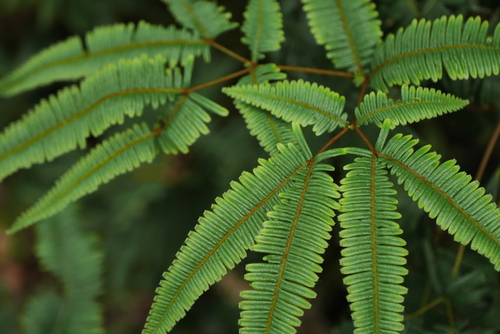
(c) 博甫, some rights reserved (CC BY-NC), uploaded by 博甫

(c) Niki Robertson, some rights reserved (CC BY), uploaded by Niki Robertson
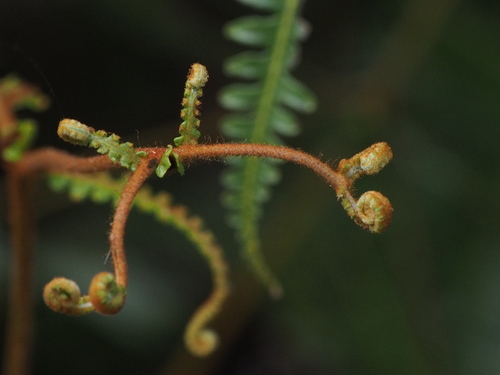
(c) Hong, some rights reserved (CC BY-NC), uploaded by Hong
What to Eat
Edible parts: Root, Fronds
The roots are softened by pounding, then roasted and eaten. Young fronds are cooked and eaten as a vegetable. The root is also used for making salt.
Known Hazards
Where to Find It
It is a tropical plant. In Bangladesh it grows in hilly areas in full sunlight or light shade. It forms dense patches. It is best in moist, well-drained peaty soils. It needs a protected position. It is damaged by frost or drought.
Africa, American Samoa, Australia, Asia, Bangladesh, Central Africa, Congo DR, East Africa, East Timor, Eswatini, Fiji, Guam, India, Indochina, Laos, Malawi, Marquesas, Micronesia, Mozambique, Nepal, New Zealand, Northeastern India, Pacific, Palau, Samoa, SE Asia, Sierra Leone, Solomon Islands, South Africa, Southern Africa, Swaziland, Taiwan, Timor-Leste, Wallis and Futuna, West Africa, Zambia, Zimbabwe,
How to Identify
A fern. It has a stout creeping rhizome or underground stem. It grows 2 m high and spreads 1.5 m wide. The fronds form dense thickets. The fronds have 25-60 pairs of narrow segments.
How to Grow
Plants can be grown by spores or division.
Propagation: Spores - Difficult to raise but easier to establish than divisions. Divisions are difficult due to the plants resentment of any disturbance. If it is attempted, only large, long established specimens should be used.
Medicinal Uses
The fronds are used in medicine in Bangladesh.
Other Uses
The stems have many functions. They are widely used for pens (which are sold in markets); they are woven into mats, used to make partitions inside houses, as stool and chair seats, pouches, caps etc. Splints are prepared by cracking the outer covering of the very long leafstalks and pulling out the ribbon-like vascular bundles. The splints are excellent weavers for coiled baskets and are also used in making belts. The petiole and racheae are used in thatching huts. The inner cores of the stems, after removing the bark, were traditionally fastened on the chest and belly as a protection against arrows. A low growing and quickly spreading plant, it is an important soil binding pioneer species that very quickly volunteers after a land slide or other erosion, or after a forest fire. It grows in thick, pure stands that can cover an erosion scar and bind the soil until other species become established.
Wikipedia
Source ↗Dicranopteris linearis is a common species of fern known by many common names, including Old World forked fern, uluhe (Hawaiian), and dilim (Filipino). It is one of the most widely distributed ferns of the wet Old World tropics and adjacent regions, including Polynesia and the Pacific. In parts of the New World tropics its niche is filled by its relative, Dicranopteris pectinatus. This rhizomatous fern spreads via cloning, spreading along the ground and climbing on other vegetation, often forming thickets 3 metres deep or more. The stem grows from the rhizome, branches at a 45° angle, and forms fronds that continue to bud and branch. In this way the growth can continue for a long distance as the plant forms a mat, grows over itself in layers, and spreads. When climbing, the leafy branches can reach over 6 metres long and can climb 10 meters high when supported by a tree. The ultimate segments of the leaves are linear in shape, up to 7 centimeters long by a few millimeters wide. The undersides are hairy and sometimes waxy. It can also reproduce via spores. The fern grows easily on poorly drained, nutrient-poor soils and in disturbed habitats and steep slopes. It does not tolerate shade, so once established it will eventually be shaded out by taller vegetation unless it climbs above it. It may suppress the growth of new stands of trees, especially when it becomes a dense thicket. The fern is a keystone species in Hawaiian ecosystems, and dominates many areas in Hawaiian rainforests. It occurs on all the main Hawaiian islands. As a pioneer species in ecological succession, it can colonize bare sites such as lava flows, talus, and abandoned roads. When the fern grows onto a new site it produces layers of stems and leaves repeatedly until there is a network of vegetation. The leaves die and the stems are very slow to decompose, so the network persists. The network then fills with organic forest detritus, forming a litter layer which can be a meter thick. The network is penetrated by the fern's rhizomes and roots, such that the fern serves as its own substrate. Where the fern is eliminated, invasive species of plants can move in, so one important benefit of the fern may be the prevention of these plants from encroaching on the rainforest. The fern may have allelopathic effects, preventing the growth of other plants. Also, the fern is a very productive member of the forest ecosystem; despite being a relatively small amount of the biomass in the forest it accounts for over half of the primary productivity in some areas. This plant is used medicinally to treat intestinal worms in Indochina, skin ulcers and wounds in New Guinea, and fever in Malaysia. In vitro samples of the fern kill bacteria. The fiddleheads of the fern are used in floral arrangements.
Notes
The fronds are used in medicine in Bangladesh.
Names & Synonyms
Jurntuma, Lirang, Old world forked fern, Tipurrukurtuwa, Unyiu, Walumanikima
References (14)
- Bodkin, F., 1991, Encyclopedia Botanica. Cornstalk publishing, p 340
- Bull. Torrey Bot. Club 34:249. 1907
- Cowie, I, 2006, A Survey of Flora and vegetation of the proposed Jaco-Tutuala-Lore National Park. Timor-Lests (East Timor) www.territorystories.nt/gov.au p 48
- Crowe, A., 1997, A Field Guide to the Native Edible Plants of New Zealand. Penguin. p 160
- Flora of Solomon Islands
- Franklin, J., Keppel, G., & Whistler, W., 2008, The vegetation and flora of Lakeba, Nayau and Aiwa Islands, Central Lau Group, Fiji. Micronesica 40(1/2): 169–225, 2008
- Gangwar, A. K. & Ramakrishnan, P. S., 1990, Ethnobotanical Notes on Some Tribes of Arunachal Pradesh, Northeastern India. Economic Botany, Vol. 44, No. 1 pp. 94-105
- Koni, J. M. & Bostein, K., 2008, Noms et usages des plantes utiles chez les Nsong, DR Congo. University of Gothenburg. Department of Oriental and African Languages. p 38 (As Gleichenia linearis)
- Kuo, W. H. J., (Ed.) Taiwan's Ethnobotanical Database (1900-2000), http://tk.agron.ntu.edu.tw/ethnobot/DB1.htm
- Parham, B. E. V., 1972, Plants of Samoa. New Zealand Department of Scientific and Industrial Research. Information Series. No. 85 p 143
- Sarker, S. K., & Enayet Hossain, A. B. M., 2009, Pteridophytes of Greater Mymensingh District of Bangladesh used as Vegetables and Medicines. Bangladesh J. Plant Taxon. 16(1) 47-56. p 51
- Taram, M., et al, 2018, Wild Food Plant Resources of Komkar Adi Tribe of Upper Siang District in Arunachal Pradesh, India. Bulletin of Arunachal Forest Research, Vol. 33(2), 27-35
- Tiwi Plants and Animals. 2001, Aboriginal flora and fauna knowledge from Bathurst and Melville Islands, northern Australia. Northern Territory Botanical Bulletin; No. 24 p 40
- World Checklist of Useful Plant Species 2020. Royal Botanic Gardens, Kew

