Berula erecta
(Huds.) Coville
Water parsnip, Petrol bush
no rights reserved
no rights reserved, uploaded by Harald Schnöde (Schnde)

(c) Paul Roots, some rights reserved (CC BY), uploaded by Paul Roots
What to Eat
Edible parts: Leaves
The leaves and flowers have been used for food.
Where to Find It
It is a temperate plant. It grows in moist to wet soils. It grows in ditches and near canals. It can grow in light shade or full sun. It is damaged by frost. In western China it grow up to 1,500 m above sea level.
Afghanistan, Africa, Angola, Asia, Australia, Britain, Central Africa, Central Asia, Czech Republic, East Africa, Eswatini, Ethiopia, Europe, France, Germany, Himalayas, India, Italy, Kazakhstan, Kyrgyzstan, Luxembourg, Mediterranean, Mexico, Nepal, North Africa, North America, Pakistan, Russia, Sicily, South Africa, Southern Africa, Spain, Sudan, Swaziland, Tajikistan, Turkey, Türkiye, Turkmenistan, Uganda, Uzbekistan, Zimbabwe,
How to Identify
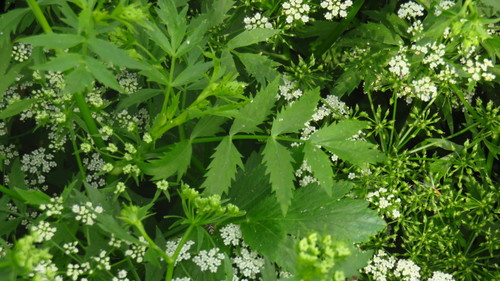
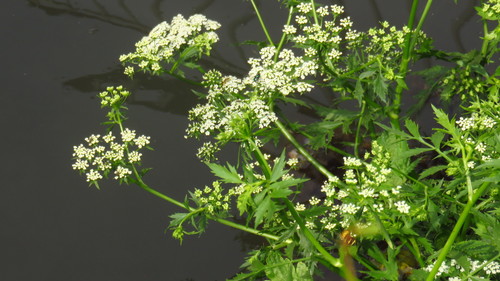
A feather-like herb. It is a creeping plant. It grows 30 cm high. It keeps growing from year to year. The runners form roots in mud. The stems are hollow. The flowers are white and in small heads.
How to Grow
Propagation: Seed -
Medicinal Uses
The plant is used externally in the treatment of rheumatism. An infusion of the whole plant can be used as a wash for swellings, rashes and athletes foot infections.
Other Uses
None known Special Uses
Wikipedia
Source ↗Berula erecta, known as lesser water-parsnip, cutleaf waterparsnip, or narrow-leaved water-parsnip, is a member of the carrot family. Growing to around 1 m (3 ft) tall, it is found in or by water. It is widespread across much of Europe, Asia, Australia, and North America. Berula erecta has a hollow stem. Underwater leaves consist of compound with thread-like lobes; leaves above the surface of the water are flatter and broader. The plant produces many small white flowers in a compound umbel.
Notes
It is used in medicine. There is only one Berula species.
Names & Synonyms
Kazayagi, Porocnik vzprimeny, Sukazayagi, Tere
References (11)
- Contr. U.S. Natl. Herb. 4:115. 1893
- Dogan, A., et al, 2014, A review of edible plants on the Turkish Apiaceae species. J. Fac. Pharm. Istanbul, 44(2) pp 251-262
- Dogan, Y., 2012, Traditionally used wild edible greens in the Aegean Region of Turkey. Acta Societatis Botanicorum Poloniae 81(4): 329-342
- Dogan, Y. et al, 2013, Wild Edible Plants sold in the Local Markets of Izmir, Turkey. Pak. J. Bot. 45(S1): 177-184
- Ertug, F., 2000, An Ethnobotanical Study in Central Anatolia (Turkey). Economic Botany Vol. 54. No. 2. pp. 155-182
- Ertug, F., 2004, Wild Edible Plants of the Bodrum Area. (Mugla, Turkey). Turk. J. Bot. 28 (2004): 161-174
- Ertug, F, Yenen Bitkiler. Resimli Türkiye Florası -I- Flora of Turkey - Ethnobotany supplement
- Pasta, S., et al, 2020, An Updated Checklist of the Sicilian Native Edible Plants: Preserving the Traditional Ecological Knowledge of Century-Old Agro-Pastoral Landscapes. Frontiers in Plant Science. Volume 11|Article 388
- Romanowski, N., 2007, Edible Water Gardens. Hyland House. p 104
- Simkova, K. et al, 2014, Ethnobotanical review of wild edible plants used in the Czech Republic. Journal of Applied Botany and Food Quality 88, 49-67
- Swaziland's Flora Database http://www.sntc.org.sz/flora