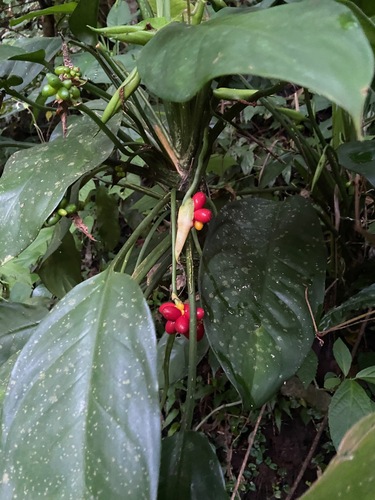
Amorphophallus angolensis subsp. maculatus
(N. E. Br.) Ittenb. ex Govaerts & Frodin
What to Eat
Edible parts: Tuber, Starch, Corm, Root
The tuber, corm, and roots provide starch and are eaten after extensive processing.
Known Hazards
Where to Find It
It is a tropical plant.
Africa, Angola, Central Africa, Gabon,
Countries: Angola, Burkina Faso, Burundi, Benin, Botswana, Congo (DRC), Central African Republic, Congo (Republic), Cote d'Ivoire, Cameroon, Cape Verde, Djibouti, Algeria, Egypt, Eritrea, Ethiopia, Gabon, Ghana, Gambia, Guinea, Equatorial Guinea, Guinea-Bissau, Kenya, Comoros, Liberia, Lesotho, Libya, Morocco, Madagascar, Mali, Mauritania, Mauritius, Malawi, Mozambique, Namibia, Niger, Nigeria, Rwanda, Seychelles, Sudan, Sierra Leone, Senegal, Somalia, South Sudan, Sao Tome & Principe, Eswatini, Chad, Togo, Tunisia, Tanzania, Uganda, South Africa, Zambia, Zimbabwe
How to Identify
A tropical herb in the Araceae family with edible tubers, corms, and roots.
Names & Synonyms
Amorphophallus maculatus N. E. Br.
References (1)
- Raponda-Walker, A & Sillans, R., 1961, Les Plantes Utiles du Gabon. Editions Paul Lechevalier, Paris. p 92 (As Amorphophallus maculatus)