Cymbidium hookerianum
Rchb.f.
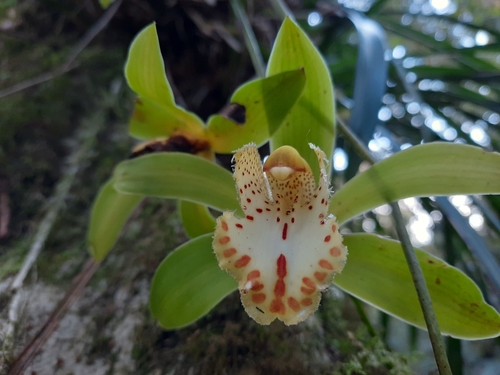
(c) Phuentsho, some rights reserved (CC BY-NC), uploaded by Phuentsho

(c) desertnaturalist, some rights reserved (CC BY), uploaded by desertnaturalist
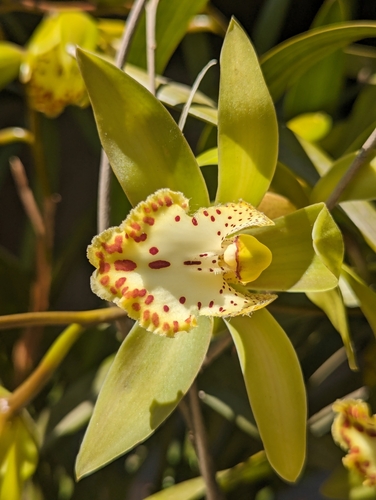
(c) Sagnik Dutta Roy, some rights reserved (CC BY), uploaded by Sagnik Dutta Roy
What to Eat
Edible parts: Flower buds
The flower buds are washed and boiled, then drained and combined with spices, melted cheese, and salt before cooking for a further 5 minutes.
Where to Find It
It is a tropical plant. It grows in trees in forests and on rocks along valleys between 1,100-2,700 m above sea level in southern China. In Northeastern India it grows at 4,300 m above sea level. In Sichuan and Yunnan.
Asia, Bhutan, China, Himalayas, India, Myanmar, Nepal, Northeastern India, SE Asia, Tibet, Vietnam,
How to Identify
An orchid. It can grow attached to other plants. The false bulbs are narrowly oval and flattened and 3-8 cm long by 2-3 cm wide. They are partly enclosed by the leaf bases. There are 4-6 leaves. They are 35-60 cm long and 1-2 cm wide. They bend 6-10 cm from the base. The flowering shoot arises near the base of the false bulbs. There are 7-14 flowers. The flowers have a scent. They are green or yellowish green with red spots.
Wikipedia
Source ↗Cymbidium hookerianum (common name Hooker's Cymbidium) is a species of orchid found in India, China, and Vietnam. It is distributed widely in Bhutan, especially in the cool temperate forests.
Names & Synonyms
Pan-thetshe-wa
References (2)
- Singapore Botanical Gardens
- Tsering, J., et al, 2017, Ethnobotanical appraisal on wild edible plants used by the Monpa community of Arunchal Pradesh. Indian Journal of Traditional Knowledge. Vol 16(4), October 2017, pp 626-637