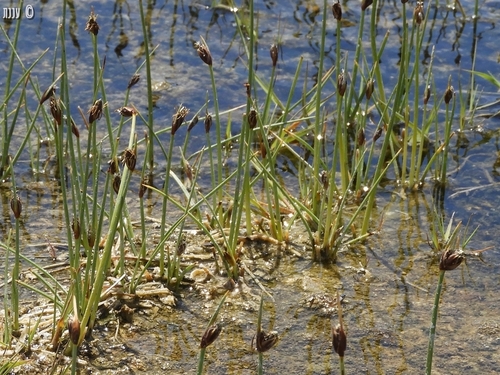
Cyperus usitatus
Burch.
Boesman uintjie

(c) lorainevdb, some rights reserved (CC BY-NC), uploaded by lorainevdb
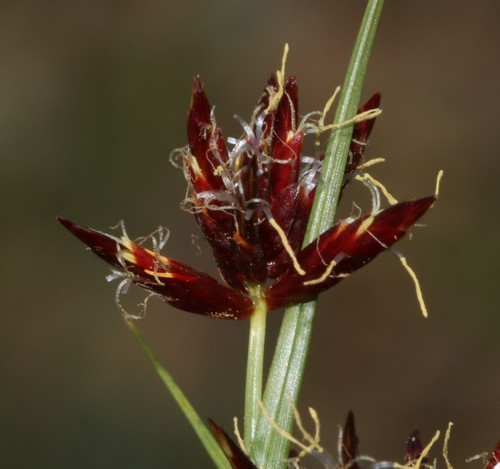
(c) Brian du Preez, some rights reserved (CC BY-SA), uploaded by Brian du Preez
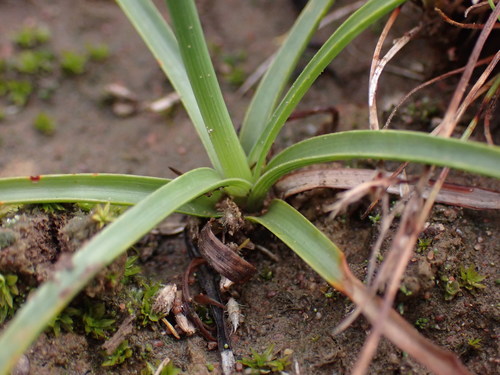
(c) David Hoare, some rights reserved (CC BY-NC-SA), uploaded by David Hoare
What to Eat
Edible parts: Bulb, Tuber, Root
The bulbs are eaten raw or cooked, and are used in soups and vegetable dishes, though they are bitter unless cooked.
Known Hazards
Where to Find It
It is a subtropical plant. It grows in hot arid areas with a marked dry season. It can be in shallow, sandy and seasonally waterlogged soils. It grows between 900-2,225 m above sea level. It can grow in arid places.
Africa, Botswana, East Africa, Ethiopia, Lesotho, Namibia, South Africa, Southern Africa, Tanzania, Uganda, Zambia, Zimbabwe,
How to Identify
A herb or sedge. It keeps growing from year to year. It has runners. It grows 45 cm high. The stalks are 10-30 cm long and 5-12 mm wide and triangle shaped. The leaf blades are 5-20 cm long by 2-6 mm wide. They are flat and rather thick. The bulbs are 6-10 mm across. They have a few thin scaled. The flowers are in crowded spikes.
Nutrition Score: 13/100
| Part | Moisture | kJ | kcal | Protein | Vit A | Vit C | Iron | Zinc |
|---|---|---|---|---|---|---|---|---|
| Bulb | 76.2 | — | — | 2.5 | — | — | — | — |
Wikipedia
Source ↗Cyperus usitatus is a species of sedge that is native to eastern and southern Africa, ranging from Ethiopia to South Africa.
Other Information
It is a famine food.
Names & Synonyms
Allaado, Engicha, Monakalali, Ozeu, Uintjie
References (12)
- Fox, F. W. & Young, M. E. N., 1982, Food from the Veld. Delta Books. p 179
- Grivetti, L. E., 1980, Agricultural development: present and potential role of edible wild plants. Part 2: Sub-Saharan Africa, Report to the Department of State Agency for International Development. p 65
- Lulekal, E., et al, 2011, Wild edible plants in Ethiopia: a review on their potential to combat food insecurity. Afrika Focus - Vol. 24, No 2. pp 71-121
- Peters, C. R., O'Brien, E. M., and Drummond, R.B., 1992, Edible Wild plants of Sub-saharan Africa. Kew. p 15
- Peters and Maguire, 1981,
- Royal Botanic Gardens, Kew (1999). Survey of Economic Plants for Arid and Semi-Arid Lands (SEPASAL) database. Published on the Internet; http://www.rbgkew.org.uk/ceb/sepasal/internet [Accessed 16th April 2011]
- Ruiters-Welcome, A. K., 2019, Food plants of southern Africa. Ph.D. thesis. Univ. of Johannesburg p 51
- Simpson, D. A. & Inglis, C. A., 2001, Cyperaceae of Economic, Ethnobotanical and Horticultural Importance: A checklist. Kew Bulletin Vol. 56, No. 2 (2001), pp. 257-360
- Sina, B. & Degu, H. D., 2015, Knowledge and use of Wild Edible Plants in the Hula District of the Sidama Zone. International Journal of Bio-resource and Stress Management 6(3):352-365
- Welcome, A. K. & Van Wyk, B.-E., 2019, An inventory and analysis of the food plants of southern Africa. South African Journal of Botany 122 (2019) 136–179
- World Checklist of Useful Plant Species 2020. Royal Botanic Gardens, Kew
- Youngblood, D., 2004, Identification and Quantification of Edible Plant Foods in the Upper (Nama) Karoo, South Africa. Economic Botany 58 (Supplement) :S43-S65
More from Cyperaceae