Digitaria nuda
Schumach.
Naked crabgrass
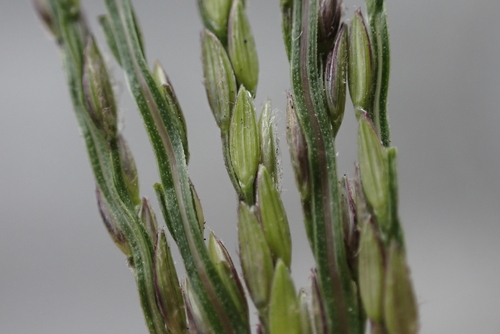
(c) Mike Ross, some rights reserved (CC BY-NC), uploaded by Mike Ross
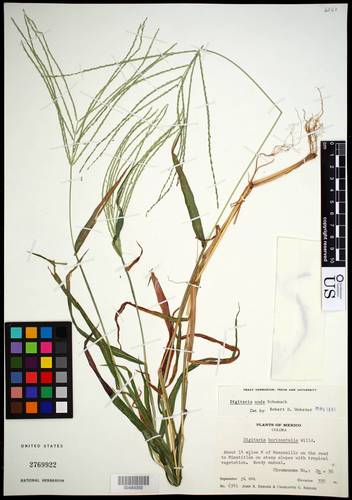
(c) Smithsonian Institution, National Museum of Natural History, Department of Botany, some rights reserved (CC BY-NC-SA)
What to Eat
Edible parts: Seeds, Cereal, Grains
The seeds are harvested as a cereal grain. It is used as a famine food.
Where to Find It
It is a tropical plant. It grows in waste places across West Africa.
Africa, Argentina, Botswana, Brazil, Burkina Faso, Cuba, East Africa, Gambia, Ghana, Guiana, Guianas, Guinea, Guinée, Guinea-Bissau, Guyana, Haiti*, Indonesia, Malawi, Mauritania, Mauritius Mexico*, Mozambique, Nigeria, North America, Paraguay, Puerto Rico, SE Asia, Sierra Leone, Southern Africa, South America*, Suriname, USA, Venezuela, Virgin Islands, West Africa, West Indies*, Zambia, Zimbabwe,
How to Identify
An annual grass. The stems are elbowed and reach 1 m high. It is creeping and can form mats. The stems are 10-50 cm long. The seeds are about 0.8 mm long.
Other Information
It is a famine food.
Names & Synonyms
Harkiya, Ndiwi, Sheshe
References (7)
- Burkill, H. M., 1985, The useful plants of west tropical Africa, Vol. 2. Kew.
- Dalziel, J. M., 1937, The Useful plants of west tropical Africa. Crown Agents for the Colonies London.
- Gallagher, D. E., 2010, Farming beyond the escarpment: Society, Environment, and Mobility in Precolonial Southeastern Burkina Faso. PhD University of Michigan.
- Peters, C. R., O'Brien, E. M., and Drummond, R.B., 1992, Edible Wild plants of Sub-saharan Africa. Kew. p 21
- Plants of Haiti Smithsonian Institute http://botany.si.edu/antilles/West Indies
- Vodouhe, R. S. et al, Fonio: A treasure for West Africa. Genetic Resources Multiplication and Utilization p 219
- World Checklist of Useful Plant Species 2020. Royal Botanic Gardens, Kew


