Hemarthria altissima
(Poir.) Stapf. & Hubbard
Swamp couch

(c) François Rousseu, some rights reserved (CC BY-NC), uploaded by François Rousseu
(c) Nick Helme, some rights reserved (CC BY-NC), uploaded by Nick Helme
(c) Rob Palmer, some rights reserved (CC BY-NC-SA)
What to Eat
Edible parts: Rhizome, Root
The rhizome is eaten raw, particularly by children.
Where to Find It
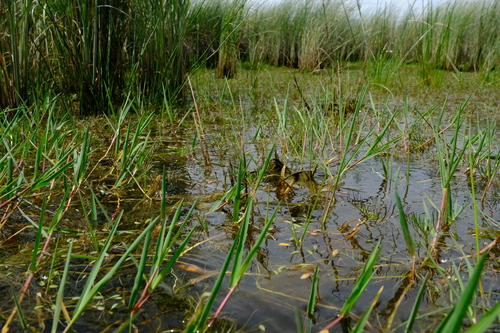
It is a subtropical plant. It grows in hot arid places. In Swaziland it grows in the high veld only. It grows in wet places and along river banks. It can be in poorly drained and salty soils. It grows from 5-2,000 m above sea level. It can grow in arid places. In Argentina it grows between sea level and 1,000 m above sea level.
Africa, Angola, Argentina, Asia, Botswana, Brazil, Central Africa, Chad, China, Congo, East Africa, Eswatini, Ethiopia, Europe, India, Indochina, Indonesia, Italy, Laos, Lesotho, Madagascar, Malawi, Mali, Mauritius, Mediterranean, Mozambique, Myanmar, New Zealand, Nigeria, Paraguay, SE Asia, Senegal, South Africa, Southern Africa, South America, Swaziland, Tanzania, Thailand, Turkey, Türkiye, Uruguay, USA, Vietnam, West Africa, Zambia, Zimbabwe,
How to Identify
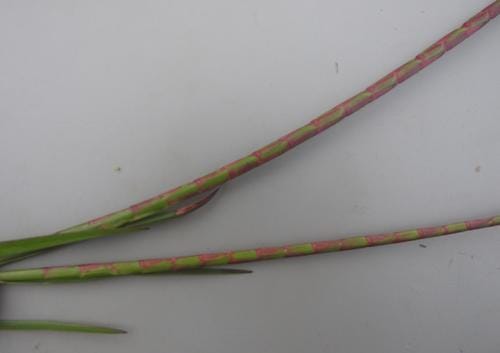
A grass. It keeps growing from year to year. It is branched and forms dense tangled masses. It spreads by underground stems or rhizomes. It can grow 1.5 m tall. The flower spikes occur singly at the top of the stems. The spikelets are pressed close to the axis.
Wikipedia
Source ↗Hemarthria altissima, variously called limpo grass, limpograss, halt grass, Batavian quick grass, swamp couch grass, red swamp grass and red vleigrass, is a species of flowering plant in the jointgrass genus Hemarthria, family Poaceae. It is native to the Old World Tropics and Subtropics; Africa, Southern Europe, the Middle East, India, Southeast Asia, eastern China, and Borneo, and widely introduced as a forage in the New World, from Texas and Florida south to northern Argentina. In addition to being a valued forage for livestock, it makes a good, fragrant silage. A number of cultivars are commercially available.
Other Information
It is eaten especially by children.
Notes
There are 12 Hemarthria species. They grow in tropical and subtropical places.
Names & Synonyms
Bulukusu, Burgu, Igasi, Manu, Tsangadzi
References (11)
- Burkill, H. M., 1985, The useful plants of west tropical Africa, Vol. 2. Kew.
- Fowler, D. G., 2007, Zambian Plants: Their Vernacular Names and Uses. Kew. p 70
- Fox, F. W. & Young, M. E. N., 1982, Food from the Veld. Delta Books. p 301
- Guillarmod, J., 1966,
- Peters, C. R., O'Brien, E. M., and Drummond, R.B., 1992, Edible Wild plants of Sub-saharan Africa. Kew. p 23
- Royal Botanic Gardens, Kew (1999). Survey of Economic Plants for Arid and Semi-Arid Lands (SEPASAL) database. Published on the Internet; http://www.rbgkew.org.uk/ceb/sepasal/internet [Accessed 3rd June 2011]
- Ruiters-Welcome, A. K., 2019, Food plants of southern Africa. Ph.D. thesis. Univ. of Johannesburg p 87
- Swaziland's Flora Database http://www.sntc.org.sz/flora
- van Oudtshoorn, F and van Wyck, E., 2004, Guide to Grasses of Southern Africa. Briza. p 51
- Welcome, A. K. & Van Wyk, B.-E., 2019, An inventory and analysis of the food plants of southern Africa. South African Journal of Botany 122 (2019) 136–179
- World Checklist of Useful Plant Species 2020. Royal Botanic Gardens, Kew


