Miscanthus ecklonii
(Nees) Mabb.

iNaturalist · cc-by-nc
(c) Gigi Laidler, some rights reserved (CC BY-NC), uploaded by Gigi Laidler
(c) Gigi Laidler, some rights reserved (CC BY-NC), uploaded by Gigi Laidler
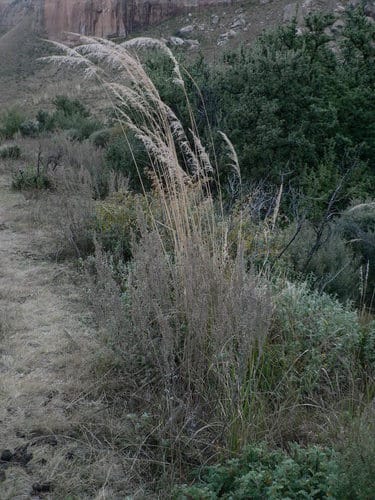
iNaturalist · cc-by-nc
(c) Dewald du Plessis, some rights reserved (CC BY-NC)
(c) Dewald du Plessis, some rights reserved (CC BY-NC)

iNaturalist · cc-by-sa
(c) Tony Rebelo, some rights reserved (CC BY-SA)
(c) Tony Rebelo, some rights reserved (CC BY-SA)
What to Eat
Edible parts: Rhizome, Root, Seeds, Cereal
The rhizome (tubers) is chewed raw, and seeds are used for meal and as a famine food, especially eaten by children.
Where to Find It
It is a Mediterranean climate plant. It grows in soils that are sometimes waterlogged. It can grow in arid places. In Swaziland it grows in the high veld only.
Africa, East Africa, Eswatini, Lesotho, Mozambique, South Africa, Southern Africa, Swaziland,
Countries: Angola, Burkina Faso, Burundi, Benin, Botswana, Congo (DRC), Central African Republic, Congo (Republic), Cote d'Ivoire, Cameroon, Cape Verde, Djibouti, Algeria, Egypt, Eritrea, Ethiopia, Gabon, Ghana, Gambia, Guinea, Equatorial Guinea, Guinea-Bissau, Kenya, Comoros, Liberia, Lesotho, Libya, Morocco, Madagascar, Mali, Mauritania, Mauritius, Malawi, Mozambique, Namibia, Niger, Nigeria, Rwanda, Seychelles, Sudan, Sierra Leone, Senegal, Somalia, South Sudan, Sao Tome & Principe, Eswatini, Chad, Togo, Tunisia, Tanzania, Uganda, South Africa, Zambia, Zimbabwe
How to Identify
A grass. A herb. It is an erect grass and can keep growing from year to year. It is a very robust plant. It grows 3 m high. The flowering shoots are 40 cm long. They are brownish. The spikelets have stalks.
Other Information
It is eaten especially by children.
Notes
There are about 20 Miscanthus species.
Names & Synonyms
Miscanthidium capensis (Nees) AndersonMiscanthidium erectumMiscanthidium sorghum (Nees) Stapfand several others
References (8)
- Guillarmod, J., 1966, (As Miscanthus capensis)
- Guillarmod, J., 1971, (As Miscanthus capensis)
- Peters, C. R., O'Brien, E. M., and Drummond, R.B., 1992, Edible Wild plants of Sub-saharan Africa. Kew. p 24 (As Miscanthus capensis)
- Royal Botanic Gardens, Kew (1999). Survey of Economic Plants for Arid and Semi-Arid Lands (SEPASAL) database. Published on the Internet; http://www.rbgkew.org.uk/ceb/sepasal/internet [Accessed 3rd June 2011] (As Miscanthidium capensis)
- Ruiters-Welcome, A. K., 2019, Food plants of southern Africa. Ph.D. thesis. Univ. of Johannesburg p 89
- Swaziland's Flora Database http://www.sntc.org.sz/flora (As Miscanthus capensis)
- van Wyk, Be, & Gericke, N., 2007, People's plants. A Guide to Useful Plants of Southern Africa. Briza. p 9 (As Miscanthus capensis)
- Welcome, A. K. & Van Wyk, B.-E., 2019, An inventory and analysis of the food plants of southern Africa. South African Journal of Botany 122 (2019) 136–179


