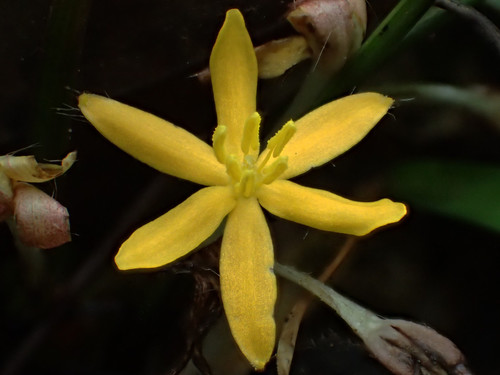
Hypoxis angustifolia
Lam.
Slender star lily

(c) Andrew Hankey, some rights reserved (CC BY-SA), uploaded by Andrew Hankey

(c) Alison Young, some rights reserved (CC BY-NC)
What to Eat
Edible parts: Corm, Bulb, Root
Roots - cooked as a vegetable. They can also be dried for later use. When dried they have a flavour somewhat like roast chestnuts. The globose to ovoid tuber is up to 36mm long and 22mm wide.
Where to Find It
It is a tropical plant. It grows from sea level to 1,800 m above sea level. It is rare in Swaziland.
Africa, Cameroon, Central Africa, Congo, East Africa, Eswatini, Guinea, Guinée, Kenya, Madagascar, Malawi, Mauritius, Mozambique, Nigeria, Seychelles, South Africa, Southern Africa, Swaziland, Uganda, West Africa, Zambia, Zimbabwe,
How to Identify
A herb. It has a bulb 2.5 cm across. The leaves are 20 cm long by 7 mm wide. They have fine hairs. The leaves taper to a long point. There are 1 or 2 flowers on slender stalks.
How to Grow
Hypoxis species are generally not very cold tolerant plants and most species are badly damaged or killed by even light frosts. They will usually grow well in a Mediterranean type of climate with little or no frost. Species in this genus generally require a light, freely draining soil and a position in full sun or light shade. This species is found in the wild in a wide range of soils including shallow, mineral soils on rocky granitic, lava, coral or calcareous outcrops; on sandy, white, yellow, reddish, dark soils; on gray, rich light brown humic loam; red ferralitic soil; heavy clay; volcanic soil; black cotton soil and on termitaria. Hypoxis species greatly resent root disturbance, plants should be placed in their permanent positions as soon as possible and left undisturbed for as long as possible.
Propagation: Seed - best sown as soon as it is ripe. Division.
Medicinal Uses
Hypoxis plants have long played a role in traditional African medicine; H. hemerocallidea and H. colchicifolia are the best known species used to make medicine and teas. The genus is not only used in traditional medicine, it has become important also in pharmaceutical preparations. Archaeological evidence found in ashes in Border Cave, South Africa has revealed that early humans roasted the rhizomes of some of the more palatable species of Hypoxis as long as 170,000 years ago.
Other Information
It is eaten especially by children.
Names & Synonyms
Ocutu
References (11)
- Burkill, H. M., 1985, The useful plants of west tropical Africa, Vol. 2. Kew.
- Chapman, J. D. & Chapman, H. M., 2001, The Forest Flora of Taraba and Andamawa States, Nigeria. WWF & University of Canterbury. p 210
- Glover, 1967,
- Herb., E. A., 1981,
- Masters, T., 2021, Traditional food plants of the upper Aswa River catchment of northern Uganda—a cultural crossroads. Journal of Ethnobiology and Ethnomedicine (2021) 17:24
- Mutie, F. M., et al, 2023, Important Medicinal and Food Taxa (Orders and Families) in Kenya, Based on Three Quantitative Approaches. Plants 2023, 12, 1145
- Peters, C. R., O'Brien, E. M., and Drummond, R.B., 1992, Edible Wild plants of Sub-saharan Africa. Kew. p 31
- Swaziland's Flora Database http://www.sntc.org.sz/flora
- von Katja Rembold, 2011, Conservation status of the vascular plants in East African rain forests. Dissertation Universitat Koblenz-Landau p 169
- Wild, 1975,
- World Checklist of Useful Plant Species 2020. Royal Botanic Gardens, Kew