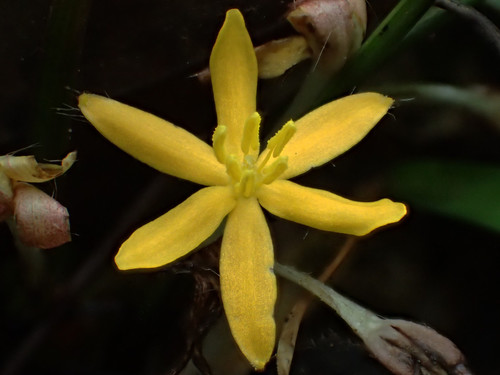
Hypoxis argentea
Bak.
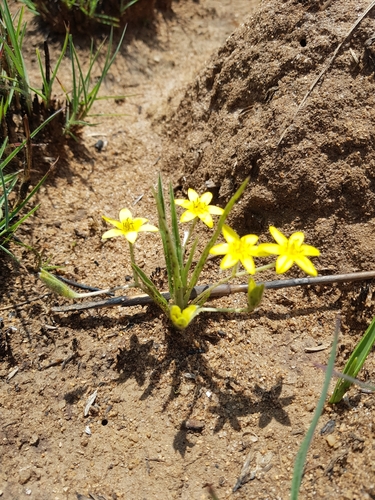
Small yellow star-flowers
(c) Richard Gill, some rights reserved (CC BY-NC)

(c) Andrew Hankey, some rights reserved (CC BY-SA)

(c) Andrew Hankey, some rights reserved (CC BY-SA)
What to Eat
Edible parts: Corm, Bulbs, Root
The corm is eaten raw or cooked.
Where to Find It
A tropical and subtropical plant. It grows in summer rainfall areas.
Africa, Botswana, East Africa, Eswatini, Mozambique, South Africa, Southern Africa, Southern Africa, Swaziland,
How to Identify
A herb. There are many leaves. They are 40 c long and 4 mm wide. They have some hairs. The flowering stalk is slender. There are several flowers.
Medicinal Uses
Hypoxis plants have long played a role in traditional African medicine; H. hemerocallidea and H. colchicifolia are the best known species used to make medicine and teas. The genus is not only used in traditional medicine, it has become important also in pharmaceutical preparations. Archaeological evidence found in ashes in Border Cave, South Africa has revealed that early humans roasted the rhizomes of some of the more palatable species of Hypoxis as long as 170,000 years ago.
References (11)
- Fox, F. W. & Young, M. E. N., 1982, Food from the Veld. Delta Books. p 238
- Gillarmod, J., 1971,
- Long, C., 2005, Swaziland's Flora - siSwati names and Uses http://www.sntc.org.sz/flora/
- Mason, 1971,
- Mogg, 1975,
- Peters, C. R., O'Brien, E. M., and Drummond, R.B., 1992, Edible Wild plants of Sub-saharan Africa. Kew. p 31
- Ruiters-Welcome, A. K., 2019, Food plants of southern Africa. Ph.D. thesis. Univ. of Johannesburg p 65
- Shava, S., 2000, The Use of Indigenous Plants as Food by a Rural Community in the Eastern Cape: an Educational Exploration. Masters Thesis Rhodes University. p 65
- Swaziland's Flora Database http://www.sntc.org.sz/flora
- Welcome, A. K. & Van Wyk, B.-E., 2019, An inventory and analysis of the food plants of southern Africa. South African Journal of Botany 122 (2019) 136–179
- World Checklist of Useful Plant Species 2020. Royal Botanic Gardens, Kew