Combretum molle
R. Br. ex G. Don
Velvet bush willow

(c) R.Lecuona, some rights reserved (CC BY-NC), uploaded by R.Lecuona

(c) Michael Schrenk, some rights reserved (CC BY-NC), uploaded by Michael Schrenk
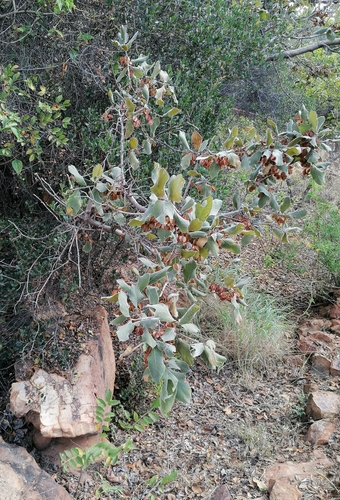
(c) Hildegard Klein, some rights reserved (CC BY), uploaded by Hildegard Klein
What to Eat
Edible parts: Root, Gum, Bark - tea
The root is used for tea and in soup, cut up and cooked as a vegetable. The plant is also used to flavour beer and drinks.
Where to Find It
It is a tropical plant. It grows on dry stony ground. It grows in savannah and woodland. In grows up to 2,300 m above sea level. It can grow in arid places.
Africa, Angola, Benin, Botswana, Burkina Faso, Burundi, Cameroon, Central Africa, Congo, Côte d'Ivoire, East Africa, Eritrea, Eswatini, Ethiopia, Ghana, Guinea, Guinée, Guinea-Bissau, Ivory Coast, Kenya, Malawi, Mauritania, Middle East, Mozambique, Namibia, Nigeria, Rwanda, Senegal, Sierra Leone, Somalia, South Africa, Southern Africa, Sudan, Swaziland, Tanzania, Togo, Uganda, West Africa, Yemen, Zambia, Zimbabwe,
How to Identify
A shrub or small tree. It grows 10 m high. The leaves are oval and 11 cm long by 7 cm wide. They are rusty velvet on both surfaces. The flowers often appear before the leaves. The flowers can occur singly or in clusters in the axils of the leaves. The fruit are 2 cm long and 1.5 cm wide. They have gland dots over them.
How to Grow
It can be cut back and will re-grow.
Propagation: Seed - The seed of most, if not all, species can be stored inside the fruit for several years without losing viability.
Medicinal Uses
A decoction of the roots is used in the treatment of dysentery, to induce abortion, treat constipation, leprosy, headaches, stomach pains, fever, dysentery, general pains, swellings and as an anthelmintic for hookworm. The root and leaf are used in combination as an antidote for snake bite. The bark is used medicinally in many parts of Africa. It is held to be cholagogue, but inferior to C. Crotonoides and C. Micranthum. Combined with cereal foods, it is taken in the treatment of dysentery, and is used in ceremonial preparation for young children to prevent sickness and other troubles. An aqueous suspension of the powdered bark together with the mumuye gum is used as a gargle and in draught for treating sore-throat. The powdered bark is applied to sores. A decoction of leafy twigs in draughts and baths are used in the treatment of bronchial affections. The leaves are prepared as a decoction for baths and draughts, or powdered and added to food in the treatment of dropsy, ascites and oedemas. Whitlows are treated by steeping the affected part in a leaf-decoction. The plant is used, in the absence of the more popular 'kinkeliba' (Combretum micranthum) for treating jaundice and yellow fever, abdominal complaints, diarrhoea etc., blennorrhoea, anuria, etc., and sometimes to women in childbirth to hasten the expulsion of the after-birth. A gum that exudes from the bark is used to treat wounds.
Other Uses
The tree is one of the sources of mumuye gum. The slashed bark exudes a gum, known as mumuye gum, which has been a minor source of trade from Bornu and Adamawa in N Nigeria. It has been examined for commercial potential and found inferior as a substitute for gum-arabic. A black dye is obtained from the leaves. Red according to other reports. A yellow dye is obtained from the roots. The peeled twigs are used as chewing sticks in order to clean the teeth and maintain oral hygiene. The bark contains compounds with antimicrobial activity and is best left on the stem when chewing. The wood is brownish or yellowish-green, very hard and compact, strong and durable, but difficult to work. It is used in making drums. The stems are durable underground and are valuable for house-posts. The wood is used for fuel and to make charcoal. An excellent fuel and charcoal, it burns slowly, giving off an intense heat. The leaf fall is a good source of mulch and green manure for the soil. The flowers are a good source of nectar for bees.
Wikipedia
Source ↗Combretum molle, the velvet bushwillow, is a medium to large tree species in the genus Combretum found in western, eastern and southern Africa. The larvae of Parosmodes morantii and Acalyptris molleivora feed on C. molle. It is recorded to contain antioxidants such as punicalagin, which is also found in the other Myrtale pomegranates (Punica granatum), a somewhat related plant. It also contains the 1alpha-hydroxycycloartenoid saponins mollic acid glucoside and mollic acid 3β-D-xyloside. Extracts from the bark of C. molle show antibacterial and antifungal as well as in vitro antiprotozoal activities. Mollic acid glucoside shows cardiovascular effects.
Production
It grows quickly. It flowers and fruits April/May in Ethiopia.
Names & Synonyms
Abelwa, Birecha, Cagunguni, Cumbo, Ekworo, Gendai, Ginama, Gnibadou, Kamol, Kaundu, Montamfumu, Mototi, Mubondo, Mudziyaishe, Mugoro, Muhomahamba, Mulama, Mupembere, Sakasari, Sakatasari, Sebe, Umbhondo, Xicucutze, Yekola abalo
References (17)
- Achigan-Dako, E, et al (Eds), 2009, Catalogue of Traditional Vegetables in Benin. International Foundation for Science.
- Bonou, A., et al, 2013, Valeur economique des Produits Forestiers Non Ligneux (PFNL) au Benin. Editions Universitaires Europeennes p 95
- Chapman, J. D. & Chapman, H. M., 2001, The Forest Flora of Taraba and Andamawa States, Nigeria. WWF & University of Canterbury. p 171
- East African Herbarium records, 1981,
- Feyssa, D. H., et al, 2011, Seasonal availability an consumption of wild edible plants in semiarid Ethiopia; Implications to food security and climate change adaptation. Journal of Horticulture and Forestry 3(5): 138-149
- Fowler, D. G., 2007, Zambian Plants: Their Vernacular Names and Uses. Kew. p 19
- Lulekal, E., et al, 2011, Wild edible plants in Ethiopia: a review on their potential to combat food insecurity. Afrika Focus - Vol. 24, No 2. pp 71-121
- Mbuvi, M. T. E., et al, 2019, Annonated checklist of plant species of Loita Forest Narok County, Kenya. Int. J. Adv. Res. Biol. Sci. (2019). 6(3): 54-110
- Molla, A., Ethiopian Plant Names. http://www.ethiopic.com/aplants.htm
- Mutie, F. M., et al, 2023, Important Medicinal and Food Taxa (Orders and Families) in Kenya, Based on Three Quantitative Approaches. Plants 2023, 12, 1145
- Peters, C. R., O'Brien, E. M., and Drummond, R.B., 1992, Edible Wild plants of Sub-saharan Africa. Kew. p 86
- Roodt, V., 1998, Trees & Shrubs of the Okavango Delta. Medicinal Uses and Nutritional value. The Shell Field Guide Series: Part 1. Shell Botswana. p 194
- Royal Botanic Gardens, Kew (1999). Survey of Economic Plants for Arid and Semi-Arid Lands (SEPASAL) database. Published on the Internet; http://www.rbgkew.org.uk/ceb/sepasal/internet [Accessed 10th April 2011]
- Termote, C., et al, 2014, Assessing the potential of wild foods to reduce the cost of a nutritionally adequate diet: An example from eastern Baringo District, Kenya. Food and Nutrition Bulletin, vol. 35, no. 4
- Swaziland's Flora Database http://www.sntc.org.sz/flora
- World Checklist of Useful Plant Species 2020. Royal Botanic Gardens, Kew
- www.zimbabweflora.co.zw 2011


