Terminalia spinosa
Engl.

iNaturalist · cc-by-nc-nd
(c) Joachim Louis, some rights reserved (CC BY-NC-ND), uploaded by Joachim Louis
(c) Joachim Louis, some rights reserved (CC BY-NC-ND), uploaded by Joachim Louis
iNaturalist · cc-by-nc
(c) Zarek Cockar, some rights reserved (CC BY-NC)
(c) Zarek Cockar, some rights reserved (CC BY-NC)
iNaturalist · cc-by-nc
(c) Zarek Cockar, some rights reserved (CC BY-NC)
(c) Zarek Cockar, some rights reserved (CC BY-NC)
What to Eat
Edible parts: Bark - tea
The bark is brewed as a tea-like drink.
Where to Find It
It is a tropical plant. It can grow from sea level to 1,770 m above sea level. In Somalia it grows between 10 and 275 m above sea level. It grows in woodland. It can grow in arid places.
Africa, East Africa, Ethiopia, Kenya, Somalia, Sudan, Tanzania, Uganda,
Countries: Angola, Burkina Faso, Burundi, Benin, Botswana, Congo (DRC), Central African Republic, Congo (Republic), Cote d'Ivoire, Cameroon, Cape Verde, Djibouti, Algeria, Egypt, Eritrea, Ethiopia, Gabon, Ghana, Gambia, Guinea, Equatorial Guinea, Guinea-Bissau, Kenya, Comoros, Liberia, Lesotho, Libya, Morocco, Madagascar, Mali, Mauritania, Mauritius, Malawi, Mozambique, Namibia, Niger, Nigeria, Rwanda, Seychelles, Sudan, Sierra Leone, Senegal, Somalia, South Sudan, Sao Tome & Principe, Eswatini, Chad, Togo, Tunisia, Tanzania, Uganda, South Africa, Zambia, Zimbabwe
How to Identify
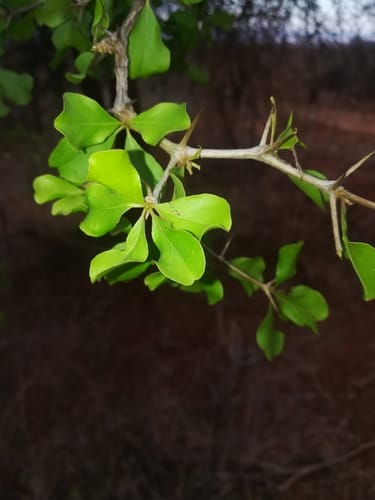
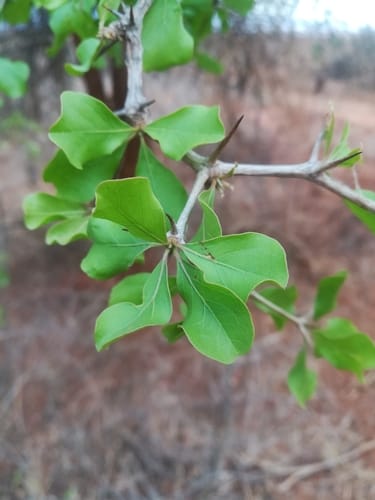
A tree. It grows up to 20 m high. The bark is grey and cracked. The shoots zigzag. They end with a spur. There are 1-3 spines at the base. The leaves are clustered on the spur shoots. They are oval and 4 cm by 3 cm. They are wedge shaped at the base. The flowers are white. They are in spikes 6 cm long. The fruit is 2-3 cm long by 1-2 cm wide. They are reddish.
Names & Synonyms
Epetait, Hara, Xarar
Terminalia robecchii Chiov.
References (5)
- Morgan, W. T. W., 1981, Ethnobotany of the Turkana: Use of plants by a Pastoral People and Their Livestock in Kenya. Economic Botany 35(1):96-130
- Mutie, F. M., et al, 2023, Important Medicinal and Food Taxa (Orders and Families) in Kenya, Based on Three Quantitative Approaches. Plants 2023, 12, 1145
- Peters, C. R., O'Brien, E. M., and Drummond, R.B., 1992, Edible Wild plants of Sub-saharan Africa. Kew. p 87
- Royal Botanic Gardens, Kew (1999). Survey of Economic Plants for Arid and Semi-Arid Lands (SEPASAL) database. Published on the Internet; http://www.rbgkew.org.uk/ceb/sepasal/internet [Accessed 10th April 2011]
- World Checklist of Useful Plant Species 2020. Royal Botanic Gardens, Kew


