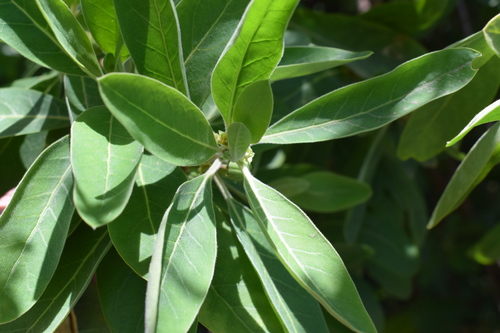
Clutia pulchella
L.
Lightning bush, Warty-bush clutea

(c) Tony Rebelo, some rights reserved (CC BY-SA), uploaded by Tony Rebelo

(c) georgfritz, some rights reserved (CC BY-NC)

(c) Richard Gill, some rights reserved (CC BY-NC), uploaded by Richard Gill
What to Eat
Edible parts: Fruit, Plant
The fruit is used to curdle milk.
Known Hazards
Where to Find It
It is a subtropical plant.
Africa, Botswana, East Africa, Eswatini, Lesotho, Mozambique, South Africa, Southern Africa, St Helena, Swaziland, Zambia, Zimbabwe,
How to Identify
A shrub. It is soft and leafy. It grows up to 2 m high. The leaf stalk is slender and 1 cm long. The leaf blade is oval or round and 5 cm long by 3 cm wide. It has spots that let the light through. Flowers of both sexes occur. The fruit is 3 mm across.
How to Grow
A dioecious species, both male and female forms need to be grown if fruit and seed are required.
Medicinal Uses
A hot leaf infusion is drunk to treat stomach-ache, diarrhoea and dysentery. An infusion of the leaves, stems and roots, mixed with milk, is applied as an enema to treat stomach-ache in children. The root ash is rubbed into scarifications to heal fractures and sprains.
Wikipedia
Source ↗Clutia pulchella, the lightning bush, is a southern African dioecious shrub of the family Peraceae. It occurs at middle altitudes in Namibia, Mozambique, Zimbabwe, Eswatini, Botswana, Lesotho and South Africa.
Names & Synonyms
Ikhambi lenkosi, Pondo lightning-bush, Umembesa
References (9)
- Fowler, D. G., 2007, Zambian Plants: Their Vernacular Names and Uses. Kew. p 25
- Fox, F. W. & Young, M. E. N., 1982, Food from the Veld. Delta Books. p 195
- Long, C., 2005, Swaziland's Flora - siSwati names and Uses http://www.sntc.org.sz/flora/
- Marker & Sheape,
- Peters, C. R., O'Brien, E. M., and Drummond, R.B., 1992, Edible Wild plants of Sub-saharan Africa. Kew. p 109
- Plowes, N. J. & Taylor, F. W., 1997, The Processing of Indigenous Fruits and other Wildfoods of Southern Africa. in Smartt, L. & Haq. (Eds) Domestication, Production and Utilization of New Crops. ICUC p 188
- Ruiters-Welcome, A. K., 2019, Food plants of southern Africa. Ph.D. thesis. Univ. of Johannesburg p 54
- Swaziland's Flora Database http://www.sntc.org.sz/flora
- Welcome, A. K. & Van Wyk, B.-E., 2019, An inventory and analysis of the food plants of southern Africa. South African Journal of Botany 122 (2019) 136–179