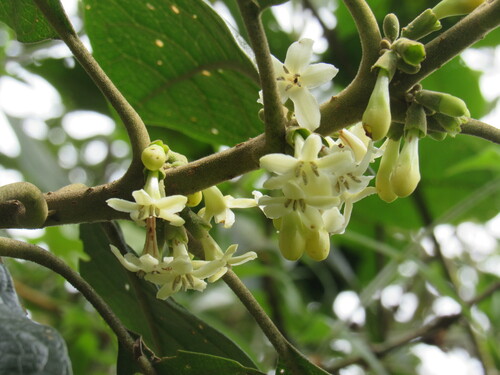
Plectranthus edulis
(Vatke) Agnew
Ethiopian potato, Gala potato

gbif · cc-by
Royal Botanic Gardens, Kew
Royal Botanic Gardens, Kew

gbif · cc-by-sa
GBIF
GBIF

gbif · cc-by
Royal Botanic Gardens, Kew
Royal Botanic Gardens, Kew
What to Eat
Edible parts: Root, Leaves, Rhizome, Tubers
The tuberous roots are eaten raw, and the leaves are cooked and eaten.
Where to Find It
It is a tropical plant. In Ethiopia it grows between 1,600-3,000 m above sea level.
Africa, Asia, Australia, East Africa, Ethiopia*,
Countries: United Arab Emirates, Afghanistan, Armenia, Angola, Australia, Azerbaijan, Bangladesh, Burkina Faso, Bahrain, Burundi, Benin, Brunei, Bhutan, Botswana, Congo (DRC), Central African Republic, Congo (Republic), Cote d'Ivoire, Cameroon, China, Cape Verde, Djibouti, Algeria, Egypt, Eritrea, Ethiopia, Gabon, Georgia, Ghana, Gambia, Guinea, Equatorial Guinea, Guinea-Bissau, Indonesia, Israel, India, Iraq, Iran, Jordan, Japan, Kenya, Kyrgyzstan, Cambodia, Comoros, North Korea, South Korea, Kuwait, Kazakhstan, Laos, Lebanon, Sri Lanka, Liberia, Lesotho, Libya, Morocco, Madagascar, Mali, Myanmar, Mongolia, Mauritania, Mauritius, Maldives, Malawi, Malaysia, Mozambique, Namibia, Niger, Nigeria, Nepal, Oman, Philippines, Pakistan, Qatar, Rwanda, Saudi Arabia, Seychelles, Sudan, Singapore, Sierra Leone, Senegal, Somalia, South Sudan, Sao Tome & Principe, Syria, Eswatini, Chad, Togo, Thailand, Tajikistan, Timor-Leste, Turkmenistan, Tunisia, Turkey, Taiwan, Tanzania, Uganda, Uzbekistan, Vietnam, Yemen, South Africa, Zambia, Zimbabwe
How to Identify
A herb. It produces tubers on stolons or runners from the stems. There are several varieties that vary in leaf colour, tuber colour and size and other characteristics.
How to Grow
Plants are usually grown from tubers. It can also be grown from young sprouts from the tubers. Young plants can be transplanted.
Production
The crop matures in 4-5 months after transplanting.
Other Information
It is a cultivated food plant.
Names & Synonyms
Agew dinich, Ajo, Dinicha oromo, Gurage dinich, Welaita dinich, Wolaita dinich
Coleus aquaticus GurkeColeus edulis VatkeColeus palustris VatkeColeus rivularis VatkeColeus tuberosus A. Rich. [Illegitimate]Majana richardiana Kuntze
References (12)
- Asfaw, Z., Conservation and use of traditional vegetables in Ethiopia. FAO
- East African Herbarium records, 1981,
- Jardin, C., 1970, List of Foods Used In Africa, FAO Nutrition Information Document Series No 2.p 12 (As Coleus edulis)
- Lim, T. K., 2015, Edible Medicinal and Non Medicinal Plants. Volume 9, Modified Stems, Roots, Bulbs. Springer p 66
- Linnaea 37:319. 1872 (As Coleus edulis)
- Lukhoba, C. W., et al, 2006, Plectranthus: A review of ethnobotanical uses. Journal of Ethnopharmacology 103 (2006) 1–24
- Lulekal, E., et al, 2011, Wild edible plants in Ethiopia: a review on their potential to combat food insecurity. Afrika Focus - Vol. 24, No 2. pp 71-121
- Mekbib, Y & Deressa, T., 2015, Exploration and collection of root and tuber crops in East Wollega and Ilu Ababora zones: Rescuing declining genetic resources. Indian Journal of Traditional Knowledge. Vol. 15(1), pp. 86-92
- Molla, A., Ethiopian Plant Names. http://www.ethiopic.com/aplants.htm
- Peters, C. R., O'Brien, E. M., and Drummond, R.B., 1992, Edible Wild plants of Sub-saharan Africa. Kew. p 118
- Plants for a Future database, The Field, Penpol, Lostwithiel, Cornwall, PL22 0NG, UK. http://www.scs.leeds.ac.uk/pfaf/ (As Coleus edulis)
- Wiersema, J. H. & Leon, B., 2013, World Economic Plants. A Standard Reference CRC Press. 2nd Ed. p 541